Christy O'Connor: More rule changes on the cards for Gaelic football but which ones will work best?

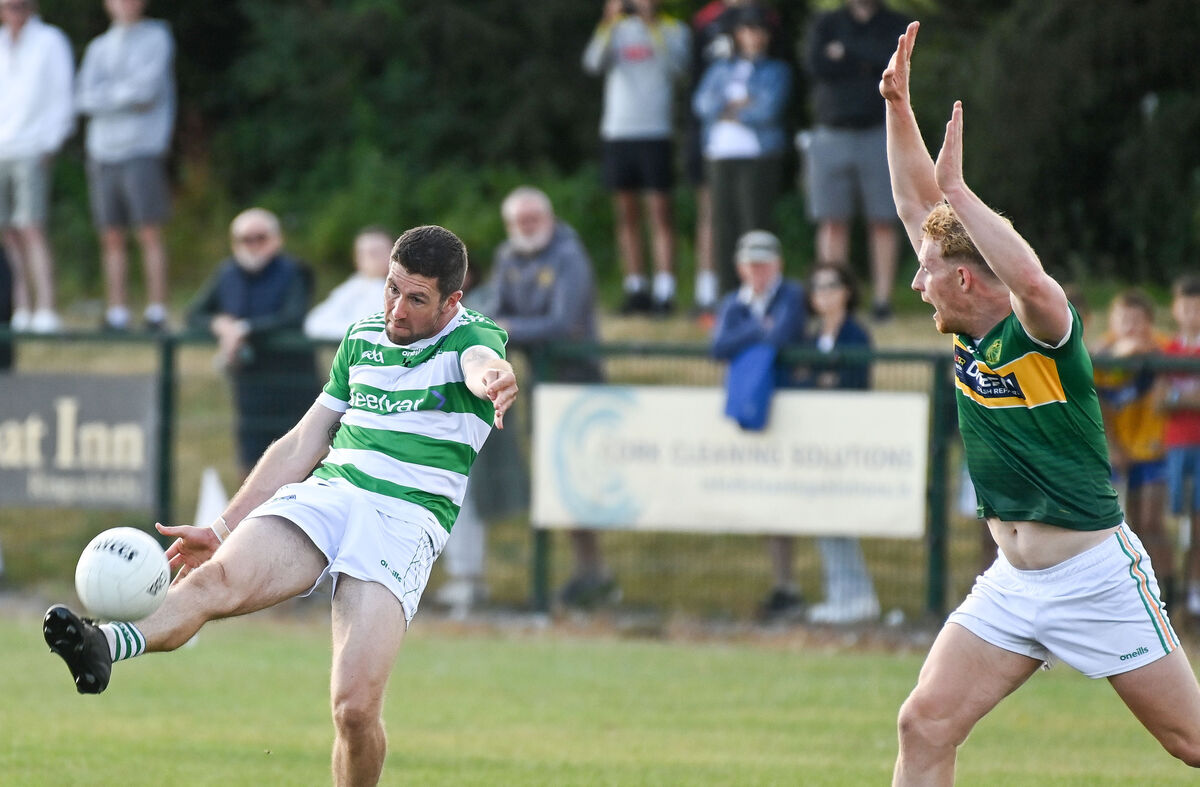
Young players impressed while Donncha O’Mahony attempts a two-pointer at Bandon GAA Cúl Camp, where he joined Rory Twohig and Evelyn McCarthy to showcase the All-Ireland minor silverware they helped bring home this year. Picture: Chani Anderson
On the afternoon that Armagh lost to Galway by one point in round two of the league back in February, Armagh manager Kieran McGeeney cut loose.
McGeeney was furious over an officiating call that saw Armagh punished for a breach of not having three men inside their own half, even though Joe McElroy had gone over to the sideline to inform management that he could no longer play due to injury.
McGeeney was already riled up so he got even more agitated when Colm Parkinson of subsequently poked the bear by questioning some of Armagh’s decision-making around the goal.
Seven of Armagh’s scores that afternoon were fisted points, some of which were clearcut goalscoring chances. Galway scored three goals, while Armagh failed to raise a green flag. One goal would have been decisive in a one-point defeat but McGeeney defended the actions of his players.
“We tell them if they go for a goal, or a point, they should make sure of it,” said McGeeney. “If they want to go for a goal, bang it in. If they want to go for a point, put it over. Their choice.”
Except it may no longer be as the GAA’s Expert Advisory Group (EAG) are set to trial a number of rule-tweaks in the upcoming Third Level Division 1 League (Ryan Cup), one of which includes a ban on fisted points, unless the ball is in flight.
A score is a score, no matter how it is scored, as long as it executed legally, but the EAG have suggested nine tweaks to make the game even more appealing.
As well as clamping down on fisted points, the EAG are looking at increasing the worth of a goal to four points, imposing a limit of three consecutive handpasses before the ball must be kicked, the implementation of a backcourt rule, kickouts only have to travel 13m rather than beyond the 40m arc, increasing the number of subs allowed from five to six, extending the 40m arc to the end-line, a 50m advancement where a mark is impeded, and all 50m advanced frees to be taken from the 13m line rather than the 20m line.
Proposing such a heavy raft of alterations after the greatest championship of all time seems anomalous but the tweaks are only proposals, the majority of which may never see the light of day.
Data has also clearly instructed and formulated some of the EAG’s decision-making. On average, there were three fisted points scored per game over the last year, which the EAG felt was too many for a reasonably low-level skill.
They are only adapting – and scoring – within the rules of the game but altering the environment would force players to think, and act, differently in certain scoring scenarios.
Read More
The EAG are also seeking to layer up the rule tweaks in order for them to complement each other. When the EAG looked at the data last year around how many games that a four-point goal would have changed, there were very few. On the other hand, how many goals would have been scored, and how many games would have been altered, if there was a four-point dividend for a green flag?
As it is, goals are already on the increase – there were 149 green flags raised in the 2026 provincial and Sam Maguire championship compared to 134 last year. And there were eight fewer championship matches in 2026 than in 2025.
The numbers around two-pointers were also bumped up but that was inevitable when the value of an orange flag is so close to a green flag now. Increasing the value of a goal to four points though, would certainly force a rethink around attacking principles.
That does risk crossing over into the territory of unintended consequences whereby players may only dink a five-yard kickpass after that third handpass before beginning the handpassing sequence again. On the other hand, playing a five-yard kickpass would only encourage the opposition to press up and force a turnover.
Everybody wants to see the ball kicked more often but that environment to promote more accurate foot-passing has already been created under the new rules.
It's the same with the proposed rule on kick-outs only having to travel 13m rather than beyond the 40m arc. With most half-forwards now cheating outside the arc and getting ready to sprint into the drop-one once the ball is kicked long, high fielders would have more of an opportunity to display their catching skills if some of those opposition forwards were more concerned with a kick-out going short.
And with the ball not allowed to be kicked back to the goalkeeper after a short kick-out, the opportunity for turnovers could be even more productive if teams go hunting and pressing so high up the field similar to how Mayo went after Kerry in the All-Ireland final.
The success of any rule changes though, is primarily based on the spirit of the approach coaches adopt towards them.
The modern trend has mostly been negative in how teams have tried to leak into grey areas to work their way around the rules as opposed to constructively and positively embracing them to make themselves, and the game, better and more attractive to watch.
However, the environment is so different now, the behavioural change has already been profound, the game has gone so fast and Gaelic football has become such an attractive product that if coaches, managers and players approach these rule-tweaks in the right manner, they could be transformative for Gaelic football.









 App?
App?


