Remembering Tadhg Barry, freedom fighter and key figure in hurling history
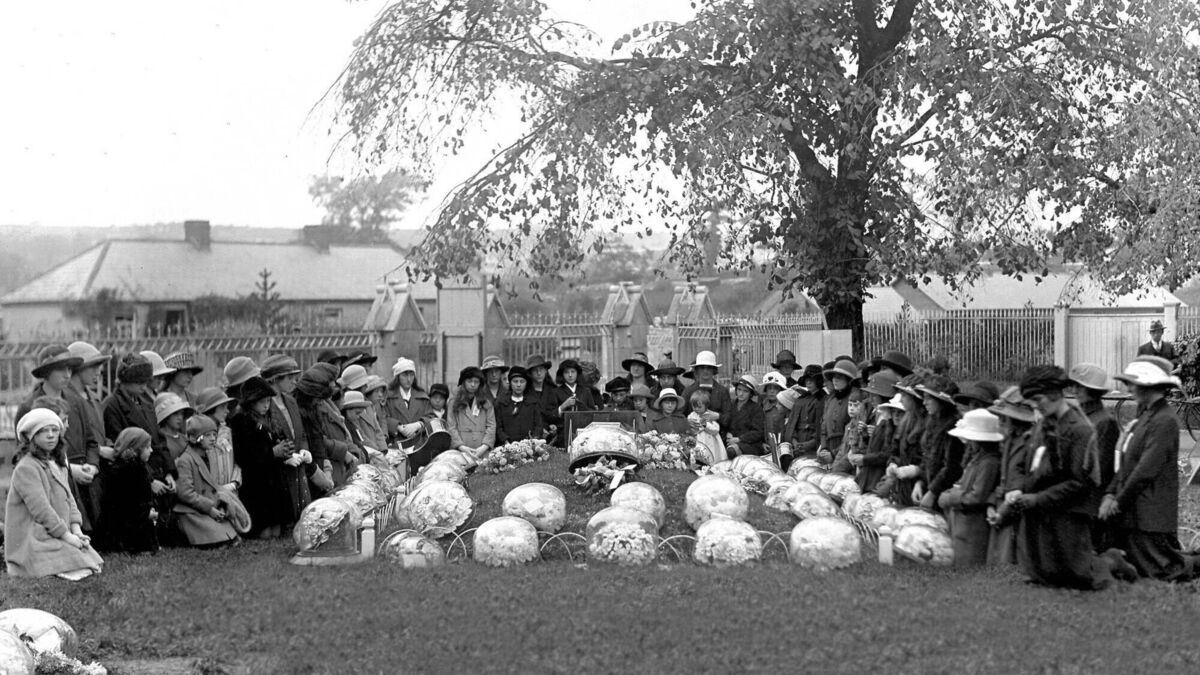
Young women and girls pay their respects at the graveside of Tadhg Barry, St Finbarr’s Cemetery, 20 November 1921. Picture: Irish Examiner Archive
NEXT Monday, November 15, will mark the centenary of the death of Tadhg Barry, a Cork native who was a key figure in the fight for Irish independence as well as playing an important role in the early days of Cork County Board.
While the northsider was well-known during his lifetime, he is not remembered as strongly as other big characters from the time. However, Donal Ó Drisceoil, a senior lecturer in the UCC School of History, has written a biography to coincide with the anniversary – – which paints Barry as a man of many talents.
“He was central to that and then he became very significant in the GAA but also in the trade-union movement,” Ó Drisceoil says.

“The Irish Transport and General Workers’ Union, the ITGWU, became a big union after 1916 and he became secretary of the Cork branch and a full-time organiser with them.
“He was imprisoned three times. He would have risen to prominence after 1916 as one of the most senior people who hadn’t been interned.
“He spent seven months in Cork Jail and went on hunger-strike and was released. Then he was lifted as part of the ‘German plot’ in 1918, when they tried to arrest the other leaders of the Republican movement to try to hobble Sinn Féin and he spent nine months in British jails.
“He was released again but arrested for a third time after he had been elected an alderman in the 1920 local elections, the time that Mac Curtain was elected Lord Mayor. In 1921, he was arrested and sent to Ballykinlar internment camp in Down where, eight months later, he was shot through the heart.”

From a GAA point of view, Ó Driscoil points out that Barry was a progressive force and helped to get the county board into shape in the early 20th century.
“He emigrated to England in 1903 for a couple of years and before that he was involved with St Vincent’s,” he says.
“He played football for them and he organised matches in the asylym on the Lee Road, where he worked. He was involved in the GAA in Hull and later London and, when he came back, he was involved in the reform – and almost revolution – in the GAA, led by JJ Walsh.
“He was part of the mainly-Republican group that effectively took over the GAA in Cork in 1909 and they completely professionalised the whole organisation, it was in a really bad state.
“They put in turnstiles and organised proper referees and jerseys, all of that.
“He was a referee and he organised Saturday hurling leagues, he put in a lot of work.”
Those efforts extended to helping to establish North Monastery as a hurling nursery and writing what was essentially the first hurling rulebook.
“He was involved in setting up Sunday’s Well GAA Club, which was in existence from 1908-1914 and was a significant junior club on the northside,” Ó Drisceoil says.
“Then, he was pushing all the time for the colleges to adopt GAA.
"Eventually, it was 1916 before the Mon officially took on hurling and became the greatest of the great!
“In 1916, to celebrate that, he wrote a book called , dedicated to ‘The boys of the Mon’. That was privately published first and then published by Whelan’s in Dublin in 1920 and re-published a number of times after that.
“It was the first rulebook on hurling that was published.”
Such achievements should have meant that his name became storied, but circumstances dictated otherwise.
“He was one of the last high-profile victims of the British in the War of Independence,” Ó Drisceoil says, “the Treaty was signed three weeks later.
“His funeral was huge, half the population of Dublin was on the streets when he passed through and the whole of Cork shut down.

“It was a massive occasion and it looked like he would become one of these martyrs but then the Treaty was signed, the split happened and that came to dominate everything. His name just got lost in the smoke with the Treaty and the Civil War, but a number of people have kept it alive.
“Certainly, the GAA should be giving him more recognition. He was a GAA journalist with the and he modernised the coverage with player ratings and all that kind of stuff.
“One of the St Vincent’s underage teams was known as Tadhg Barry’s and there was a Tadhg Barry Cup. Then the trade unions – there’s a Tadhg Connolly Meeting Room in Connolly Hall and, 10 years ago, on the 90th anniversary, there were a few talks and I published a pamphlet on him.
“Siptu pushed the council and they named a road after him, up where Apple is. Now, to mark the centenary, the Lord Mayor will lay a wreath at his grave on November 15, which is the anniversary.
“The city council will have a special occasion and there’s a plaque going up on his house at 54 Blarney St. He’s finally taking his place in the public space of Cork!”


 App?
App?


