Cork GAA Jersey Wars: Carrigaline v Nemo Rangers

Nemo Rangers' Conor O'Donovan trying to get past Carrigaline defender Peter Ronayne. Picture: Denis Minihane.
WE want to know what your favourite GAA geansaí is.
From here until the end of August, your votes will decide the best design in our Cork GAA Jersey Wars competition.
Our resident jersey expert Denis Hurley compiled a list of 32 clubs, based on those involved in the senior tiers and a selection of wild cards. We put them in alphabetical order and paired them up and we're now down to the last 16 stage.
Full details of the competition are here.
Voting will run from 8am each day for 24 hours on the link below:
While the colours have been the same since the various townlands clubs in the parish amalgamated, the current layout of the jersey is a fairly recent development, however — introduced in the late 1970s or so.
Courtesy of John Dineen and Thomas Maye, we are informed that one one of the most notable hurling clubs in the area was Kilmoney, who played in black and white jerseys, while Hilltown were known as ‘the Baa-Baas’ but, while you might assume they also had those colours like Barbarian RFC, their choice was blue and yellow. Kilnagleary was another club, though their colours are not recorded.
When everything came under the Carrigaline banner, blue and gold were chosen, but four-inch hoops, and this remained the look for much of the mid-20th century. In the 1970s, games against Carrigtwohill resulted in colour-clashes and so a back-up set in the Clare design — gold with a blue hoop — was procured, before landing on the opposite to that as the first-choice strip.
After opting to re-grade from junior to intermediate football at the end of 1992, they made a quick impact, reaching the final in 1996 and doing so again in 2003 and 2007 before finally pushing through to premier intermediate in 2009.
While there was a brief flirtation with relegation, 2015 brought victory in the second tier and a place in senior football, where they still reside. On the hurling front, it was also a case of going close at intermediate before scaling the heights, losing the 2006 final and then winning in 2008.

In the mid-2010s, the wheel came full circle in a colour sense as a change jersey was developed for senior football matches against St Finbarr’s. With the Barrs having gold as their second jersey, the Carrigaline players were canvassed as to what they would like to wear as an alternative and the consensus was for a black jersey — trimmed in blue and gold — which recalled the colours of Kilmoney from all those years ago.
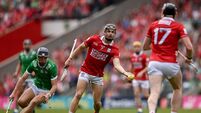
The current Carrigaline jersey is a clean and classy O’Neills offering, featuring a gold crew neck, CUFFS and three stripes along the shoulders, with the gold hoop housing the logo of main sponsor, Barry Collins’ SuperValu.
The two names were married easily and the Nemo Rangers website outlines the rationale when it came to choosing colours: “As Nemo had been playing in green and black and Rangers in black and white, it was agreed that the new colours would be black — the common denominator — with a green stripe to represent Nemo’s green and a white shamrock (which was later discarded) to represent Rangers’s white.”
With few other clubs wearing black kits, Nemo’s colour clash throughout the 20th century was with officials, but the 1984 All-Ireland Club SFC final win over Meath’s Walterstown — the fourth of seven — threw up an unusual scenario.
At the time, the All-Ireland was run like the Sigerson or Fitzgibbon Cups used to be, with the semi-finals and final on consecutive days. When Nemo and Walterstown both won their semis on the Saturday, Nemo were informed that they had lost the toss for colours for the decider and would have to source alternatives.
Frantic calls were made and Nemo’s Frank O’Connell was able to secure sets from Cork County Board, Coláiste Chríost Rí (close to a reversal of Nemo’s kit, but with one black hoop in between two white ones) and neighbours Douglas (green, white, and black hoops, albeit in a slightly different format to nowadays).
In 2002, the All-Ireland series also provoked a change, though Nemo’s powers of persuasion ensured it was not drastic. Playing the green-clad Charlestown of Mayo in the semi-final, live television coverage meant that Nemo were asked to wear alternative jerseys, but a compromise was reached: They donned black shorts instead, increasing the contrast with their opponents. Nemo won that game, but lost to Ballinderry in the final, having been beaten by Crossmolina Deel Rovers in 2001. They would make it third time lucky in 2003, however, avenging the Crossmolina loss with victory in Croke Park.

Television considerations also led to Nemo’s most recent high-profile change, the 2008 county SFC final against Douglas. While games between the clubs had featured both first-choice jerseys up to then, both were asked to change and Nemo were in grey tops and black shorts as they claimed a fourth successive title, Douglas fielding in green shirts and white shorts.
At the time, they were sponsored by Atlantic Homecare, later to become part of Woodie’s, whose name also graced the Nemo chests. The current O’Neills design features motor dealership Johnson & Perrott as the main sponsor.



 App?
App?


