Tom MacSweeney: Remembering the Asbestos War in Cork
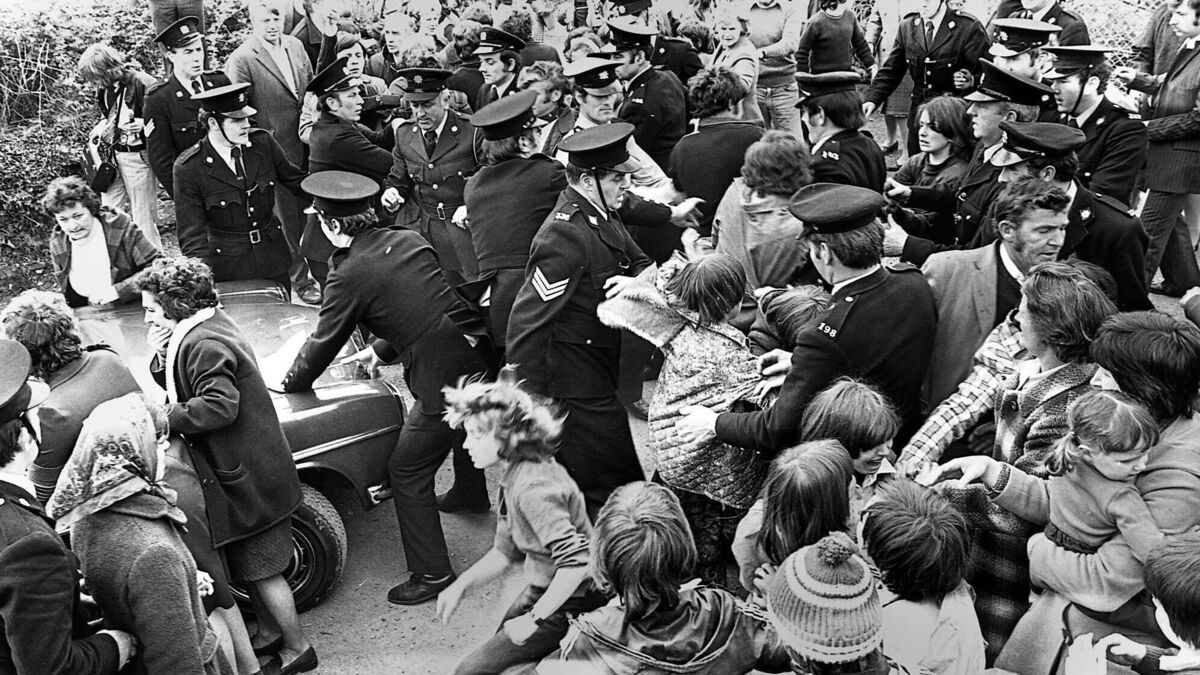
Protesters confront gardai at the Raybestos asbestos dump in Ringaskiddy in 1978. File picture.
Erosion of local democracy and a harbourside community described as “natives causing trouble” were topics debated at the Spirit of Mother Jones Festival in the historic Shandon Quarter of Cork city on Saturday morning. The theme was ‘Remembering the Asbestos War in County Cork, 1975-1980.’
The focus of the debate was a ‘rough protest’ on May 15, 1978, at Ringaskiddy, against the dumping of asbestos waste from the Raybestos Manhattan factory in Ovens, which produced brake pads. The Ovens community opposed dumping.
The Industrial Development Authority (IDA) had attracted the company to Cork when jobs were needed after the closure of Dunlop’s, Ford’s, and Verolme Dockyard.
But asbestos was a big health issue. Medical opinion regarded it as a ‘severe carcinogen,’ but it was in high demand for commercial use. Pressure increased for a dump site. Cork County Council offered one at Ballybane, and councillors approved on a 27-17 vote.
A community-versus-authority confrontation followed. The people of Ringaskiddy regarded the dumping of dangerous waste as a health threat.
John Twomey and Gerti O’Driscoll, from Ringaskiddy Residents’ Association, and activist Derry Chambers, were on a panel at the discussion and recalled how they still felt about that day.
“We were regarded as natives causing trouble. It destroyed and broke trust in gardaí and the council. We were pushed aside, our concerns ignored. Ringaskiddy has not opposed reasonable development, but, on that occasion, our community had to stand and fight. We had to defend our community,” they said.
I was on the panel, also, having reported the protest for RTÉ News. I had covered the ‘Troubles’ in Belfast in the 1970s, so wasn’t unused to difficult situations. But I did not expect to see in Cork what happened at Ringaskiddy. Gardaí forced a lorry carrying asbestos waste through a protest cordon of mainly women and children. Most local men were at work at the time.
The council and IDA decided that Ringaskiddy would be the waste site.
The Garda superintendent in charge on May 15, 1978, admitted to me it was a ‘rough’ occasion. Labelled ‘Peaceful Protest Turns Violent,’ in the RTÉ News archives, my report shows gardaí pushing and shoving women and children aside.
A brick was thrown, breaking the windscreen of an accompanying car. Residents claimed nine children were injured. Gardaí denied that. Their view was that the residents were illegally blocking access to the site.
Those were different times, and Garda training has changed in dealing with public disorder.
There have been years of controversy about developments in Ringaskiddy. The battle of harbour residents against the Indaver incinerator project continues after 25 years. Saturday’s debate discussed erosion of local democracy. The abolition of urban district/town councils and town commissioners removed a local voice.
How effective is communication between ‘authorities’ and local communities? Is the current system of ‘public consultation’ fit for purpose? Would it not be better to talk, to meet face to face, listen, before decisions involving communities are made? Those were points made. The art of talking is in listening.
The link between ‘Mother Jones’,’ from Cork, known as ‘the most dangerous woman in America’, was festival organiser Ger O’Mahony. He told me that the committee, focusing on social issues, believed the asbestos confrontation is part of Cork Harbour community history.
“The 50th anniversary is approaching. What happened has lessons for community activity, should be remembered and recorded for history archives. It is historically and socially important.”
The discussion was filmed/recorded by Cork Community Television.
‘Mother Jones’ was Mary Harris, born on Cork’s Northside at the end of July 1837, baptised in the North Cathedral on August 1. Her family emigrated to Canada during the Great Famine. Marrying George Jones, she moved to the USA, where her husband and their four children died in a ‘yellow fever’ epidemic.
A business she ran was destroyed in the Great Chicago Fire of 1871, Becoming a ‘tough and feared union organiser for miners seeking better pay and working conditions,’ her slogan was, ‘Pray for the dead, fight like hell for the living.’
She organised the ‘March of the Mill Children’ in 1903, to highlight exploitation by big business of young children in the mines, mills, and factories of America. She was arrested and jailed several times for union activities supporting workers and underprivileged people.
SEASCAPES
SEASCAPES podcast and blog website: https://tommacsweeneyseascapes.ie, Ireland’s only maritime podcast. Upcoming in the August edition from Saturday: ‘On the oceans alone for nine months.’


App?