UCC astronomer contributes to major discovery on how elements are created in space
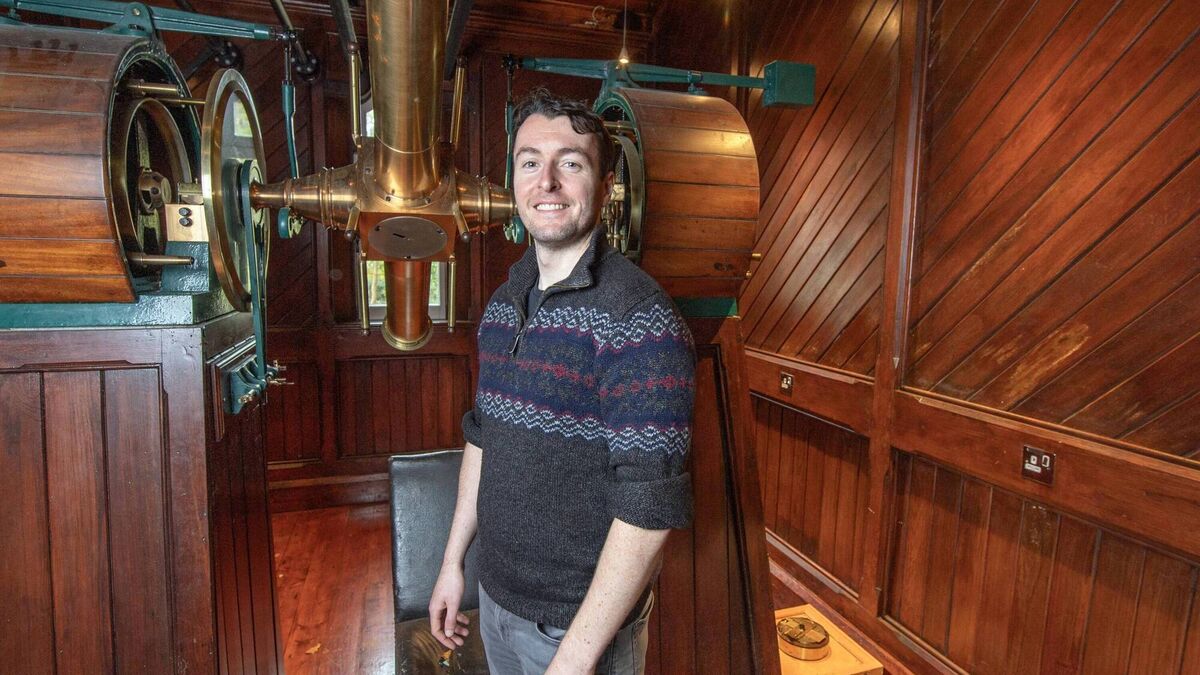
Dr Mark Kennedy at University College Cork’s Crawford Observatory, built in 1878. Dr Kennedy, an astronomer based at UCC’s School of Physics, took data with a European Southern Observatory telescope in Chile which led to the discovery of a kilonova. Credit: Michael McSweeney/Provision.
A UCC astronomer is part of an international team of researchers who have made a major discovery linking evidence of heavy elements to a violent cosmic explosion.
In a paper published in the prestigious scientific journal, Nature, the team, which includes Dr. Mark Kennedy based at UCC’s School of Physics, detailed how it discovered evidence of how elements were created in space.
The team has used multiple space and ground-based telescopes, including NASA’s James Webb Space Telescope (JWST), NASA’s Fermi Gamma-ray Space Telescope, and NASA’s Neil Gehrels Swift Observatory, to observe an exceptionally bright gamma-ray burst, GRB 230307A, and identify the neutron star merger that generated an explosion that created the burst.
Dr Kennedy is co-author of the paper in Nature and took data with the European Southern Observatory’s New Technology Telescope in Chile which led to the discovery of the optical counterpart to the kilonova.
“Not every gamma-ray burst produces an explosion that we can study with JWST, and the light from those that do can fade very rapidly.
“This means every second - between when NASA’s Fermi Gamma-ray Space Telescope detects a gamma-ray burst and when we point our telescopes on Earth at where we think the bust occurs - counts.
“This explosion occurred in the very southern part of the night sky, making it impossible to observe with most of our ground-based facilities.
“Fortunately, I was observing with a telescope in Chile - remotely from my dining room in Cork - several hours after the explosion reached us here on Earth, and found a new object had appeared in the night sky right where the burst had come from.
“This excitement rippled out through the astronomical community as we realised we might be witnessing a kilonova.
“In the following weeks, our group submitted proposals to use JWST to study such an event for the first time, with the results speaking for themselves.”
Scientists have long theorised that the explosions caused by two neutron stars merging with each other – otherwise known as a kilonova – should create the pressure cooker conditions in which many elements heavier than tellurium are created. However, observing such events and proving they create these “heavy” elements has proven elusive – until now.
By using the James Webb Space Telescope’s spectacular sensitivity, astronomers have captured the first mid-infrared spectrum from space of a gamma-ray burst, which they think was most likely caused by such a kilonova. This marked Webb’s first direct look at the creation of heavy element from such an event.





 App?
App?


