My mission to help women be aware of their breast density
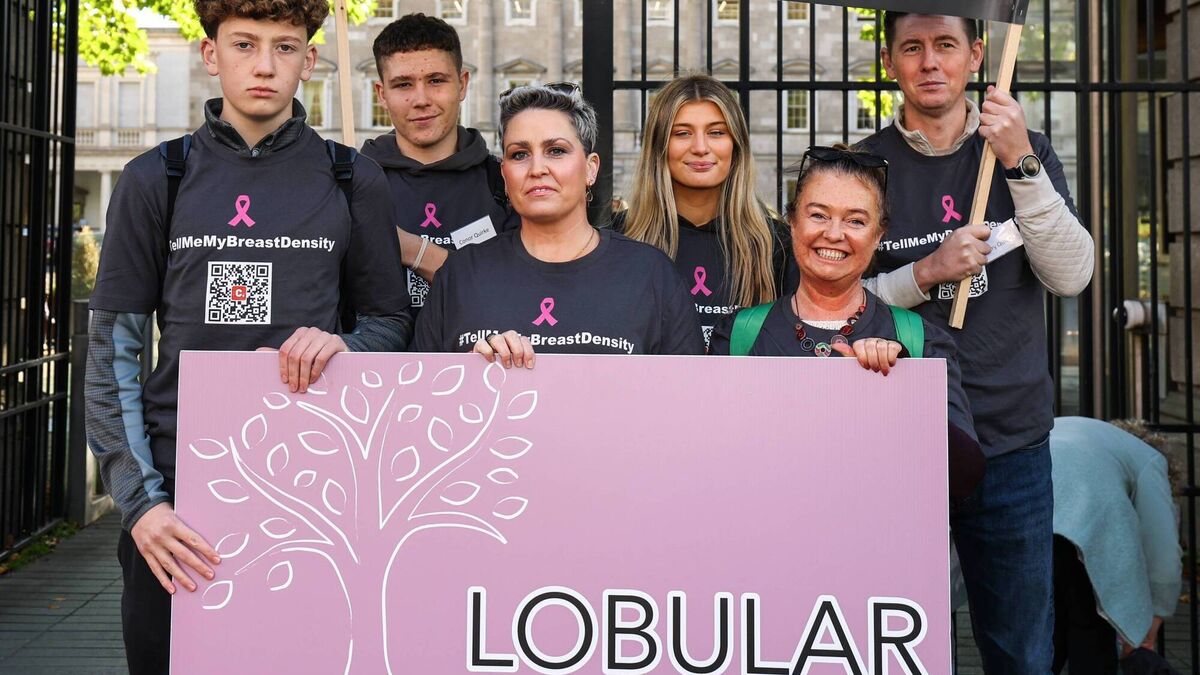
Laurna Quirke, front centre, campaigning with Lobular Ireland
I was diagnosed with breast cancer last year after having two clear mammograms. I later underwent a double mastectomy.
I am now pleading with the Government for an urgent overhaul of how breast cancer is tested for and diagnosed in relation to breast density.
Any woman going for a mammogram today or tomorrow should be told, ‘You have dense tissue, here’s what you need to know for now and here’s what you need to know for the future’. Let’s educate women.
So what is dense breast tissue?
Some 43% of women have dense breasts. Most women have never heard of it. Your body shape and size have nothing to do with breast density.
Non-dense breasts are made up of fatty tissue whereas dense breasts are made up of fibroglandular tissue.
Non-dense breasts are grey on a mammogram so cancer (a white mast) is easily seen.
Dense breasts fall into four categories - a, b, c, d - based on a scale of how white they show up, so trying to see a cancer can be very difficult in these cases as it is white on white. It’s like looking for a snowflake in a snowstorm.
Half of all breast cancers are missed on standard mammograms in dense breasts. Mammograms do save lives, but have their limitations.
All women who have dense breasts should be appropriately notified about their personal breast density, which will determine the most appropriate form of screening.
Around 3,500 women are diagnosed with breast cancer each year in Ireland, and 10-15 % are lobular breast cancer, which is the second most common type after ductal breast cancer.
Both ductal and lobular cancers are affected by breast density.
In 2025, 173,000 women had mammograms; 75,000 of those women had dense breasts and were not informed because it is currently not part of the screening policy.
Not all 75,000 women will develop breast cancer, but it is a precursor.
If you have dense breast tissue, you have 4-6 times an increased risk of developing breast cancer, which is considered a stronger risk than family history of the disease.
HIQA are currently undertaking a Health technology assessment (HTA) in which they are considering standardized breast density notification, but this won’t be available until the end of 2027 at the earliest, at which point it will go back and forth to government. Too many women will have delayed breast cancer diagnosis by the time this is introduced.
I was sent by my GP for a mammogram in 2020 at age 38, I was told the mammogram was clear. I was referred by my GP in 2024 for another mammogram and again given an all clear result.
In June, 2025, I was for the third time referred by my GP for a mammogram, and diagnosed two weeks later following a biopsy with lobular breast cancer.
In September, 2025, I had a double mastectomy and breast expanders were placed in my chest to prepare the muscle and skin for reconstruction surgery in 2027. I had five months of chemotherapy and 15 sessions of radiotherapy.
I have commenced a seven-year endocrine therapy plan which has induced menopause, which I’m told is significantly worse than a natural menopause.
All of these words have become normal, but these surgeries and treatment therapies are anything but normal, they are so invasive on so many levels.
A diagnosis significantly affects family, husband/partner, children, wider family, friends, etc., There is a huge financial loss and a massive physical and mental health cost.
Nearly half of all women over 40 have dense breasts, yet a shocking number have no idea that this single trait dramatically spikes their cancer risk while simultaneously masking the cancer.
It is one of the most common cancer risk factors in women yet it remains one of the best kept secrets in modern healthcare.
If I had been told I had dense breast tissue and understood the significance and associated risks, I would have been afforded the opportunity to advocate for myself.
Providing this information empowers women to make informed decisions with healthcare professionals, helps safeguard against the potential harms of delayed detection.
I have been involved in campaigning for Lobular Ireland and we met TDs and senators last month at Leinster House. Several women and one woman’s husband spoke and told their personal stories.
Our national campaign, #TellMeMyBreastDensity, focuses on early detection and has cross-party support. We believe no woman should have to wait until after a breast cancer diagnosis to find out that she has dense breasts.
Lobular Ireland have a very simple ask. We want all women to be informed of their breast density along with their mammogram results.
Women have been asking for standardised notification of breast density with mammogram results since 2016, a whole decade. In those ten years, nothing has been done.
This is not a reflection of the work done by these women, but a reflection of the work not done by our Government.
If those women’s voices had been heard properly, I could have been told I had dense breasts and educated, and possibly been diagnosed stage 1 rather than stage 3.
Knowing your numbers, your weight, your blood pressure, and your cholesterol can save your life. Not knowing your breast density is missing a critical piece of your health puzzle.
The problem - is not knowing about breast density, which can lead to delayed diagnosis.
The solution - is standardised notification along with mammogram results.
The benefit - is earlier detection, less invasive treatments, better outcomes, and lives saved.
We don’t want platitudes, we want action.

App?