Former Rose of Tralee: 'I was 48 when I had a stroke..here's what I want people to know'
When former Rose of Tralee winner, Gerrie O’Grady suddenly felt unwell last year, she never suspected she could be having a stroke. Now, she tells MARY CORCORAN, she is raising awareness of some of the symptoms of stroke, which people might not be aware of.
Former Rose of Tralee: 'I was 48 when I had a stroke..here's what I want people to know'

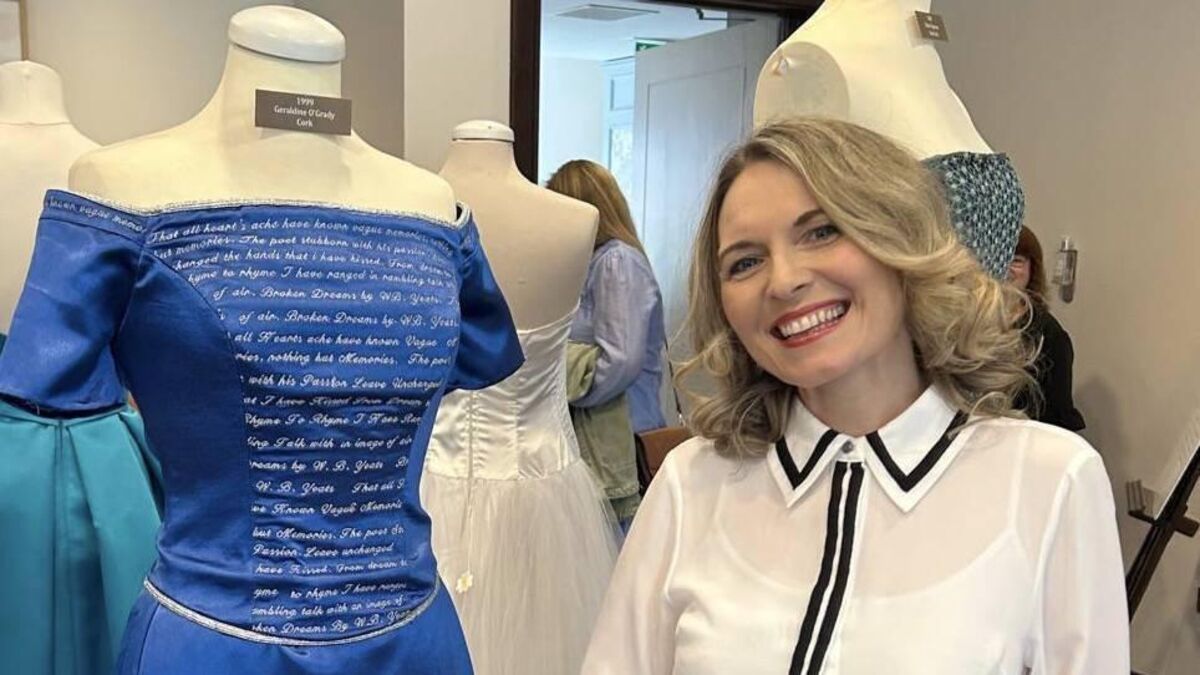
Gerrie with her gown from the 1999 Rose of Tralee.
When Gerrie O’Grady felt what she describes as jolt running across her brain while on a call to a friend in June, 2025, she knew something was wrong, but had no idea how serious things were. Her vision became distorted, and she asked her friend if she could call her back.

“My head began to pound. I thought I was experiencing a strange version of my usual migraines,” she says.

What the former Rose of Tralee winner couldn’t explain, though, was the surges of panic coursing through her body.

“My husband, Martin, grew concerned when I told him the same thing three separate times and reported that the past, present and future had melted together for a moment.”

Martin insisted that Gerrie see a doctor before going to sleep for the night.

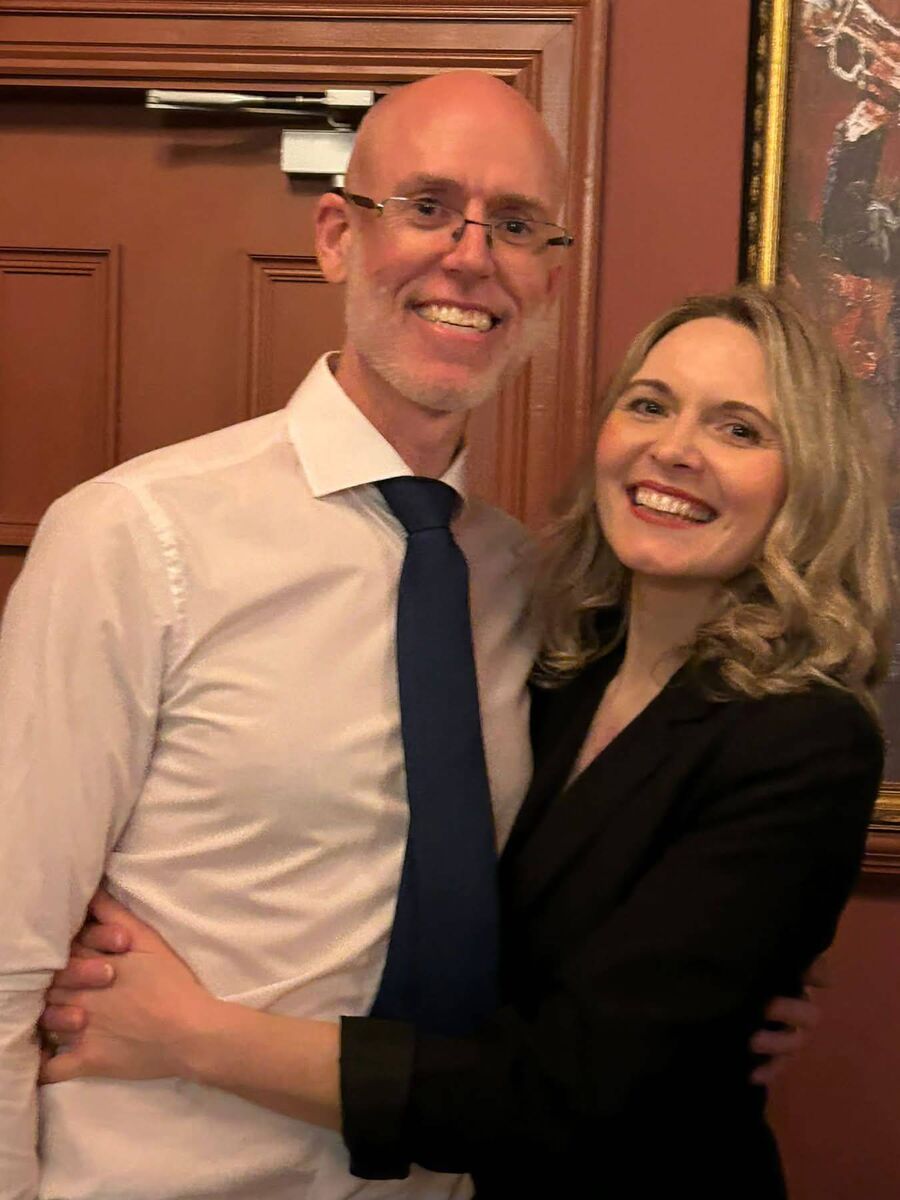
Gerrie with her husband Martin who had insisted she go to the doctor when she began feeling unwell.

“It was not obvious that I was experiencing a medical emergency. I went to the out-of-hours doctor, who referred me to A&E, but overall, we didn’t get a sense of urgency,” Gerrie recalls.

Tests showed that Gerrie had experienced a stroke.

The news came as a shock.

“Stroke was not on my mind. I get frequent migraines, so I thought it was most likely a severe version of migraine. However, I did have surges of panic and confusion that I couldn’t explain. It took 24 hours from onset for my stroke to be identified. My husband and I were completely flabbergasted,” says Gerrie.

“We thought strokes were noisy events; the histrionic at the party with the ‘look at me’ energy. But my stroke had been so quiet. No dramatic external indicators. No blue lights or sirens. No frantic doctors. All the turbulence took place within my body. I was 48 with no major risk factors. It made no sense.”

Given it was 24 hours from onset before Gerrie received confirmation of a stroke, she said it was too late to explore clot-busting options.

She explained that damage to the visual processing centre of her brain resulted in a halved visual field, called hemianopia. The stroke also hit a part of Gerrie’s brain involved in working memory.

“I couldn’t make sense of the strangeness of sudden right-sided visual field loss. Everything I focused my gaze on was halved. People and objects seemed to appear and disappear at random.

“I couldn’t see faces properly, and everyone had one eye,” says Gerrie.

Therapy started the next day.

“The occupational therapist advised me to keep scanning my head like a lighthouse to get the full picture. She brought me for walks and did reading exercises with me.

“As I ran my fingers under the letters and read aloud, I thought a lot about my childhood classroom and the vibrant letters on the wall. I also thought about my dad’s Reader’s Digest magazines. I used to practice so hard with them, longing for the day I could read fluently.

“I could feel that little girl’s determination fuelling me when the adult me was overcome with sorrow. I learned this before; I can learn it again in a new way,” she said.

Gerrie says that her hospital visitors seemed glad she still seemed like ‘myself’. “I looked reassuringly the same. It was easier to play along, but I didn’t feel the same. It would take a long time for me to understand the changes.”

After she left the hospital, the outside world was overwhelming.

“The first month or two were full of terrible moments. One day, a child spun into me in a supermarket, and I frightened us both by yelping ‘I have a visual impairment’! Another day, I walked in front of two cars. Adrenaline constantly coursed in my body.”

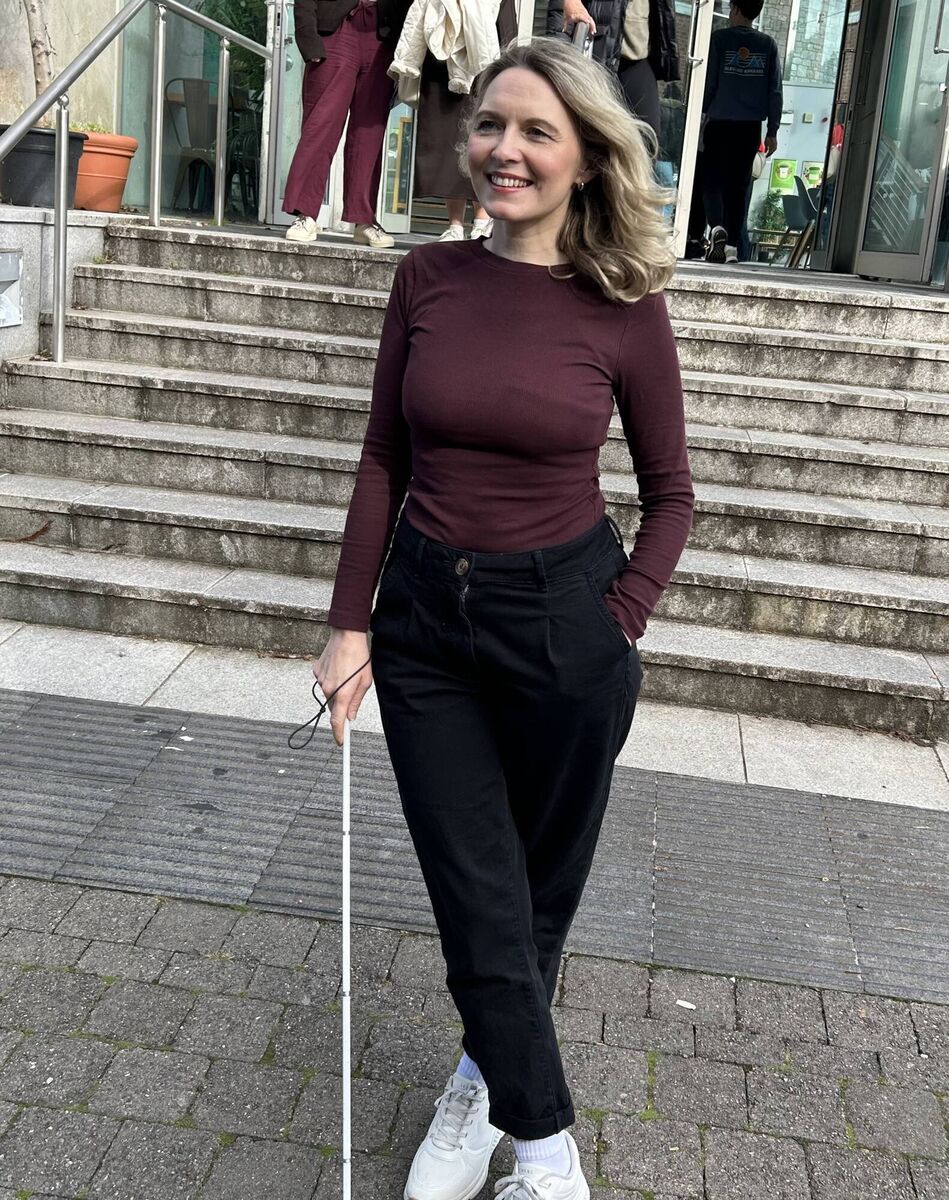
Gerrie’s home support OT recommended a white cane. “Vision Ireland gave me a short cane designed to alert others to my visual loss. It also protected me on my blind side. My environment changed immediately. Cars slowed down. People gave me a wide berth in shops or on footpaths, and they gave me the heads up if the green man was broken.

“As the world slowed down, I slowed down. In a less panicked state, I made better decisions and my confidence grew. I became brave enough to take buses and trains on my own. I steadily worked out new ways of doing many other things.”

The stroke had other impacts too.

“The stroke has fundamentally changed the way I exist in the world and that inevitably impacts those around me. However, it helped that my children were at an older age when they were becoming naturally more independent and I was quite determined that my experience would not overwhelm their life experiences. We are very adaptive as a family unit.

“Even a few years younger would have been significantly harder so my heart does go out to people with younger children.”

Gerrie says she misses the simplicity of driving her children Mia, 18, and Isaac, 14, and the post-school debrief. “I miss the effortless consumption of information and the wide blue expanse of the sea at Roche’s Point as the ships roll into Cork harbour.”

She has since returned to her role as CEO of Cork Deaf Association.
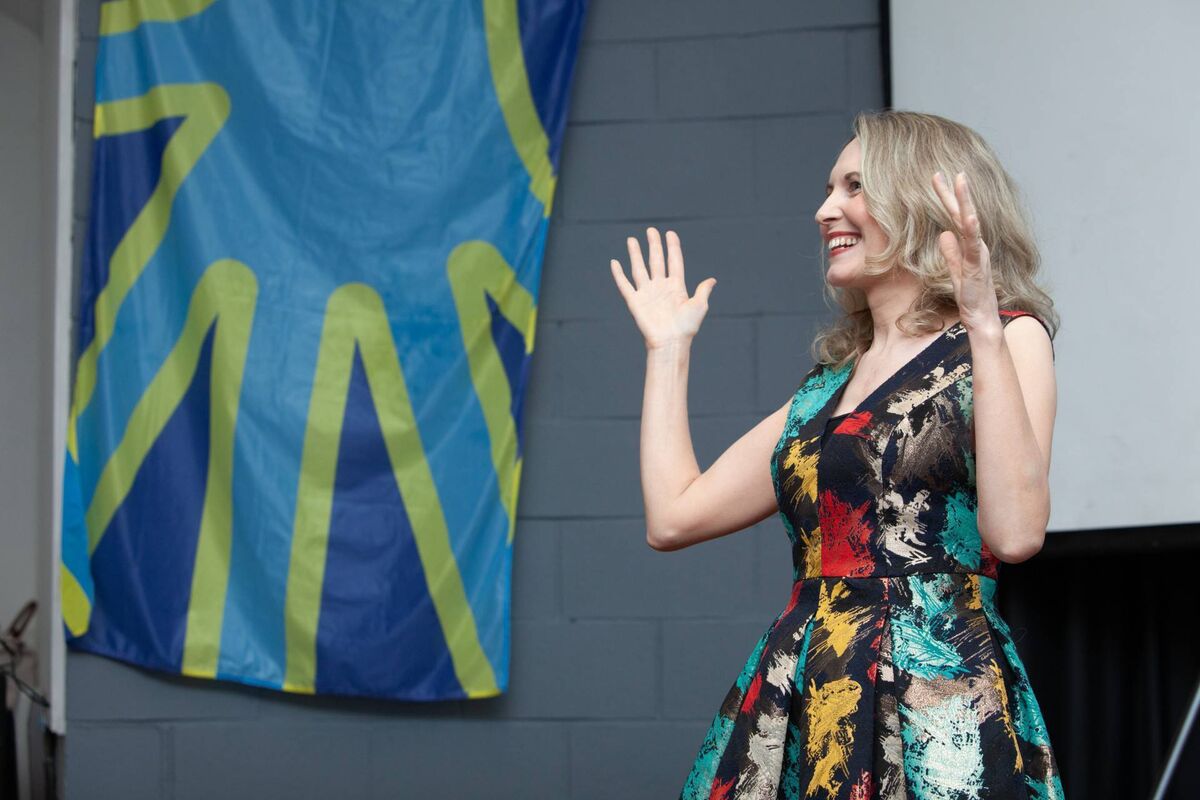
Gerrie is CEO of the Cork Deaf Association. She is pictured above signing at an event.

“I returned to work with the support of a dynamite personal reader and assistant, funded through the DSP Work and Access Scheme. I even got back on stage singing, which was a great joy to me, and I joined the incredibly dedicated Board of Cork Stroke Support.”

Gerrie says that using her cane changed the environment around her.

Gerrie says that when she meets people for the first time post-stroke, they commonly tell her that she has made a remarkable recovery.

“That’s usually based on a fixed idea of what a stroke looks like. The reality is more complex. In fact, my vision loss is largely unchanged, and I looked the same on day one as I do now. The impact of a stroke is not always outwardly obvious. I want people to know that strokes can look like this to improve recognition and to help people like me be better understood and supported,” she says.

Recovery of Gerrie’s vision loss is not expected at this stage. She continues to experience fatigue and says she has to pace herself strategically. “The impact of stroke is complex and requires ongoing adjustment.”

The Cork woman says she wants people to know that the impact of stroke can be hidden and you cannot accurately assess the impact from the outside.

“Nobody should make assumptions based on how a person looks. I have met some tremendous people who have had a stroke over the past year.

“People commonly talk about having to manage people’s assumptions in ways that can make life more difficult. One of these wise new friends pointed out that many of us have felt invalidated or dismissed because of an overemphasis on how we look as an indicator of impact.

“I would say, make no assumptions about anyone’s internal experience based on external factors.”

Ahead of World Stroke Day, Gerrie wants to raise awareness of the BEFAST warning guide for stroke, which is used in some parts of the world.

“Many people are now familiar with the FAST acronym to help recognise signs of a stroke and promote speedy action: Face, Arms, Speech and Time. This is an excellent and effective warning tool but it doesn’t include changes in vision or balance, which can also be signs of a stroke.

“I want to draw attention to the BEFAST warning guide, which is used in some parts of the world. This adds B for balance and E for eyes.

“Might I still have my full sight if my stroke had been caught earlier? Perhaps. As is frequently said after a stroke, time is brain. There is no going back. I can, however, extend my white cane and go forward.”

  • World Stroke Day takes place on October 29

More in this section

row of different color cars on asphalt parking lot at cloudy summer day Julie Helen: Good access is really about feeling safe and comfortable
Asian middle-aged woman in active wear jogging with female friends in the park during daytime Which exercises are most beneficial during menopause?
Girl counting US Dollar bills, using calculator, and writing expenses. Woman doing budget, estimating money balance for shopping 9 bad money habits to avoid in the lead-up to Christmas

Sponsored Content

Aisling Walsh, customer and strategy manager at ESB Networks More than 50,000 households are being rewarded for flexible electricity use
The office worker presents a document to the client across the desk. Pensions become part of the talent equation
CS ESB Networks Oct 2026 Got a smart meter? Time to unlock its value with an ESB Networks online account
Contact Us Cookie Policy Privacy Policy Terms and Conditions

© Examiner Echo Group Limited

Add Echolive.ie to your home screen - easy access to Cork news, views, sport and more