Fibremaxxing... Just another trend, or does it have benefits?
With the concept of ‘fibremaxxing’ trending, KATE RYAN finds out more about the concept, and chats to Dr Jens Walter about whether it could be beneficial.
Fibremaxxing... Just another trend, or does it have benefits?

Fibremaxxing is gaining a lot of attention online, says Kate Ryan. 

When it comes to food and diets, fads and trends are no strangers to each other.

In the age of wellness, there has been a collective obsession with protein in a trend called ‘proteinmaxxing’. In diet culture, it has its origins in the Atkins and Paleo diets, putting proteins (particularly lean meats, fish, and eggs) at the core, eschewing carbs of all kinds, and relegating plant foods as a mere support act to the mighty protein.

It’s hard, time-consuming and expensive to eat huge amounts of protein daily; enter, protein powders. A by-product of the dairy industry (particularly large scale cheese production), whey is a high-protein, low-fat, low-cost ingredient that, when powdered, can be easily added in everything from yogurt to chocolate, snack bars and porridge pots, bread and cereals, or scooped into your homemade morning smoothie.

The most recent iteration of this protein obsession could be connected to the rise of wearable tech, particularly Continuous Glucose Monitors (CGMs), originally designed to help diabetes patients monitor their blood glucose without finger-prick tests.

CGMs have been adopted by a number of wellness apps and reimagined as a weight loss or control system. The idea is by stabilising blood sugar in a metabolic state called ketosis (or keto), bodies burn fat resulting in weight-loss. A diet rich in protein is key to achieving ketosis.

Protein is an essential nutrient. It’s important we have enough in our diet, particularly as we age, but too much could run the risk of doing more harm than good, and there may be some downsides to following a high protein diet, including not having enough fibre.

You can imagine my scepticism when I read about a new food trend called fibremaxxing.

Remember a Netflix documentary called Hack YourHealth: The Secrets Of Your Gut released in 2024? A key contributor to it was APC Microbiome, a research institute in UCC. The core advice was to eat more fibre and fermented foods to improve gut health, which in turn improves overall health.

So, maybe there is something to fibremaxxing after all?

To find out more, I spoke to Dr Jens Walter, professor of microbiome science at APC Microbiome. Dr Walter is co-author of a study which found a diet developed by the researchers - the NiMe Diet (Non-industrialized Microbiome Restore diet) - emphasises the important role of fibre in healthy diets and encouraging good bacteria to thrive in the gut.

“The NiMe diet is not vegetarian but a plant-forward diet,” says Dr Walter. “It is based on two aspects. Firstly, how non-industrialised human populations eat and that they tend to have very low levels of chronic diseases - diseases caused by consuming a modern industrialised diet.”

The industrialised diet Dr Walter refers to is often referred to as the Western Diet, and so the second principle looks at how this diet can cause chronic disease. Specifically, Dr Walter and his team look at diet-microbiome interactions – or how our gut microbiomes respond to the foods we eat by producing good or bad bacteria. The NiMe Diet was created to prevent the bad ones.

“The NiMe diet is very plant-rich because that’s how non-industrialised populations eat and because that feeds the microbiome. We discourage certain staples from industrialised foods, like wheat and red meat, and are cautious on dairy, specifically high-fat dairy.”

These are foods which, over time, stimulate an inflammatory response in the gut leading to chronic diseases.

“We are looking to emphasise eating whole foods and to avoid ultra-processed foods because they disrupt the microbiome,” says Dr Walter. “I don’t make the claim that this is the paradigm healthy diet; there are many other good diets out there, but a diet based on whole foods that is plant-forward and fibre rich is more beneficial, and this is why we put an emphasis on it.”

Dr Jens Walter, professor of microbiome science at APC Microbiome, says that a diet based on whole foods that is plant-forward and fibre rich is more beneficial. Picture: Clare Keogh

Interestingly, Dr Walter says that he doesn’t necessarily agree with his APC colleagues that fermented foods are as important as fibre.
“I’m not critical of them, but there is very little strong nutrition research that supports the health effects. We didn’t include fermented foods in our NiMe human trial, yet we still saw tremendous benefits in terms of cholesterol and glucose lowering and anti-inflammatory effects.

“That’s not saying they are not good, but I don’t think fermented foods are completely needed. Dietary fibre and foods containing dietary fibre, on the other hand, are very beneficial to health.”

In the two horse race between fibre and fermentation, fibre is already winning.

Current guidelines set by the Food Safety Authority of Ireland (FSAI) recommends consuming at least 25g of fibre per day. However, NiMe diet suggests averaging 40g of fibre a day. That’s a lot of fibre. Is 40g even achievable?

“The reason we go beyond what is recommended with the NiMe diet is because we base the diet on eating habits of non-industrialised populations, and simply they eat more dietary fibre. There’s a key study on dietary fibre published in the Lancet, 2019, which suggests going beyond what is recommended will induce additional benefits to the prevention of chronic diseases.”

But even Dr Walter acknowledges consuming 40g of fibre a day is very difficult to do.

“I would recommend people eat as much fibre as they can,” he says. “If you are very committed and can go to the levels of the NiMe diet, you will get additional benefits. Research shows the more fibre you eat, the more beneficial it gets, so even an extra 5-10g daily will increase health. I struggle reaching this myself, so my advice is for people to try and do as much as they can.

“I’m more interested in prevention, but because we live in a modern society, we are all predisposed to chronic diseases like type 2 diabetes, now recognised as a health emergency in some countries. I’m healthy now, and I want to try at least to stay healthy into the future. Research on healthy eating shows you can add ten years of healthy life if you eat a healthy diet, like the NiMe diet.”

It sounds like fibremaxxing is a food trend that matches the science.

“I think fibremaxxing through whole foods is definitely good, and you almost can’t overdo it. If you follow dietary recommendations, you are already encouraged to make 50-70% of your plate vegetables, so with whole foods you can fibremaxx as much as you want,” says Dr Walter.

“You can do it wrong, though, and I am much more sceptical about fibremaxxing with supplements because there is much less evidence that they do the same thing. We have our own human trials in which we studied NiMe in humans and we studied fibre supplements in humans. It’s not that these fibre supplements don’t do anything, but I would be quite critical of fibremaxxing only through supplements. Fibremaxxing with whole plant-based foods and vegetables I do think is a very good nutrition trend.”

We know that fibre from whole foods (not supplements) is the foundation from which good overall health can be leveraged, but does it matter what type of fibre we eat?

“In terms of what fibre types, soluble and insoluble fibre has lost a little bit of interest in the nutrition field. What nutritionists like to look more for now is viscous and non-viscous, and fermentable and non-fermentable fibres,” says Dr Walter.

“The reason why viscosity is important is because it turns your gut content into a chewier gum that reduces how sugar and other nutrients are absorbed, blending your entire glycaemic response. Fermentable is important because it feeds your gut microbes to produce lots of good metabolites.”

Examples of foods containing viscous fibre are psyllium husks, legumes, asparagus, Brussels sprouts, oats and flax seeds, while beans are ideal food for fermentable fibres.

Dr Walter says it’s important to look at what we eat as a whole, aiming for as diverse a diet of whole foods and plants as possible, to be in with the best shot of making good gains on the fibre content of our diet.

“I would more look at it from a holistic approach, that there is a diversity in the foods you eat, and perhaps focus on plant foods that don’t deliver a lot of refined carbohydrates. Sweet potatoes are great and they have fibre, but you should probably not only eat sweet potatoes. It’s better to throw in some broccoli, kale, salads and seeds and get a bit of diversity going.”

Fibre aside, there is still a place for protein in our diet, but again good quality protein from whole foods, lean meats, etc, and maybe step away from protein powders.

“The NiMe diet is not anti-animal proteins. The non-industrialised populations we studied when creating the NiMe diet are normally not vegetarian. They eat a lot of plants, but they do still eat meat - when they can get it.”

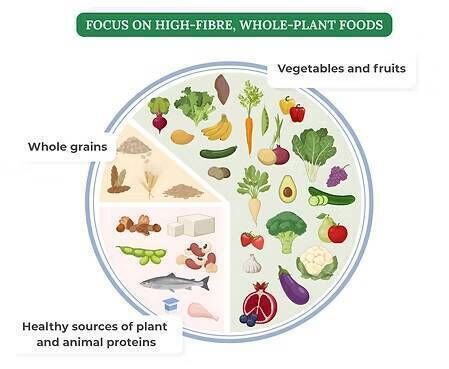
An example of a plate on the NiMe diet.

Beans, peas and lentils are excellent sources of both fibre, protein and myriad vitamins and micronutrients. So too are nuts, seeds and soy-based foods like tofu. All are recommended for the NiMe plate, alongside fresh fish, lean poultry and low-fat dairy which are excellent sources of fibre, too.

So, it looks like this food trend has indeed got it right.

The NiMe Plate recommends approximately 70% of every meal to be made up of fibre-rich vegetables and fruits, 25% lean and low-fat proteins, and around 5-10% in whole grains.

Dr Walter says fibremaxxing poses no threat to good health, and in fact research shows overshooting current guidelines in favour of NiMe’s 40g per day target will not only keep you healthy but decrease your risk of chronic disease developing in later life.

The key – as always - is eating the whole food instead of processed powders and supplements, as diverse a range of vegetables as possible, and the more fibre you can pack in the better the benefits to overall health.

Simple!

More in this section

Emer O'Callaghan: Your beauty queries answered  Emer O'Callaghan: Your beauty queries answered 
Cork author: ‘My path to becoming an author was paved by amazing women’ Cork author: ‘My path to becoming an author was paved by amazing women’
What's 'frugal chic' - 5 habits to save you money What is frugal chic? 5 fashion habits to save you money

Sponsored Content

The power of the G licence The power of the G licence
Happy couple receiving new house keys from real estate agent Time to get to grips with changes in rental laws
Boatbuilder turned engineer proves alternative paths can lead to success Boatbuilder turned engineer proves alternative paths can lead to success
Contact Us Cookie Policy Privacy Policy Terms and Conditions

© Examiner Echo Group Limited

Add Echolive.ie to your home screen - easy access to Cork news, views, sport and more