Colette Sheridan: Borrowing immunity from Trump? It could mean life or death...
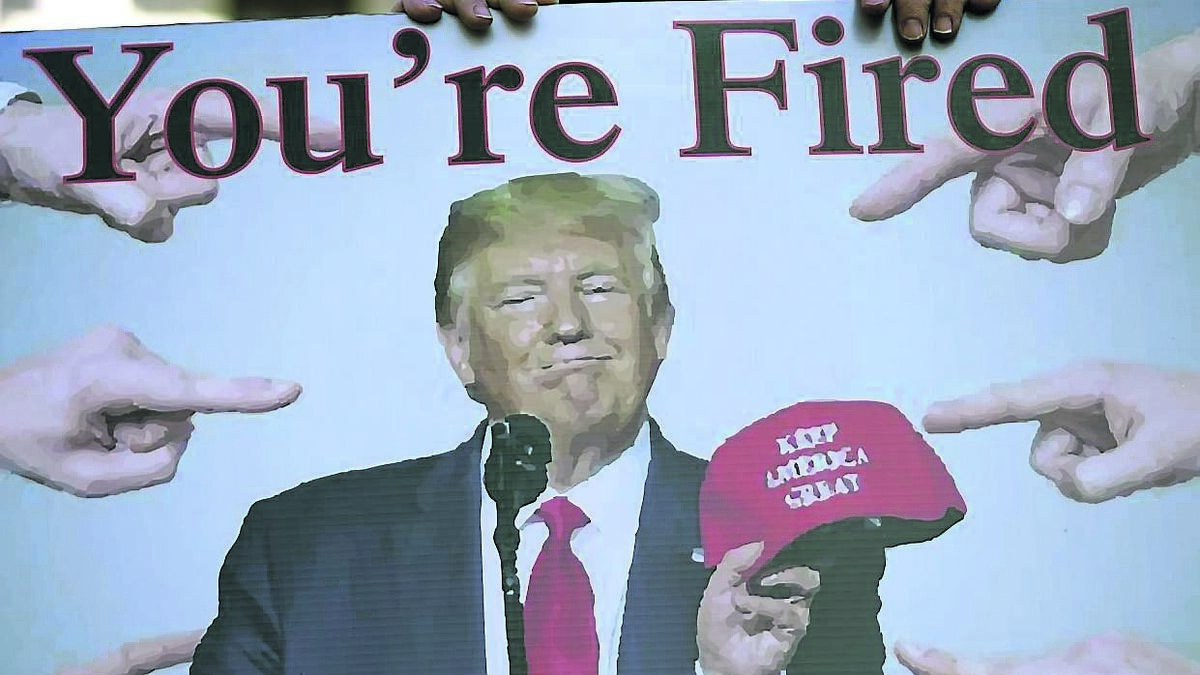
A supporter of President-elect Joe Biden holds a sign referring to President Donald Trump outside the Pennsylvania State Capitol. Picture: AP Photo/Julio Cortez.
The plasma — what remains after red and white blood cells, platelets and other components are removed — of people who have recovered from the disease contains precious antibodies that helped them fight the virus.
They could help others to do the same or even make them temporarily immune, according to the New Scientist magazine.
U.S health official, Anthony Fauci, has said that antibody therapies could act as a “bridge to a vaccine”, allowing us a stop-gap before we get inoculated.
The use of antibody-suffused blood plasma was developed more than 100 years ago to treat diphtheria. With the introduction of antibiotics, it wasn’t used much but was revived in 2002 during the SARS epidemic and has gone on to be used against Ebola.
Another use of plasma injections is to provide effectively a short-term vaccine for diseases such as hepatitis B.
The research for using a number of types of plasma to treat Covid-19 is still in its early stages. The most basic antibody therapy is convalescent plasma. The plasma is transfused from a recovered patient into a sick person’s bloodstream to give them an instant immune response.
As Jeffrey Sturek of the University of Virginia, who is running a convalescent plasma trial, says, you can borrow immunity from other people.
Donating plasma is similar to blood donation. Blood is taken from a vein in the arm, but then separated using a process called plasmapheresis.
The plasma is retained but the red and white blood cells are infused back into the donor. The plasma is screened for pathogens, tissue-matched and then infused into the bloodstream.
While there are no approved convalescent plasma therapies for Covid-19 yet, some limited pilot studies have reported benefits for very sick people.
A few months ago, the U.S Food and Drug Administration granted the therapy an emergency use authorisation. This means it can be given to patients with the disease, despite not having gone through all the regulatory hoops.
More than 50 clinical trials are underway, some of which are examining it as a vaccine. There have been some reports of side effects, including the slight risk of lung injury.
Another promising approach is called hyperimmune globulin (H-1g), reports the New Scientist. It is “essentially turbo-charged convalescent plasma that has been purified and concentrated”.
It is already used for numerous conditions, including flu and other respiratory viruses. It’s said to be cleaner and more consistent than standard convalescent plasma as that contains a variable amount of the desired antibodies and “might also contain toxins or other nasties”.
But unlike convalescent plasma, which can be dispensed immediately, H-1g takes time to prepare and several donors are required to make one dose.
Then there are monoclonal antibodies (a monoclonal antibody is made by cloning a unique white blood cell.) The procedure is to screen convalescent plasma to find the most potent antibodies and then engineer cells to produce them in large quantities.
Monoclonal antibodies are already used for hundreds of diseases such as cancers, autoimmune diseases and some infectious diseases.
But monoclonal antibodies are not a guaranteed success. Despite the production method not relying on donors, making large quantities of it is a challenge.
Regeneron, the biotech company that hit the headlines after its experimental therapy was administered to Donald Trump, has said that people with Covid-19 who are given the antibody cocktail, have a lower viral load, get better faster and require less medical attention. But you’re talking about a huge financial outlay.
The New York-based Regeneron has published positive interim results from one of its trials in people with mild or moderate Covid-19 who hadn’t been admitted to hospital. Those who had the treatment were less likely to end up in hospital.
Even when a vaccine is available, not everyone will respond well to it. For those who don’t get protection from vaccines, antibodies could be their only chance of immunity.
Trump was given a cocktail of two monoclonal antibodies selected for their ability to block the virus from entering cells. This concoction is in clinical trials both as a therapy and as a prophylactic.
His recovery appears to have been remarkable, so good that some conspiracy theorists claim he never had Covid-19.
Presumably, their argument goes, Trump wanted to show people that Covid-19 isn’t such a big deal and it ought not to get in the way of the economy booming. But Covid-19 can, in some instances, be deadly.
Maybe Trump could actually do something useful and donate blood. Whether you’d want to take his plasma is another matter.
Still, making a blood donation would be good PR for Trump, even now, as he navigates the next stage of his kamikaze career.







 App?
App?


