Throwback Thursday: Do you recognise any of these extras from the Moby Dick film set in Cork? 
This week on Throwback Thursday, JO KERRIGAN hears from a reader who believes her gran is in a photo from the filming of Moby Dick in Cork in the 1950s, plus more holiday memories. 
Throwback Thursday: Do you recognise any of these extras from the Moby Dick film set in Cork? 

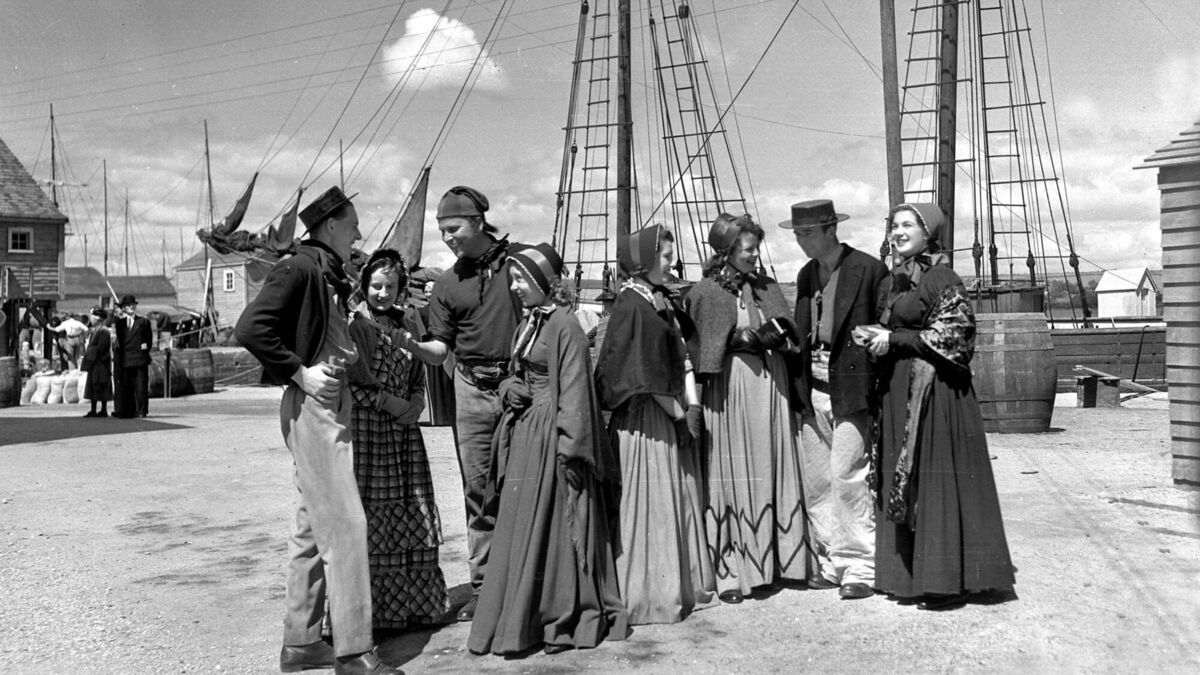
Extras on the set of the film Moby Dick at Youghal, Co. Cork, on July 9, 1954. A Throwback Thursday reader believes her gran is among them

We have heard from Anthony (he didn’t give us his surname), who was delighted to read of the old days in Youghal in recent Throwback Thursday columns.
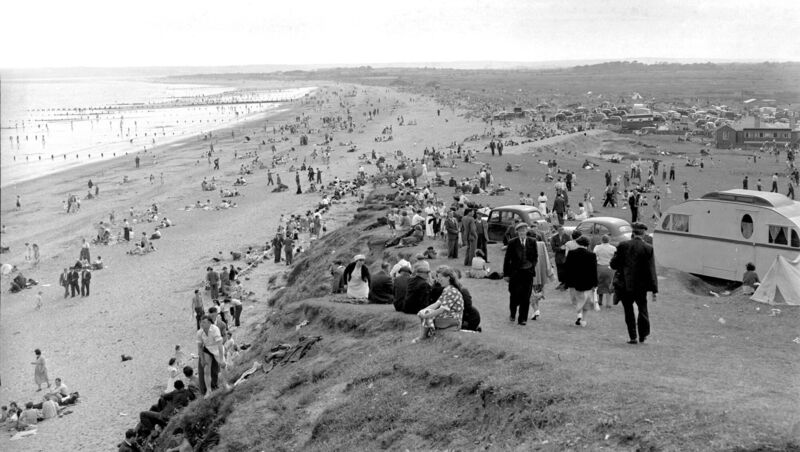
“It is with great affection that I recall our family annual holidays in my boyhood in Youghal around the time referred to in your articles,” he said.

“The evening after dark shows out in Claycastle were a highlight for me then, and stay in my memories of that time. I was a kid, we were up late, out after dark, and it was great.

“My recollection is that the entertainment was of a variety nature rather than of plays on tour in the style that you mention.

“There was a stage all right, and perhaps canvas on top and/or sides, but not totally I think. Some chairs and/or seating too perhaps.

“In my mind, the location was up at or close along from that end of the prom as it was then, and slightly on to the Claycastle grassy top there.

“Cox’s shop was near to and on the opposite side of the road from the church. We used to stay and have our meals in in Miss Cox’s house straight up the hill opposite the shop.”

Anthony added: “Maybe we used to get our ice cream there, but I do not particularly recall it along the beach area.

“There were some shops about of course, and candy floss is one thing that stands out a bit, probably for the novelty.

“My only remaining memory of the sea is of the tide being out and the water being extremely cold, and me being a bit difficult to encourage on that front!”

We hear you, Anthony, and agree wholeheartedly. Almost every seaside memory of childhood features that icy cold Atlantic water, so discouraging to shivering young limbs.

It was never a case of “did you have a good swim?” but rather “Did you get down? Did you get right down?” Because between ankles and knees it was bad enough, but the thought of going further and immersing the entire body in that freezing sea was, to put it mildly, a step too far.

Big brothers would sometimes show off by rushing wildly in and throwing themselves into the waves, or, if rocks were handy, jumping off them into deeper water, but I for one always wondered why they didn’t get heart attacks from that icy plunge.

How many of us only discovered the joys of sea swimming much later in life, when we went to warmer countries and found to our amazement that it can actually be a pleasant experience, not a traumatic trial to be endured as a rite of holiday passage?

A packed beach at Youghal on August 2, 1953

After floating in the bay off a Greek island or a southern Spanish holiday resort, the Atlantic around Ireland, for most of us, was firmly confined to childhood memories. (Although we do realise that hardened locals like Mary Holly, who, as she told us last week, bathes off Courtmacsherry every single day in summer, have somehow become immune to the unfriendly temperature. How, we cannot imagine, but there it is.)
“The merries, i.e. Perks amusements, were the nightly attraction,” continues Anthony of his Youghal childhood memories.

“And staying up late in the evenings for that was a real highlight.

“A few yards across the road from it, people would be fishing and getting plenty of mackerel and sprats when the tide was right.

“More or less alongside the merries you had the Showboat dance hall for those a few years older, and it used to get the leading bands in, which were a great draw.

“In the late 1950s, I used to play in the annual tennis junior open week.

“I remember that there was a popular shop on the seafront selling refreshments at that time. It had a juke box, and was very popular when we were having a snack or hanging about.

“I suppose it’s just that being very young in those years of little affluence, the atmosphere of the whole set-up is what lingers,” Anthony concludes.

“Like many, we did not have a car then, and so with the excitement of the train (when going as distinct from returning!) and when Capel Island came into view, and then the rush over the 50 yards from the train to actually ‘see the sea’, it’s hardly surprising that the images linger.

“Also, being brought out and allowed to stay up late made those times so special.”

A lovely expression of the enjoyment we used to get from the simple treats in life back then, Anthony.

When you don’t have much, the rare occasional break-out is so much appreciated. Thank you for sharing that.

And we have also had some information from our regular correspondent, Cyril McIntyre, on the subject of shoreline shops in the Youghal of yesteryear.

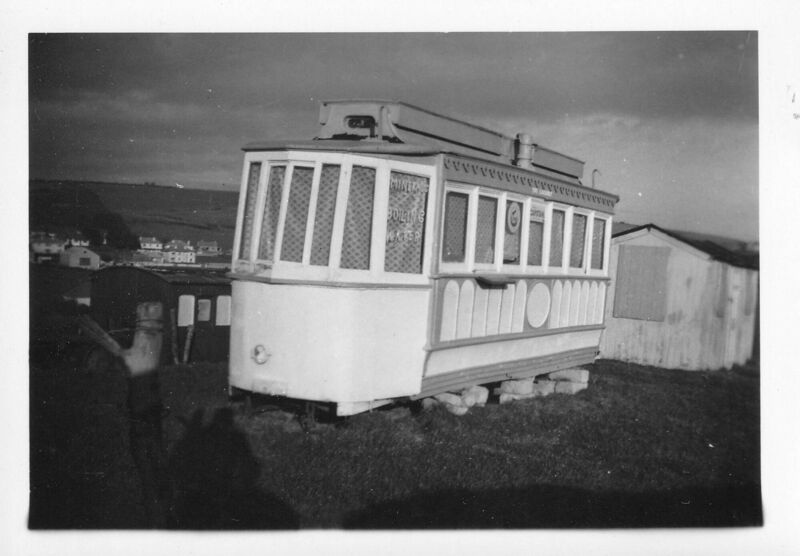
“The reference in last week’s feature to the marquee in the field at Claycastle just outside Youghal prompted me to wonder if any readers still remember the old tram which served as a shop at this location for many years,” writes Cyril.

“On Friday, January 11, 1957, the McIntyre family were travelling, by car on this occasion, to spend a weekend with my grandparents in Modeligo, Co Waterford.

“Diverting off the main road at Claycastle, I recognised the converted tram as having come from Ireland’s first electric tramway, linking the Giant’s Causeway with Bushmills and Portrush, which opened in 1883 and closed in 1949.

“The tram body was mounted on concrete blocks and was used as a shop during the summer months, operated by Ms Nellie Meagher, who was the local librarian.

The converted tram at Claycastle, which was mounted on concrete blocks and used as a shop during the summer months. Picture suppled by Cyril McIntyre

“After her death, it became derelict and in 1982 was presented by Youghal Urban District Council to the National Transport Museum at Howth, Co Dublin.
“It has since been restored and will hopefully be on display there soon.”

Cyril continues: “The shop was strategically located, as across the road overlooking the sea was a large field filled with holiday homes. Most of these were converted from old railway carriages and redundant bus bodies, including at least one double decker from the fleet that replaced Cork’s electric trams in 1931.

“How I now regret that I did not also photograph some of these unique vehicles... but film for my mother’s Kodak Brownie box camera was expensive and pocket money was scarce!”

We love that picture of the tram, Cyril, supported more hopefully than firmly on concrete blocks and the occasional handy rock!

Note the handwritten signs on the window offering not only ‘Minerals’ but also ‘Boiling Water’, a reminder of simpler times when we brought our own kettle, tea, sugar, etc, with us on our jaunts to the sea. None of this ‘two skinny lattes and a cappuccino with soy milk, please, an’ two of those millionaires’ shortbreads’. As the saying goes, ‘Tis far from millionaires’ shortbread our parents were reared!

“How we came to be travelling by car instead of by bus casts another interesting sidelight on motoring in those days,” continues Cyril. “Back then, every new car came with instructions on ‘running-in’... who remembers what that was?

“For the first 500 miles, it had to be driven no faster than certain designated speeds in each gear, usually detailed on a sticker inside the windscreen.

“It so happened that among my father’s friends was Tom Maloney, a fellow Cavan man, who ran a car hire business from an office and garage on St Patrick’s Quay. On taking delivery of new cars, he would loan some of them to trusted friends for a week to get the ‘running-in’ mileage clocked up by reliable drivers who would drive them properly.

“So while my mother, my sister and myself enjoyed a weekend in Modeligo, my father could work from there checking buses in the area, using an ‘anonymous’ car instead of the normal CIE staff car!”

Well, isn’t that just great, Cyril! Many of us will remember the complaints about the ‘running-in’ necessity, but that clever idea thought up by Tom Maloney must have benefited many.

We will say nothing about the cunning use of an unknown car for your father’s inspecting duties!

Cyril has one final comment. “By the way, I think that George Daniels was one of the touring theatrical companies which used to visit Youghal. Another one may have been McFadden’s?”

Moving on, and we have had a query or two about Joey Kerrigan and his motorbike escapades that summer of 1954 in Youghal. How did he get the entire family of two adults and five children down there as well as the bike? Did he drive everybody down, then catch a bus back, and finally ride down on the motorbike?

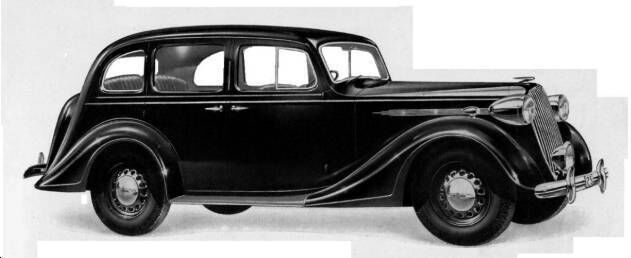
“Oh no,” explains my brother, Tom. “We had the Vauxhall 25hp then, and that was big enough for all of us. ZB1586, the 1937 model.

“It had one of those huge boots that open downwards, and he just laid the bike on there to bring down to Youghal.

“He might not have done that normally, but he had damaged the boot earlier, through backing up against a wall or a tree or something, so once that had happened, he didn’t mind leaving it open to carry the bike, as you would on the back of a truck. Anyway, he got it down there safely!

“It was a great old car, dark blue,” recalls Tom, “but when it got scraped (as it inevitably did during its tour of duty as a Kerrigan bus) it was maroon underneath, so obviously it had been resprayed before we bought it.

“It had big running boards, and headlights mounted on the wings. We all took turns at riding on those running boards or sitting behind the headlights. Health and safety? We didn’t have things like that back then...

A Vauxhall 25hp, 1937 model, the make once owned by Joey Kerrigan and used for his family trips to Youghal

“I vividly remember climbing on to its roof to get up into the high doorway of the Martello tower down at Rossleague. It was a really useful size of car.”
Now, a week or so back we featured several pictures of people involved in the filming of John Huston’s classic, Moby Dick, down in Youghal that summer of 1954, and this caused Emma Valentine to write to us.

“In your recent Throwback Thursday pages, a photo was included of the Moby Dick extras,” says Emma. “I know it’s a long shot, but is there any way that the names of these extras were captured at the time the photo was taken?

“We are fairly sure that one of them is my late grandmother but we would love to know for certain.”

Well, we had to chase that one up of course, and immediately checked with the archives. Nope, alas, no names taken for the extras. But surely there are others of you out there who might recognise somebody in that picture?

We went further. We contacted Dorothy Heaphy, who is a perfect fount of knowledge on all things to do with Youghal, and she suggests that Emma should get in touch with the Film & Photography Museum in the town, where pictures of that unforgettable event are also displayed.

The museum, she explained, is run by volunteers, and she thoroughly recommends Wayne Ruxton who, she says, “is fantastic at researching a fact”.

Well, there you are, Emma. Head down to the Film & Photography Museum and ask for Wayne.

In the meantime, though, we ask all readers of Throwback Thursday if they know someone who was there in that summer and might recognise the locals dressed up as extras.

I wouldn’t mind hearing a few memories too – what it was like to work with Huston and his team, whether they met the stars in person, anything like that.

Email jokerrigan1@gmail.com, or leave a comment on our Facebook page: www.facebook.com/echolivecork.

More in this section

Throwback Thursday: Responding to a 22-year-old letter with memories of Moby Dick Throwback Thursday: Responding to a 22-year-old letter with memories of Moby Dick
Throwback Thursday: 'Our father was in charge of dismantling the old Youghal bridge' Throwback Thursday: 'Our father was in charge of dismantling the old Youghal bridge'
Throwback Thursday: Memories of the Cork bridge you had to walk across Throwback Thursday: Memories of the Cork bridge you had to walk across

Sponsored Content

Transform your career, your way: choose MTU part-time education Transform your career, your way: choose MTU part-time education
Keeping their house in order: How PSRA regulation has raised the bar for Ireland’s property services sector Keeping their house in order: How PSRA regulation has raised the bar for Ireland’s property services sector
"My master's at UL taught me that structured learning and a demanding career can coexist" "My master's at UL taught me that structured learning and a demanding career can coexist"
Contact Us Cookie Policy Privacy Policy Terms and Conditions

© Examiner Echo Group Limited

Add Echolive.ie to your home screen - easy access to Cork news, views, sport and more