Throwback Thursday: 'The road was washed away...the army had to put a bridge in place’
In this week’s Throwback Thursday, JO KERRIGAN hears stories of another Bailey bridge in Cork, the Muskerry tram, and the discovery of an almost 100 year old copy of a special Cork publication.
Throwback Thursday: 'The road was washed away...the army had to put a bridge in place’

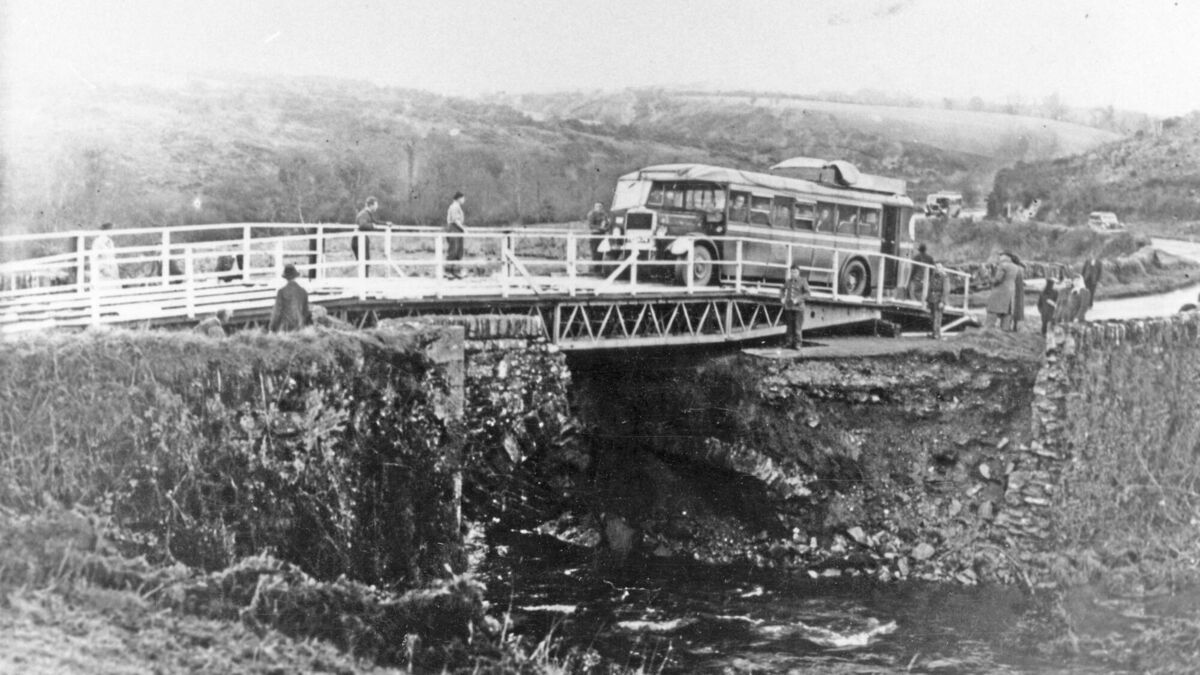
The first bus to cross Bailey bridge from Mallow to Cork, Dec 11, 1948.

Now here is an exciting tale of danger and derring-do, from our correspondent Cyril McIntyre, whose father was a stalwart of CIE back in the day.

“Reading about the Bailey Bridge in use while the new North Gate Bridge was being built reminded me of another Bailey bridge in the Cork area, which had a personal connection. 

“On the evening of December 6, 1948, there was torrential rain and flooding throughout County Cork. Near Mourne Abbey on the main road from Cork to Limerick, a bridge known locally as Hackett’s Bridge was washed away by the flood waters, leaving only the left-hand side wall and a strip of roadway about four feet wide remaining. At 7.25pm, the 6.30pm buses from Cork to Limerick and to Newmarket had to stop on the Cork side of the bridge, and the passengers had to walk across the remaining strip of roadway to join buses waiting on the Mallow side, guided by the lights of a parked CIE staff car.” 

That is so, Cyril. The newspapers were full of it over the following few days, and this, from the Evening Herald of December 7, 1948, highlighted the results of that freak weather: “The aftermath of the floods has created an unenviable problem for the hundreds of people directly affected through the inundation of their homes and property, and also for the Co. Council, whose engineering staffs and manual personnel have been diverted to the great task of repairing widespread damage to bridges, roads, and boundary walls. The most urgent task is repair to Hackett’s Bridge, near Mourne Abbey, on the Cork-Mallow road. That structure collapsed on Sunday night, and it is now impassable. The bus service to Mallow and Limerick is, nevertheless, being operated. Buses from Cork proceed to the bridge, across which the passengers walk, and rejoin other buses on the Mallow side.” 

Incidentally, the Cork-Macroom bus service via Coachford was also put out of action, as the roads remained flooded and strewn with stones and debris, making it necessary to divert the route via Crookstown. And a bridge connecting Cork with Glanmire had to be hastily replaced by yet another Bailey bridge to enable people to get home. This was a time, remember, just after WWII, when most people depended on CIE to get them anywhere. Any disruption to the service had far-reaching social effects. But Cyril has more fascinating information to add about that Hackett’s Bridge collapse: “My father, Inspector Philip McIntyre, was supervising this transfer, assisted by a local County Council road worker, warning the passengers to cross in single file, and to keep close to the wall. However, one lady passenger apparently became disoriented and instead of following the path walked between two barrels blocking the road and fell into the river, a drop of about 15 feet.” 

Good heavens, what does a CIE inspector do in such a situation? Inspector McIntyre didn’t hesitate for a moment. 

“Along with a man named John Power, he jumped down, and between them they succeeded in getting her out of the river. “Accompanied by a nurse, who was a passenger on one of the buses, he brought her to Mallow Hospital in the staff car, arriving there at 7.45pm. After medical attention, she was discharged; he then drove her to her destination... He finally arrived back at Capwell bus depot at 2.45am the following morning. “Army engineers from Collins Barracks in Cork erected a Bailey bridge, which was opened four days later, on Saturday, December 11. The photo shows the first bus from Limerick to Cork to cross the temporary bridge, which remained in use for several months while the road was realigned and a new bridge built.

“I remember hearing the story from my father when I was still at school,” adds Cyril, “but several years ago, while going through some old CIE files, I actually found his official report of the incident, hence the detail of the bus times, etc.” Well, thank you for sharing that quite extraordinary family story. Just shows that a CIE inspector’s work is never done. And you even found a picture. Howzat! 
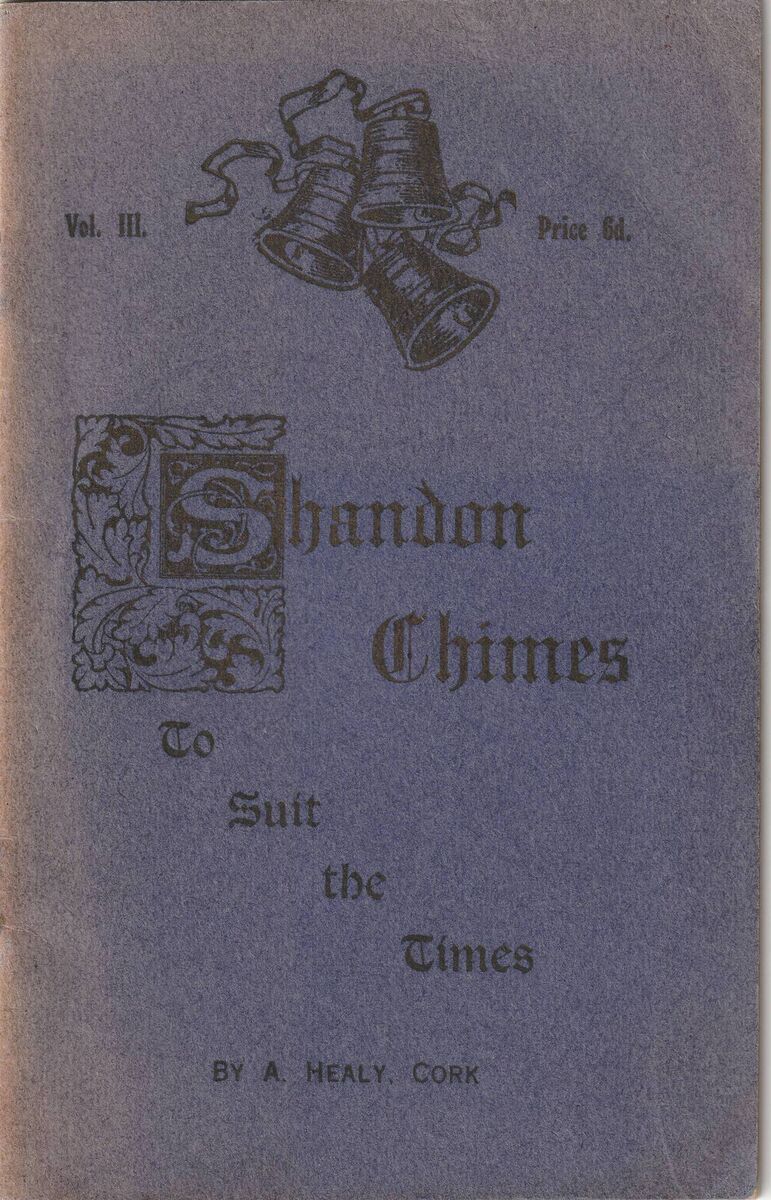
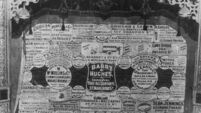
The cover of the copy of Shandon Chimes, which Cyril found in his book collection. It dates back to the 1930s.

Mr McIntyre thought we might also be interested in a delightful little publication dating from the early 1930s, entitled Shandon Chimes To Suit the Times. “When sorting through some of my book collection recently, I came across a small booklet of verses which I picked up many years ago in the Lee Book Store on Carroll’s Quay, another Cork institution now sadly no longer with us. Written by A. Healy and printed by the Shandon Printing Works, Shandon Chimes seems to have been an annual publication, as my copy is Volume 3, apparently published around Christmas 1931. It contains 22 ‘ditties’ about topical matters relating to Cork, some written to suit the airs of such popular songs as The Bells of Shandon and The Mountains Of Mourne
An introductory verse sets the scene:

“The old dying year is departing for ever,

And scarce does it bid us a final adieu,

When the chimes of dear Shandon with melody never

Forgets at its entrance to welcome the new.

Ring out, Shandon Bells, and for long ages chime

At morn, at noon, and when evening shades fall,

Unheeding the wear and the progress of time,

Ring out! and may thousands respond to your call.”

“A footnote on the first page reads: ‘Added interest will be given to Shandon Chimes this year for two reasons: Shandon Steeple appears on the back of the Five Pound Free State Notes, and the beautiful chimes will be heard in ‘Talkies’.

“It was only a few years earlier that Talkies, as films with sound were then known, had appeared in cinemas. The film referred to was probably Sweet Inniscarra, directed by Emmett Moore. Starring Seán Rogers and Mae Ryan, it was based on a play by Augustus Pitou first produced in New York in 1897. The film was released in 1934.

“The 1932 Cork Industrial Fair & Exhibition then in prospect is featured, as in the following lines:

“Oh, Paddy dear, and did you hear the news that goin’ around?

That an Exhibition we’re to have on our own native ground.

The site is not selected, but soon it will, I ween,

Before our Town Hall’s erected or complete the Tivoli Scheme.

‘Twill be the best we’ve had for years.I tell you this, my friend,

With all the newest industries which are not yet at end.

We’ll have Fordson’s latest tractors, in which such trade’s been done,

In city and in country they’re now used by everyone…”

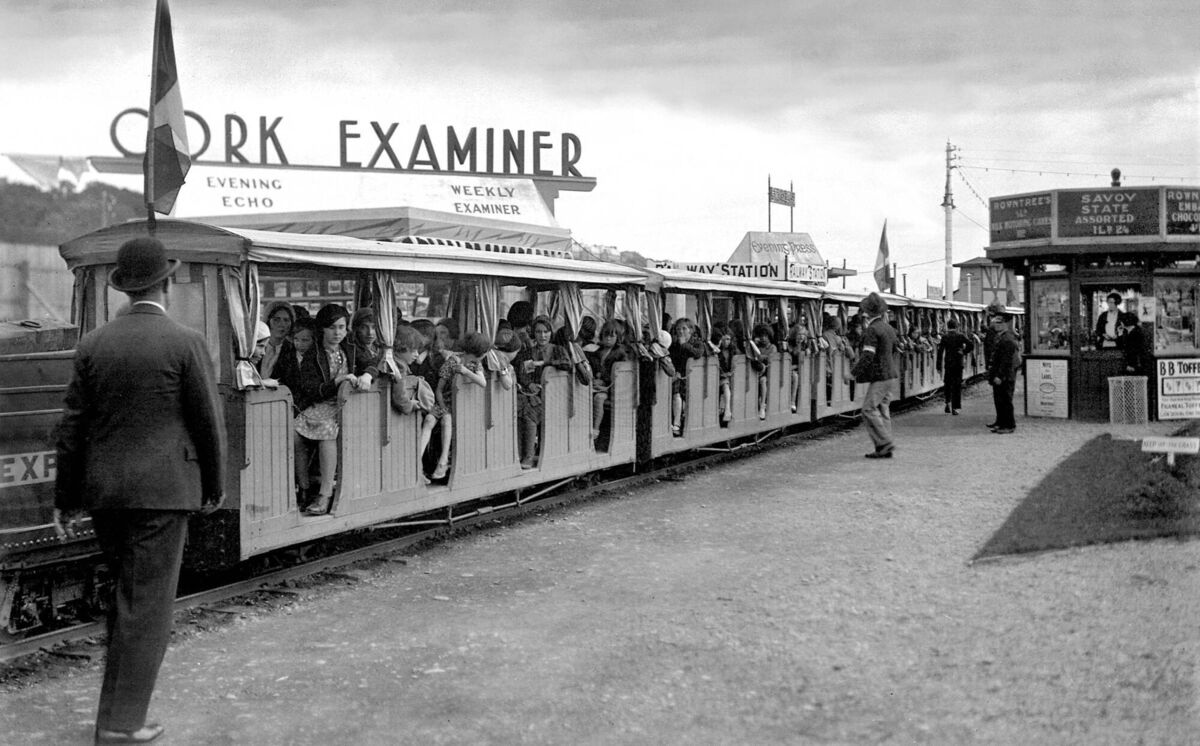
In the early 1930s, “the City Hall was still under reconstruction following its destruction during the burning of Cork in 1920, and the land reclamation scheme which resulted in the Tivoli Industrial Estate was also still in progress. The Exhibition opened on May 11, 1932 alongside the Carrigrohane Straight Road and continued until the end of September. It covered 83 acres and included an amusement park of 13 acres, described as the largest ever seen in Ireland. An unusual feature was a miniature railway encircling half of the grounds and operated by two miniature steam locomotives imported from Germany. The carriages were open-sided with canvas roofs and side curtains. A special platform was built outside the grounds on the Cork and Muskerry railway to cater for passengers travelling to and from the exhibition, while The Irish Omnibus Company ran a daily shuttle service from the Statue. The first bus from the Statue was at 8.15am, and the last bus left the exhibition grounds at 11pm. The adult bus fare was 3d. There were also excursion trains from all parts of the country to this great event.”

All aboard the mini-railway at the Cork International Industrial Exhibition in 1932.

Even the Holly Bough got a mention in Shandon Chimes:
The “Cork Weekly Exam”

We welcome it now

With feelings of joy

Like the “Cork Holly Bough”

We look forward each week

To the date ‘twill appear

But the “Cork Holly Bough”

Only comes once a year.

Their stories are good

And their verses are nice;

The jokes make you laugh,

And you’ll think it worth twice

The money you pay,

They are such a good size,

And from the Eds, any day

You may get a surprise.

Cyril, that just shows just how much can be discovered from a simple publication by noting dates, places mentioned, prices, and more, and then researching those. And you mention such classic Cork memories – for example, the Straight Road, and the Muskerry Light Railway. It is believed that the Carrigrohane Straight was originally built as a ‘famine road’ in the 1840s, but in the 1880s, the construction of the Muskerry train vastly increased its importance. Starting on Western Road (where the pillars for its bridge can still be seen in the river), it served 21 stops, including Carrigrohane, Leemount Cross, St Ann’s Hydro, Blarney, Donoughmore, and Coachford. Can anybody supply the whole 21 stops?

It used to be claimed that passengers on the Muskerry Tram, or the “Hook and Eye” as it was sometimes called, could pick blackberries as it moved along because of its slow speed. That story, it must be said, is a hoary one, having also been told of the West Clare Railway, although there it was gathering wild flowers while in transit. We understand that the ticket collector had to move from carriage to carriage on the outside, which was quite a dangerous procedure, given its propensity to rock and sway while heading on its merry way out of the city.

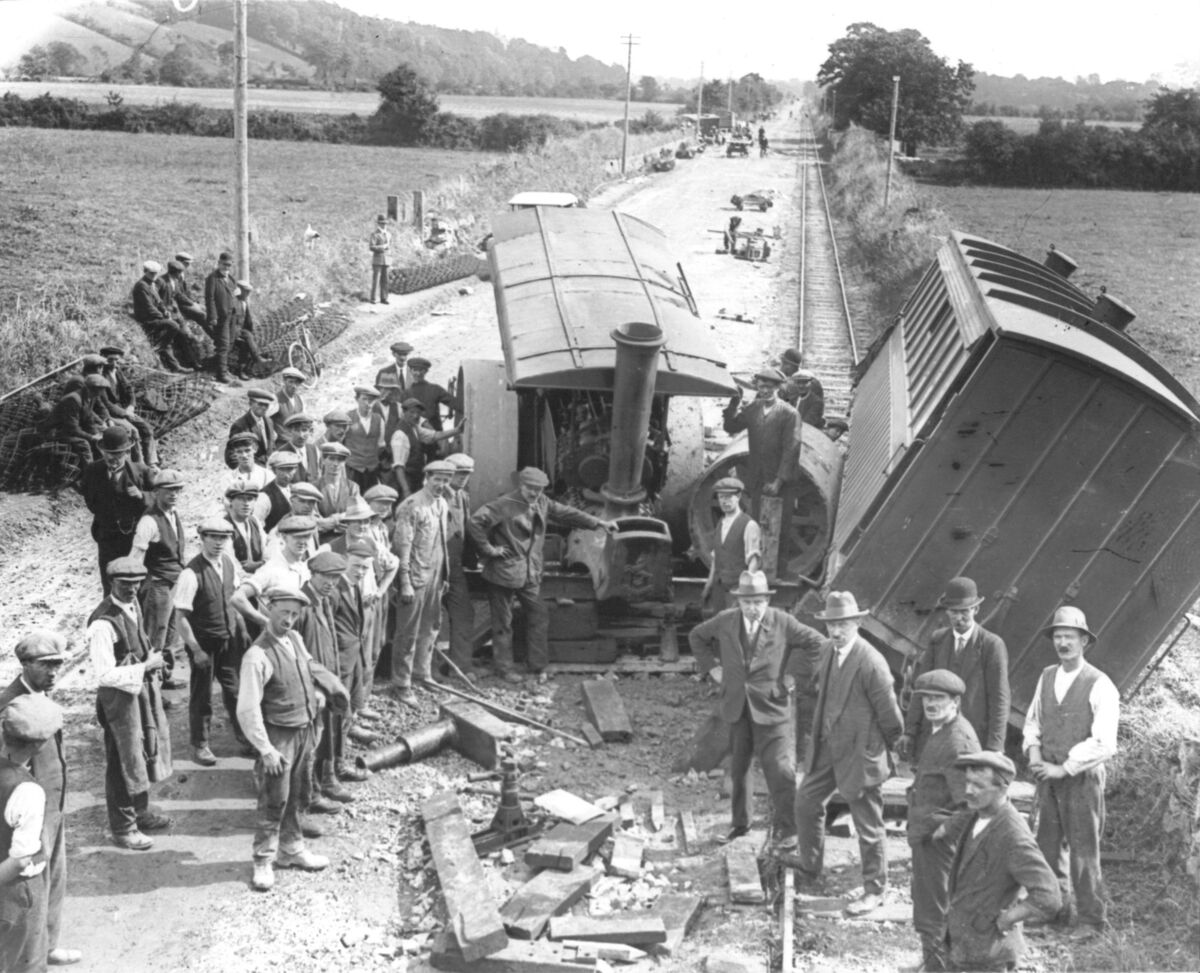
The collision between the Muskerry Tram and a steamroller attracted international interest in 1927.

The most famous incident in the life of the Muskerry was its collision with a steamroller and subsequent derailment in 1927. Amazingly, nobody was hurt. The service closed in 1934, but was still there for the great Exhibition, famed for evermore in the ballad, The Bold Thady Quill

At the Cork Exhibition there was a young lady

Whose fortune exceeded a million or more

But a bad constitution had ruined her completely

And medical treatment had failed o’er and o’er.

“Oh mother,” said she “sure I know what will ease me,

And cure this disease which will certainly kill.

Give over your doctors and medical treatment

I’d rather one squeeze out of bold Thady Quill!”

Share your own memories with us! Email jokerrigan1@gmail.com or leave a comment on our Facebook page: www.facebook.com/echolivecork.

More in this section

Throwback Thursday: My mother’s treasure trove of memories stored in an old teapot... Throwback Thursday: My mother’s treasure trove of memories stored in an old teapot...
Mary MacSwiney Mary MacSwiney: ‘A life motivated as much by love as her political ideals’
Throwback Thursday: Memory of dad's coffin being hoisted from Innisfallen etched in my mind  Throwback Thursday: Memory of dad's coffin being hoisted from Innisfallen etched in my mind 

Sponsored Content

Say cheese, think Kerrygold: Dinner is a dream with a simple but tasty pasta bake Say cheese, think Kerrygold: Dinner is a dream with a simple but tasty pasta bake
CS Yuno Energy July 2026 Yuno Energy brings clarity to customers’ energy bills
Don’t skip the foundation: The PSRA’s role in making property transactions transparent Don’t skip the foundation: The PSRA’s role in making property transactions transparent
Contact Us Cookie Policy Privacy Policy Terms and Conditions

© Examiner Echo Group Limited

Add Echolive.ie to your home screen - easy access to Cork news, views, sport and more