Throwback Thursday: We sang The Banks at campfire on scout trip to Scotland in 1950s
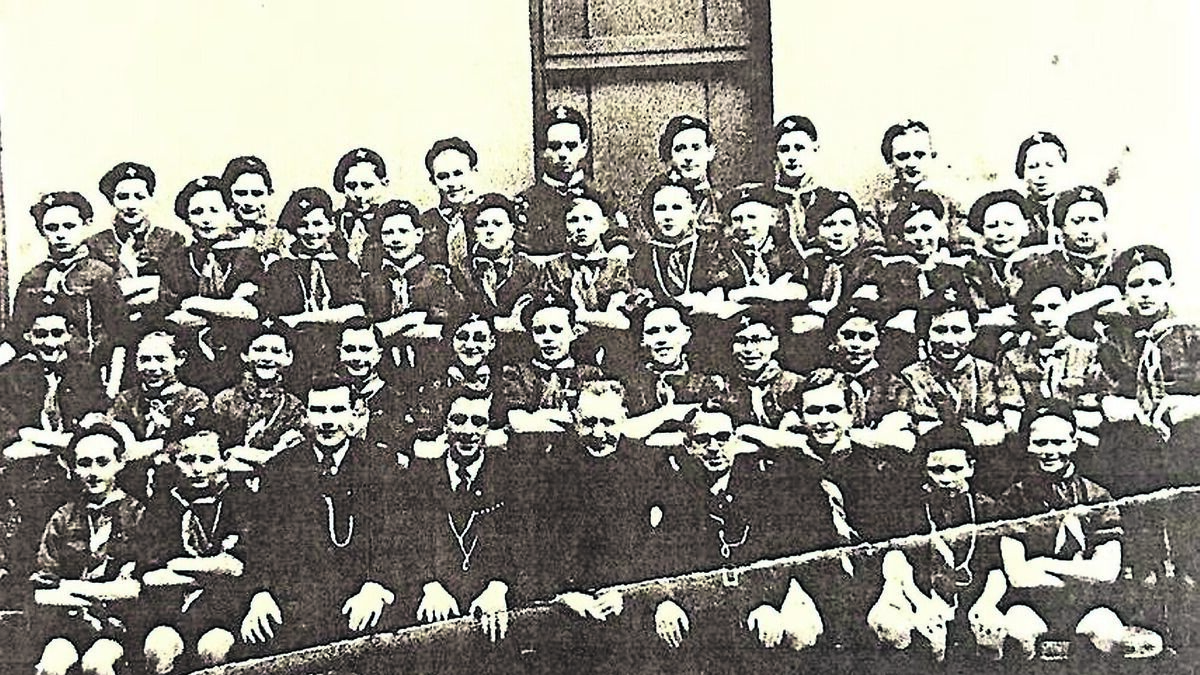
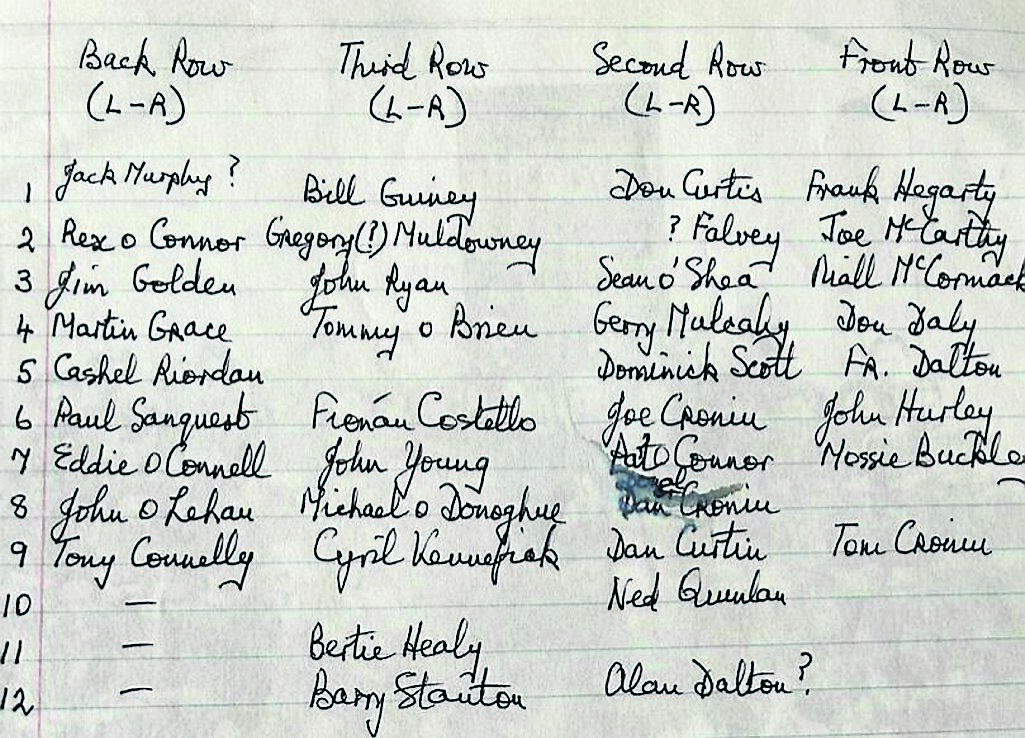
Brian Cronin’s scout troop ready to embark on the trip to Scotland in 1955. (Names in the article)
And here we are, a week into the New Year, 2026! Have you made your New Year resolutions yet? Or, more to the point, have you made them in good faith and broken them already?
Is it our imagination, or is it only women and girls who make them these days? Although every female we asked admitted to having done so, most males looked askance and said they hadn’t even thought of it.
Two polls posted online, the first taken in the late 1940s and the second recently, show how we have changed.
Back then, New Year resolutions tended to be very virtuous –, being nicer to friends and neighbours, for example, attending church more regularly, doing good in the community. Today, that has changed into a much more self-oriented angle – be nicer to your inner being, walk 2,000 steps a day, visit the gym regularly, fly off to those bucket-shop destinations you had always dreamed of...
Are we getting more private, drawn in to ourselves, our immediate household, our own health and enjoyment, rather than looking out and around at our community?
Back in the late 1940s, you did as a matter of course look out for friends and neighbours, and people in need, and saw churchgoing as a commitment rather than an option. And you wouldn’t have dreamed of questioning a priest, a teacher, or a garda, let alone your parents. The law was the law back then.
What traditions were observed in your household at this time of year? Did someone knock at the door with a gift of bread or coal, to ensure plenty in the months ahead?
If you lived in the city, did you listen to the chimes of Shandon or the hooters of ships on the river as midnight struck? Did you go out for the Poc Fada, or a January walk?
Today, most people head for the shops and sales, which is a sad reflection on the commercial mind of the modern world.
It was back last month that Throwback Thursday reader Brian Cronin shared with us his memories of when he proudly became a Boy Scout and enjoyed going on camping weekends with his troop.
We asked for more, and he told us of one very exciting annual trip that he remembered.
“1955 was a very special year for one particular reason,” says Brian. “Our scout master decided to bring the entire troop over to Scotland in place of the usual summer camp in Ireland, to join hundreds of other troops from around the world at an International Jamboree.
“The event was to take place in Auchengillan, in Stirlingshire, some 50 miles north of Glasgow. For me, and for many of my fellow scouts, it would be our first ever visit outside Ireland, which of course made it an exciting and memorable occasion.
“The entire exercise lasted for 16 days and the total cost per person amounted to four shillings and six pence (which we were expected to pay from our saved pocket monies of course.)”
Brian continues: “On the appointed day, we travelled by rail from Cork to Dublin and then, bursting with excitement, boarded the ferry for Glasgow.
“I recall the first sighting of land was greeted by shouts all round and claims of having been the first to glimpse the Scottish coastline!
“We travelled up the River Clyde in the early morning mist and we reckoned the large cranes in Greenock were bowing to us as we passed by, were offering us a ‘welcome’ to Scotland.
“As we travelled by bus from Glasgow to Auchengillan, we remarked how neat and tidy the countryside appeared. In place of the rambling hedges which are commonplace in Ireland, we noted the neat fencing on the roadside which enables one to have views of the fields and far away hills.
“Auchengillan campsite, operated by the Clyde Scouts, is on a 120 acre estate set against a backdrop of stunning scenery with views of the Campsie Hills and Loch Lomond.
“It features camping, indoor accommodation, cabins for those who weren’t using tents - all of the scout troops of course were tenting - and facilities for kayaking, mountain climbing and other activities.
“There weren’t any public toilets on the site during the time of our visit but I gather they have been added since.
“We learned to dig a trench near to our tent, which took a little while to get used to, but we persevered as we were used to that situation in our regular summer camps at home.
“This special Jamboree was attended by more than 100 scout troops from all over the world and afforded us a unique opportunity to meet and enjoy the company of boys from many different countries.”
Brian recalls some of the activities in detail.
“Our days started with a bugler playing Reveille on a trumpet on a raised mound in the centre of the campsite. This was a signal for all scouts to stand in line outside their tent in preparation for inspection by the scout master which followed. (This exercise trained you to keep your uniform in good order.)
“That was followed by the raising of the Union Jack flag (which we would duly follow by raising our own tri-colour.)
“We lined up and saluted the British flag, however, as a mark of respect to our hosts. A Scottish troop to one side of our tent did likewise.
“Young boys as a rule tend to be very perceptive and we also noticed that another troop, this time from Blackpool in England, didn’t observe the same procedure, which we thought was rather odd and displayed rather bad manners on their part.
“Each night we sat around an enormous campfire and sang until we were hoarse. We didn’t have The Fields Of Athenry in those days but weren’t found wanting in belting out The Banks Of My Own Lovely Lee, Molly Malone and many other Irish ballads.
“We delighted the Scots by joining them in singing Loch Lomond lustily and eventually wound up proceedings with Auld Lang Syne.
“Having settled in our tents for the night, ‘lights out’ was followed by the The Last Post, the haunting sound of which even to this day never fails to cause the hair of my head to stand on end. After our hectic day we slept like logs!”
Brian continues: “Each day during our two week stay was filled with many different activities. We sailed across Loch Lomond and our Scout Master offered a special prize for anybody spotting the famous Loch Ness Monster, but despite several false alarms the prize sadly remained unclaimed.
“On another day, we climbed Ben Lomond and were able to jokingly tell our new-found Scottish friends that our own Carrauntoohill in County Kerry, which we had climbed on a previous occasion, is over 1,000 metres in height, whereas Ben Lomond falls short of that by some 25 metres!
“Nevertheless, on a bright sunny day with little wind to hinder us we enjoyed the fabulous views of the Scottish countryside stretching into the far distance.
“Another vivid memory I have of that memorable visit was travelling into Edinburgh and climbing right to the top of Edinburgh Castle, and later visiting the famous Flower Clock which was set up to commemorate the 200th anniversary of Robbie Burns.
“The Flower Clock has 14,000 individual plants and flowers and also a famous cuckoo who sings out on the quarter hour.
“The 16 days seemed to fly by and, all too soon, the time came to say a sad goodbye to our newly-found friends, with invitations to visit each other’s countries, and before we knew it we were disembarking at Glanmire Railway station.
“It was the trip of a lifetime and one that will remain forever in my memory.”
I should think it would, Brian! Travelling far in the 1950s was not a common experience, and a camp like that, where you met so many lads of your own age, from such different countries, must have contributed immeasurably to your awareness of this world and the people in it.
Meanwhile, Katie O’Brien remembers travelling on that boat to Glasgow some ten years later, on a hitchhiking trip with two friends, and also recollects vividly the dark before dawn as the boat slid up the Clyde past the great clamorous shipbuilding centres crowding its banks.
“I recall seeing them actually working on what would become the QE2,” recalls Katie, “and even though it was well before daylight, the hammering and banging and riveting that was going on at that early hour was very impressive.”
She and her friends got off the boat in Glasgow, took a bus to the outskirts, and started hitchhiking north for Inverness and Ben Nevis.
“I remember seeing great, gaunt, grey structures in the distance as we passed through the city, but didn’t realise until afterwards that they must have been none other than the legendary Gorbals, the old tenements of the city,” said Katie.
“By then they were being pulled down, and replaced by modern flats, like they did in Dublin. I wish I could have explored them back then, and seen up close those hugely tall blackened brick buildings, the rickety staircases, the enclosed yards with one water tap and one outdoor loo for everybody to share.
“But perhaps it’s as well we didn’t venture in there in our innocence. Coming from Ireland, you tended to assume you would be welcome anywhere…”
For those who did not have the opportunity or good fortune to travel further afield, a bus trip to a local beauty spot was something to be anticipated eagerly for months ahead.
You will remember that back in December, Mícheál Kenefick related his memories of excursions with the Cork Pioneer groups, and shared images of groups, one all male, the other all female.
We wondered if they were segregated into different days, to suit the strict rules of the then Bishop of Cork, Cornelius Lucey. Not so, says Mícheál.
“Those pictures were indeed taken on the same day. Two buses, grouped by collection points.
“The spiritual director was the local curate and also the photographer.”
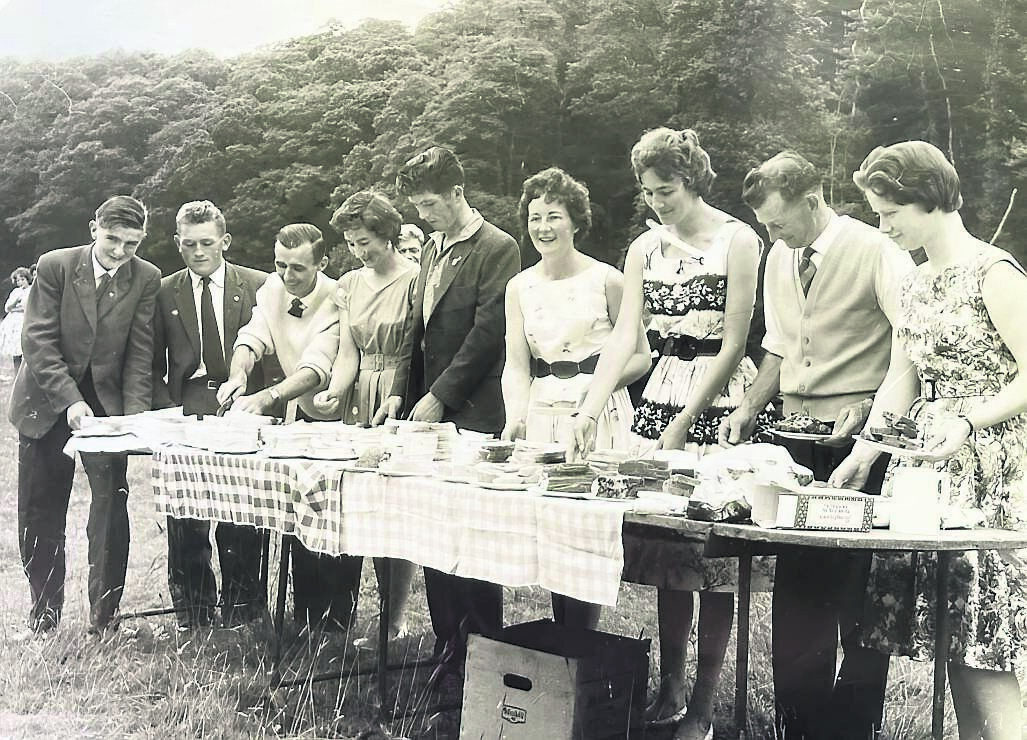
Micheál sent in another photograph, of the Pioneer Council setting up the foodstuffs, also taken on that day. He is on the far left in the photo.
“A trip to the beautiful little harbour of Glandore would have been an enormous adventure, and yet, strangely enough, I have no recollection of it,” he said.
“However, I remember that picnic in Innishannon as if it were yesterday. The field just beyond the bridge is today exactly as it was then and I mention the picnic every time I pass it.
“Happy days of innocence and ease!”
Well what a relief that boys and girls were allowed to mix on their big day out, Mícheál! Thank you for elucidating that worrying point. And what a lovely picture you have shared this time, with all those cups and saucers, sandwiches, slices of cake – and is that a Thompson’s box on the far right there? A Swiss Roll surely?
Do you remember similar outings? Or indeed the old traditions for this time of year? Email jokerrigan1@gmail.com or leave a message on our Facebook page: www.facebook.com/echolivecork.