Throwback Thursday: When Cork schools were heated by turf fire
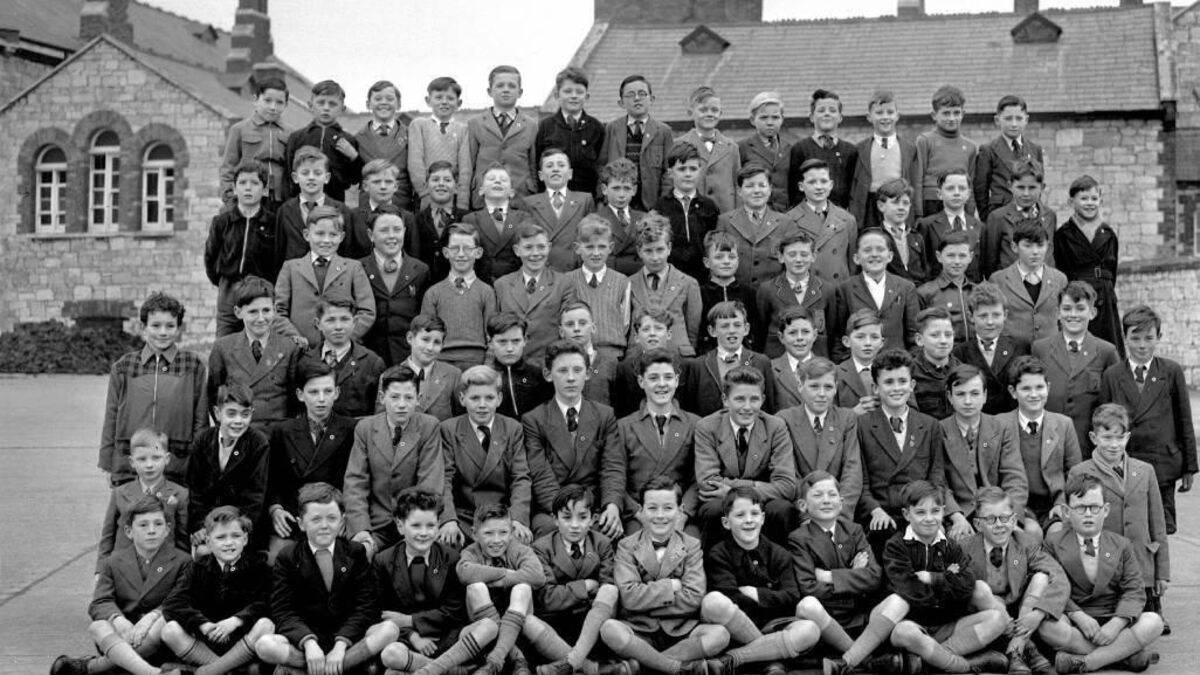
The turf store on the left of this photo of the Model School, Anglesea Street, Cork, in 1956, stirred memories in a Throwback Thursday reader
READER Tony Finn was delighted with last week’s Throwback Thursday wherein his experiences with our native language were detailed. And he particularly loved the archive picture of Model School pupils in 1956.
“I would have been too young to be in it,” said Tony, “but what grabbed my attention was the turf store on the left of the photo (beneath the three windows), which seemed full to overflowing.
“It reminded me that every classroom was heated by a large turf fire, and at least once a day each classroom’s turf pile would have to be replenished from the store.
Pupils were assigned by the teachers on a rota basis to bring turf from the store to the classroom, so at least once a day a team of four ‘volunteers’ would take a couple of buckets to the store, fill them and bring them back, with each heavy bucket being carried between two pupils.
“It usually worked out that each pupil was ‘volunteered’ once a week.”
Tony adds that he really enjoyed the topic we introduced, and hoped it would spur more contributions from readers.
Which indeed it did! Tim Morley was one of the first to respond:
“I can only remember that when I finished school at 17, I was MIGHTY glad that the Irish horror trip was finally over,” he said.
“My negative feelings began I suppose sometime after I went to secondary school at the Quay. There, most of my class coming from the primary school had been in the ‘scholarship’ class, where there had been intensive schooling, especially in Irish, and where indeed those pupils collared most of the Corporation and City post-primary scholarships.
“After all, the parents’ income would generally have been below average, so the school (the ‘Christian’ part of the Brothers’ title was well-earned) saw to it that secondary school was available to those who could profit from it.
“For those of us not coming from a primary school with a scholarship, the fees were then ‘ten pounds if you can afford it’.
“I was disadvantaged from the start in that I was well below the level prevailing there in Irish.
“I was naturally good at ‘sums’, and at home was always encouraged to read (English) books, so that my only struggles were with Irish.
“Then came the Inter Cert. years and we had a Brother McInerney. I mention his name because if there had been any sort of a scoring system, I very much suspect he would have won the title of being Ireland’s best teacher (in his subjects).
“The general system of learning our native language involved a sort of soaking it up. There was no formal structure where you could, with your own willpower, learn it.
“Our Brother McInerney didn’t primarily teach us Irish; rather he concentrated on teaching what was needed for the exams: that we knew our poetry with its critical commentaries thereof.
“Pure Irish was taught in ‘bits’, i.e. fancy words and phrases which we could incorporate into our Aiste (essay), and of course grammar was honed to perfection. Irish conversation was irrelevant in this system.
And of course the’ tally stick’ method you mentioned was rediscovered and very successfully put into practice in our school.
“Brother McInerney used to put up some sort of short essay on a notice board, with a number of grammatical mistakes. Our exercise was to rewrite it, WITHOUT the mistakes, and the number of wallops with the leather was determined by the number of overlooked mistakes.
“I assure you, I really shone in Irish at my Inter!”
Tim added: “Came the Leaving two years later, I sagged back to just being a bit better than mediocre. And all that came back to bite me 13-14 years later.
“I was then living in Germany and decided to study medicine. In a land where bureaucracy rules, my admission wasn’t determined by the fact that I had an excellent university degree, only by my Leaving results, where my low Irish marks worked like a ton of lead.
“Fortunately they let me in ‘without reaching the quota’.
“Then there is the factor of the home atmosphere towards Irish and the degree of nationalistic fervour prevailing.
“My father was born in 1895, when the legal (?) government was Britain, and as an active trade unionist, the enemy were the employers and capitalists, not the British government.
“My mother spent nearly 20 years teaching in Scotland, employed by the state, so she also had respect towards British traditions.”
Tim Morley remembers a friend in Cork, “probably the cleverest of my contemporaries in my youth”, who later became a prominent legal authority.
“He actually failed his Leaving because of Irish (only the fact that he also had the Matric let him go further), while another friend appointed as a professor at Galway had to do his oral Irish exam there about a half dozen times before they gave him his title.”
Tim Cagney is another who had a pronounced antipathy to Irish in childhood.
I, and most of my classmates, hated it. It seemed unnecessary - after all, it wasn’t the everyday language we used, and the likelihood of ever using it post-schooldays was slim.
“Added to that was the little matter of what became known as Compulsory Irish - that daft notion, conceived by our government, that determined that, if you failed Irish in State Exams, you failed the whole thing.
“Yes, you could score 100% in every other subject on the curriculum, but fail Irish, and you could look forward to a career as a messenger-boy.
“Not surprisingly, this did nothing to further endear us to our native tongue.
“The whole matter of the Irish language, of course, had its origins in the unwelcome attentions of our nearest geographical neighbour, over a period of 800 years (give or take). The whole process of subjugation involved the suppression of everything the victim nation held dear. These included our customs, religion, sporting activities and - not least - our language.
“Ireland wasn’t the only country to suffer such a regime, of course - it was universally practised in every other land which became ‘colonised’.
“After a century or two of browbeating, we had somehow got used to - and even accepted - these new ways of living. I might even suggest that we began to aspire to the cultures of the dominant nation, even to the extent of believing they were superior to us.
“Like many others, I was a keen reader of publications such as The Dandy and The Beano. Later, I became an avid fan of Enid Blyton (The Famous Five, The Secret Seven), and it would not be inaccurate to say that I identified with many of the characters in the stories.
“I was also, of course, a great fan of Charles Dickens, and greatly admired the timber-fronted houses, which were popular in his day. Little wonder, then, that so many of us began to embrace things such as golf, soccer and pop music, regarding céilí music - and, indeed, anything remotely Irish - as something nearly to be embarrassed about.
It is often said that hindsight is a great thing. Nowadays, being older and (hopefully) wiser, I reflect on the history of our native land, and the havoc wrought by the domination of a foreign power.
“The near-demise of our beautiful language is now of significant importance to me. If I were at school again, I’d certainly adopt a different approach to it.”
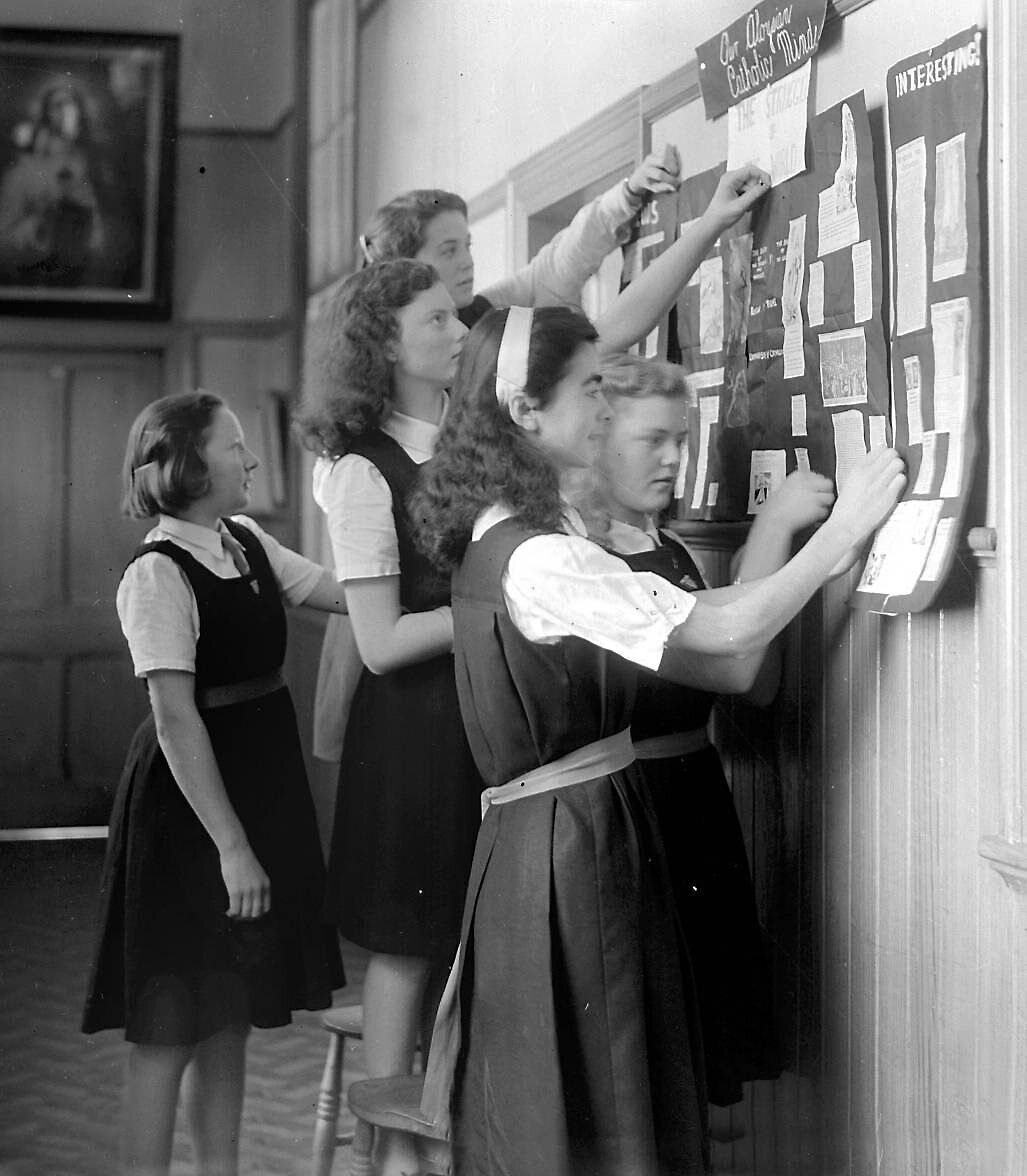
Girls were as vexed by compulsory Irish as the boys. Katie O’Brien vividly remembers the horror of moving to secondary school from a very small establishment where Irish was notionally taught by a visiting teacher one day a week and otherwise ignored.
“I was completely unprepared for everyone around me leaping to their feet and chanting these incomprehensible litanies whenever a nun showed her face in the classroom: ‘Diasmirrigutspawdrigawahir’,” recalled Katie.
“It took me quite a while to work out how to sound, at least, like the rest of them, even if I hadn’t a clue what it all meant.
“And I was another of those who was denied Honours in the Leaving Cert because of a poor pass mark in Irish, even though I was top of the class in everything else.
“Fortunately, my parents had suggested I take the Matric as well, and I sailed through that, so was able to go on to university anyway.”
Mary Holly is of much the same mind.
“In primary school I just got on with it, but when I moved into secondary, I was in a class with girls who came from several other schools, where Irish might have been more to the forefront.
“Some knew about something called the ‘tuiseal ginideach’ and I was lost. The teacher presumed we all knew about this mysterious ‘tuiseal ginideach’ and as far as I was concerned, it was all a struggle from that day on.”
Oh, don’t we all remember sitting at the back of the class as a teacher said “Do you follow that?” and some bright spark at the front would pipe up, “Oh yes, I get it!” And you would sink down in your desk, knowing that from now on you would always be on the losing side…
“Peig and her grim life didn’t help either, adds Mary Holly wryly.
Sean bean is ea mise anois, le cos amháin san uaig agus an cos eile ar an bruach… I mean, how dreary can you get?
Nevertheless, she says, she would welcome other readers’ memories of An Réalt, which was an Irish-speaking social club run by teachers in St Augustine’s Hall, and which provided an opportunity to meet others ( i.e boys) in a manner approved by the most conservative parents.
As an adult, says Mary, “I have come to love Irish, and use my limited knowledge when I can but I find radio very difficult to understand.
“The dialects and pronunciations are so hard. TG4 with subtitles is great and I occasionally enjoy the challenge of Gaelic on BBC Alba.”
Eileen Barry says she didn’t mind Irish classes so much as a general rule, “except for sixth class, and that was mainly down to a frightening teacher who scared the heck out of me.
“My main fears were of being asked to open the door for a teacher, or, worst of all, being sent on an errand to another class!”
Tom Maloney gave some serious thought to the question of how most schoolchildren felt about compulsory Irish.
“We never somehow saw it as interesting or useful,” he said. “It always carried an air of grim obligation, a sort of cold unfriendliness, something we had to do whether we liked it or not.
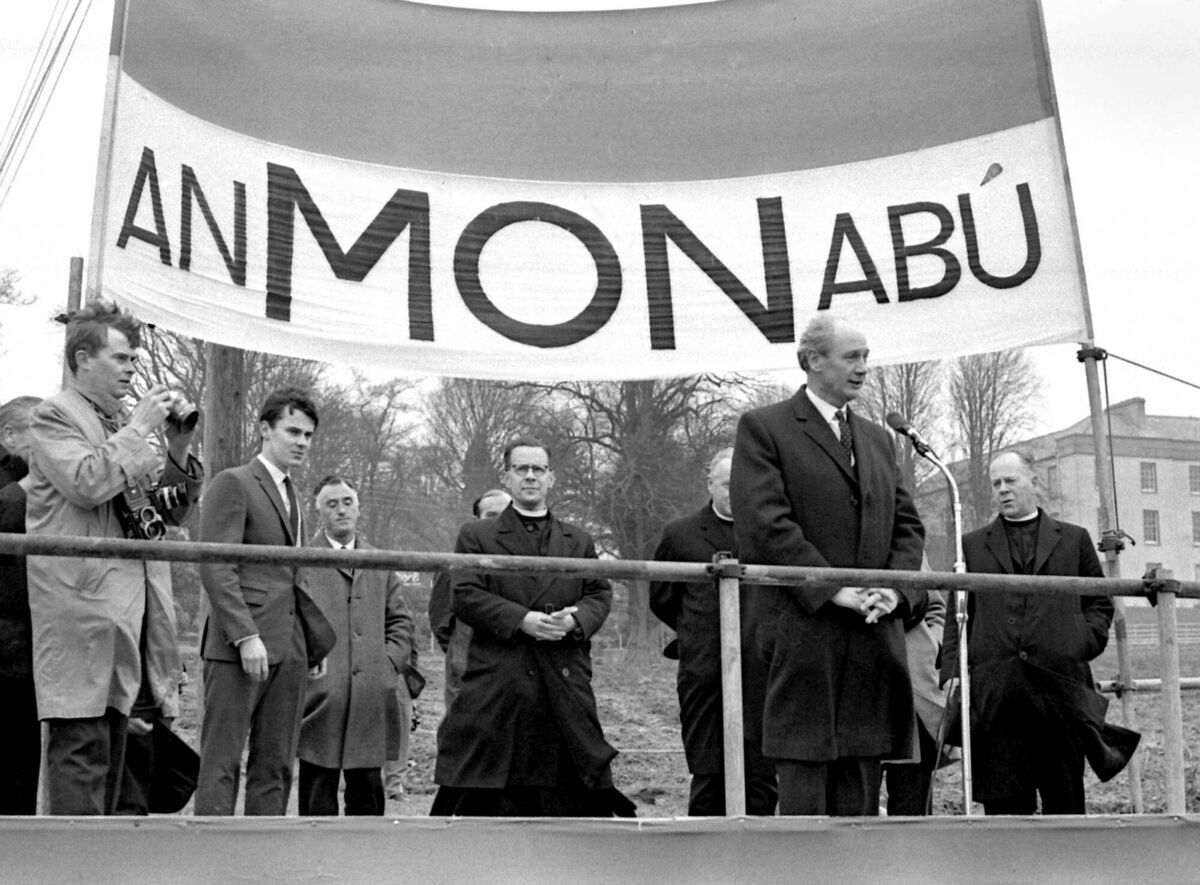
“Of course, Éamon de Valera was trying to rescue a genuine and priceless Irish culture from the wreck left behind by the English colonists, but although his motives may have been praiseworthy in a worldwide cultural sense, it can’t be denied that they built up a huge core of resentment in pupils who had to work with this unfamiliar language, being reminded constantly that to do poorly or worse still to fail would mean failure in all other subjects as well, never mind future careers, no matter how brilliant they might be at music or mathematics, science or history.”
Share your own memories with us. Email jokerrigan1@gmail.com. Or leave a comment on our Facebook page: https://www.facebook.com/echolivecork.