John Dolan: What kind of people watched public executions in Cork...all sorts
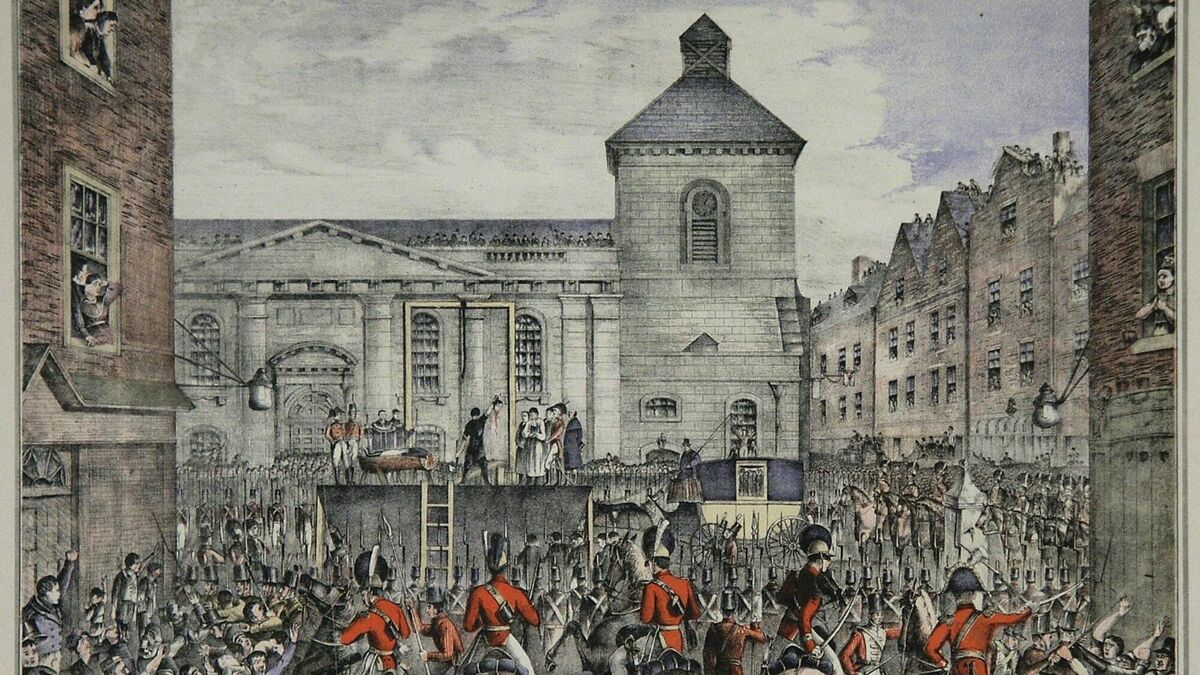
An 1877 illustration of the execution of Robert Emmet, which took place before a large crowd in Thomas Street, Dublin, in 1803
That question was raised lately when dotty old President Trump and his U.S administration spoke of their plans to show the death by firing squad of a mass murderer live on the internet.
There were reports this week that Trump had rowed back on this barbaric plan, and we can only hope common decency prevails. Aside from a few outliers, such as Iran, public executions have been consigned to the past, hopefully never to return.
However, we do know what sort of person would have willingly watched a public execution in Cork a few hundred years ago: The answer is an awful lot of them, and from all cohorts of society.
The curious, the gossips, the well-to-do, the down-at-heel, hawkers, young and old. All human life would turn out to watch the expiry of a fellow human being back in the day. It was like Netflix, presumably without too much chilling, although it takes all sorts I guess.
It goes without saying that public executions in long-ago Cork, like in all areas of the British empire, were gruesome affairs. And just as in the case of the murderess in the U.S a few weeks ago, they were often botched. Putting someone to death really isn’t as easy as some might think.
Take the first-ever execution to be held outside the newly-built Cork City Gaol in April, 1828.
Owen Ryan had been found guilty of the rape of a fellow domestic servant the previous month and was sentenced to hang - the wheels of justice turned remarkably quickly in those days.
As it was the first execution inside the four-year-old prison, the public were invited, and it must have been a horrific spectacle that stayed with them for the rest of their lives.
A large crowd assembled and, at 12.30pm, a black flag was raised and the gaol bell rang every three minutes until 1pm, when Ryan arrived on the hangman’s platform.
A newspaper report described how he was then “lunged into eternity,” but due to the lack of experience from the officials, and the incorrect length of the drop, rather than breaking his neck, he suffered “a long and despairing death”. It took Ryan almost 15 minutes to stop convulsing.
Imagine the horror of witnessing that, even in those rough and ready days in 19th century Cork.
Just one reason not to allow the public access to an execution.
Another is that the mob may turn on the authorities, as happened in the infamous case of Cork farm labourer David O’Shea in 1931.
He had been found guilty of murdering a young woman whose body had been discovered in a bog on the Cork/Kerry border.
Although he was hanged privately in Mountjoy Prison, a crowd gathered outside it as he faced the hangman, and “cursed the Irish police”. This wasn’t because they thought O’Shea was innocent - rather they objected to the guards using sneaky means to convict him after a police officer hid under his bed and heard him talking about the case.
Imagine what the mob would have done if they had witnessed the execution in person.
That was certainly the case when Cork priest William Tirry was hanged in 1654 for the ‘crime’ of being a Catholic during Oliver Cromwell’s brutal regime.
As he awaited the noose, Fr Tirry declared defiantly: “There is only one true Church, whose head is the pope: Pope and Church are to be obeyed.” He then publicly forgave the three men who had betrayed him, and revealed he had turned down the chance to live if he simply renounced his religion.
The crowd were suitably roused and when Fr Tirry was dead, they surged forward to soak pieces of cloth in the blood that ran from his nose, which were seen as relics of a martyr.
The heyday of public executions in Cork, if we can call it that, was in the 18th century, when criminals were beheaded, hanged, and burnt at the stake, and lesser miscreants were subjected to floggings and whippings, also in the streets.
In an infamous case in 1740, seven people, including two women, were sentenced to death for stealing a piece of linen cloth. The fact it was stolen from the home of one of the Cork city sheriffs, John Terry, and that he got to escort the culprits to the gallows, must have given him some grim satisfaction.
As one of the men - Con Fowloe - awaited his fate, he pointed at a nearby blanket and shirt on a butt, and declared that if he were free, he would steal those too.
One is left wondering if Fowloe was mad, bad, or brazen beyond belief, but he certainly left an impression on the crowd looking on as he breathed his last.
Anyone who missed the public spectacle of the hanging, quartering and beheading of Daniel Hoolahan for murder at the junction of Blarney Street and Shandon Street in 1751 was left a keepsake. Hoolahan’s bloodied head was left on a spike at the North Gael as a warning to all, with the knife he had used to murder stuck in it. Different times alright.
However, by the dawn of the 1800s, the appetite for public executions was diminishing.
The author Charles Dickens was among 30,000 who watched a couple hang for murder in London in 1849, and was more struck by the crowd’s appalling demeanour than by the fate of the criminals.
“When the day dawned, thieves, low prostitutes, ruffians, and vagabonds of every kind, flocked on to the ground, with every variety of offensive and foul behaviour,” wrote Dickens, as he beseeched the government to make “the infliction of capital punishment a private solemnity within the prison walls”.
Perhaps Trump, who once said he never read books, should at least read Dickens’ few sentences about why the great unwashed should never be allowed to view executions.
By then, Dickens was preaching to the converted in civilised society. The last public floggings of civilians in Cork, which traditionally took place between the North Gate and South Gate, had already been outlawed in the 1820s, and soon after, executions on Gallows Green - the modern-day Greenmount - also ended.
Private executions continued into the days of the Irish Free State, but the last one took place in Mountjoy Prison in 1954.
One would suggest they no longer have a place in civil society, be that in private or in public, but maybe Trump knows better.





 App?
App?


