Kathriona Devereux: Robot athletes? Nah... but I’d love to see one washing Pana!
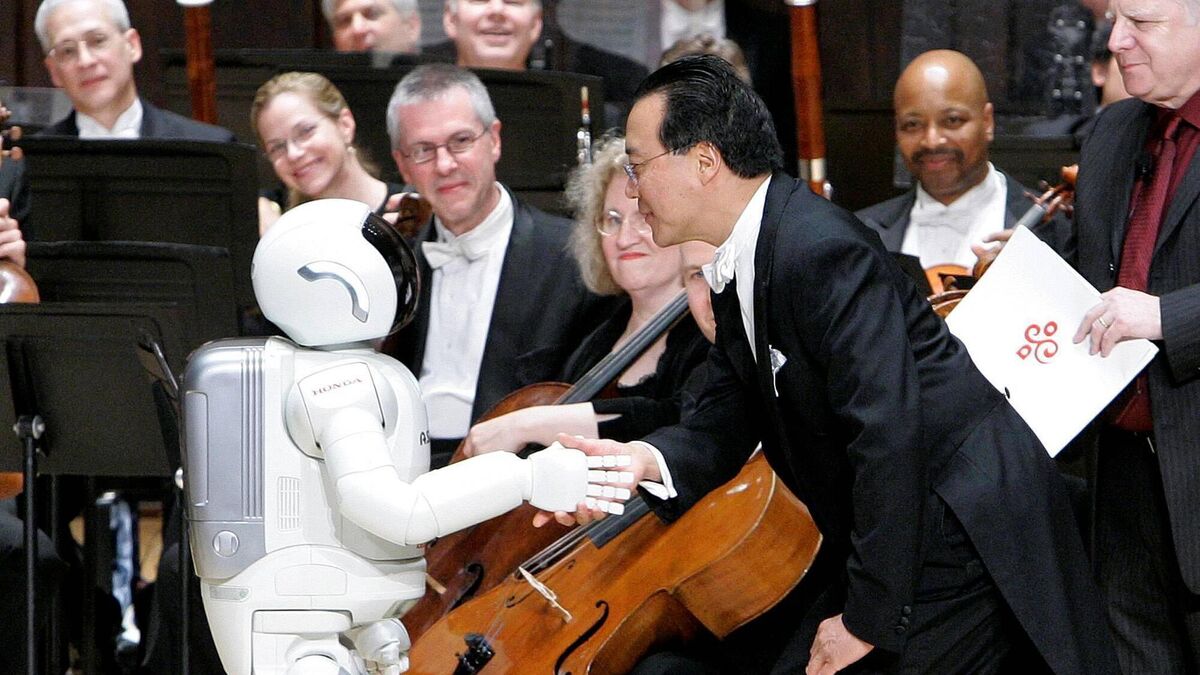
The famous Japanese robot Asimo greets the Detroit Symphony Orchestra in 2008. Kathriona Devereux met an iteration of the robot around 20 years ago, but was not overly impressed with its talents
A headless machine ran 190 milliseconds faster than Bolt. Then it crashed into a padded wall at the end of the track.
Did you see the Chinese showcase of robotic prowess? Packed arenas watched robot dancers, karate robots sparring badly, soccer players tentatively passing the ball. It was a flamboyant demonstration of China’s ambition to become world leaders at robotics. (Is there a technological field that China does not aspire to dominate?)
About 20 years ago, I travelled to Tokyo to film a science show. With LED billboards and hi-tech gadgetry at every corner, it felt like Japan was five or ten years in the future.
I had the opportunity to meet the most famous humanoid robot at the time - Asimo. All white, 4ft 3in, it was a creation of Honda and represented decades of robotics research.
Back then it was an impressive feat to just keep a robot upright on two legs. Asimo was able to take a penalty kick, and go up and down stairs. One of his modest tricks was to push a trolley and pour a drink. but he never threatened the air steward jobs market. Mainly because he cost about $10 million.
There were many iterations of Asimo, but he was formally retired in 2022. Honda said they would use aspects of his various robotic elements elsewhere.
Robotics have advanced tremendously since I met Asimo, but the mass real-world deployment of humanoid robots has yet to happen.
These robots take millions of dollars’ worth of human time and ingenuity to build and need teams of (human) engineering teams to replicate the complexity and dexterity of human motion.
The blooper fail compilation videos from the World Humanoid Games is entertaining robot slapstick - bots slipping, getting stuck in things, collapsing in an ungainly pile. Hilarious, if expensive, fails, and evidence of how far humanoid machines still have to go.
Yes, it was a remarkable technological achievement to get a machine to run super-fast, but it’s like comparing planes to birds. Both fly. Planes fly faster, but birds do it effortlessly.
Planes require whole industries of engineers and technicians to get them off the ground and to stop them from falling out of the sky.
Comparing the achievements of the robot to Usain Bolt is similarly pointless. Bolt was born fast. Once his sprinting talent was recognised in primary school, he was coached to become an eight-time Olympic gold medallist, 11-time World Champion, and world record holder in the 100 metres, 200 metres and 4 x 100 metres relay. A monumental record that made him the greatest sprinter of all time.
Robots are already part of life today, in Chinese factories more than two million robots are said to be working.
Irish company Akara Robotics has cleaning robots working in the UK’s NHS. Using UV light to decontaminate hospitals, robot hoovers take away some of the slog of house-keeping - heck, a sushi restaurant in Douglas has robot waiters.
The ultimate aim for humanoid robots is to be able to do anything a human might do. Or, more specifically, a task that a human can do but might not want to do.
Repetitive and dangerous jobs in manufacturing roles in factories, or soldiers in battlefields (although drones seem to be increasingly covering that job already) are the holy grail, but humanoid robots capable of doing multiple tasks are still decades away. (My fantasy of a robotic housekeeper cleaning the house, doing laundry, and cooking a delicious meal while I’m at work will most likely remain elusive in my lifetime)
There is, understandably, great unease that in the future human workforces will be replaced by humanoid robot workers who don’t need allotted breaks, sick leave, holiday pay, or pensions.
Instead of thinking about robots replacing human skills, could we develop humanoid robots to do the Sisyphean tasks that are laborious and never-ending? How about a graffiti removal robot? Or a 24/7 tree planting robot?
Cork’s cleaning crews do a great job cleaning up after their filthy fellow Corkonians, but there are only so many jobs they can get to on a given day. Could we have more nice things in the city if there was a Cork City Council robot removing graffiti, watering plants, planting trees, and power washing pavements?
Imagine snapping a pic of graffiti and pinning the location for a robot to come to spritz and squeegee it away? I’d be much more enthused by that than a soccer-playing robot.
Proponents of robotics see them as essential for the future - caring for elderly people, doing dangerous or dirty tasks. But at what cost? Financial, ecological, societal?
The billions spent developing these machines is money that could be used to end global poverty, halt climate change, eradicate disease. The metals, rare earth minerals and other natural resources that go into their construction carry a huge ecological footprint of their own.
So no, I’m not excited over a headless robot beating Usain Bolt’s time by milliseconds before crashing into a wall. Give me one quietly power-washing Patrick Street at 3am instead. That’s the robot future I’d actually queue up to see.






 App?
App?


