Cork Views: We need political leadership to combat racism
Hostility towards immigrants and asylum-seekers is growing, and must be challenged from the top, says Liam Quaide, a Social Democrats TD for Cork East
Cork Views: We need political leadership to combat racism

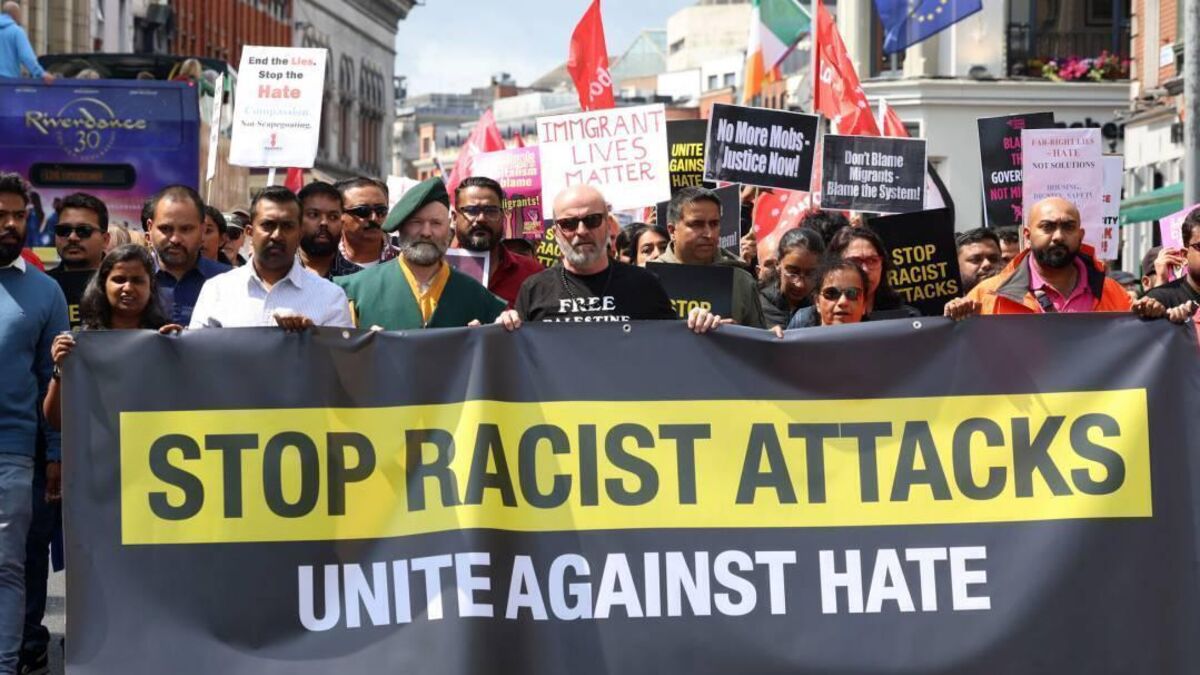
Protesters at the Dáil after an assault on an Indian national in Tallaght last year. Picture: Leah Farrell/© RollingNews.ie

In June, I posted on social media about the uncertainty hanging over more than 500 Ukrainian residents in Trabolgan in East Cork.

I wrote about families wondering where they would live when moved, and called for a clear transition plan that accounted for the vulnerability of older and disabled residents and children settled in local schools.

There followed an endless stream of vitriol underneath that social media post, and related posts directed at Ukrainians, refugees, and asylum-seekers generally. What struck me was the tone of it: the glee, the scorn, the casual cruelty towards people facing a terrible limbo.

The Ukrainian residents were not being spoken about as families, children, workers, neighbours, older people or disabled people. Instead, they were reduced to a problem to be disposed of.

It takes a lot to shock me, but I was rattled by what I witnessed - not just anonymous ‘bot’ accounts but many local people as well, whose genuine grievances about the cost-of-living are being stoked online by algorithms owned by right-wing billionaires. I am seriously concerned about where we are going as a country.

There is not as much distance as we might like to think between degrading, dehumanising comments about minority groups and those same people being physically targeted. Not every person posting an ignorant or abusive comment would commit violence. But when people are repeatedly depicted as dangerous, exploitative, or undeserving, mistreating them starts to become normalised.

As we have seen throughout history, the slide from casual callousness to dehumanisation to violence can happen frighteningly quickly. How much more dangerous could this get if we entered into an economic recession or depression?

In Carrigaline last month, Syed Haque, a father of two from Bangladesh who has lived in Cork for almost 24 years, said he was racially abused and assaulted while in a park with family and friends. He suffered a wound above his eye requiring 12 stitches. His children witnessed it. He said his attacker told him to “go home” and that Ireland was “not your country”.

There are different strands to what is happening. There is violent thuggery. There are far-right agitators deliberately cultivating fear and resentment. There is anonymous poison online. And then there is the respectable version: the ‘I’m not racist, but…’ politics, delivered by articulate people in suits, which generalises about whole nationalities, ethnicities and religions while insisting it is merely asking legitimate questions.

Mainstream politicians have a particular responsibility not to feed this. Yet too often the Government appears to be chasing the same political ground.

In February, 2023, the Government told the Dáil it was developing a whole-of-government communications strategy to provide clear facts on migration and the immigration system.

The Social Democrats have repeatedly called for a serious national public information campaign explaining why people come here, how international protection works, what people are actually entitled to, and who is responsible for failures in housing and public services.

More than three years later, the kind of sustained, visible national campaign required has never materialised. A Government webpage on the issue eventually appeared in October, 2024. That is hardly an adequate response to one of the most dangerous currents developing in Irish society.

Instead, we have seen increasingly performative politics around immigration. Deportations, where legally required, are part of any functioning rules-based immigration system. But there is a difference between enforcing the law and turning deportation into political theatre.

When charter deportations resumed, the gardaí published footage of the operation and Ministers prominently publicised the flight. Subsequent operations have been accompanied by Government announcements emphasising enforcement and tougher borders. Minister Jim O’Callaghan has made this highly visible projection of toughness a feature of his approach to immigration.

Our Government is clearly not motivated to properly challenge this misinformation. There is political capital in allowing refugees and asylum-seekers to absorb anger that should be directed towards decades of failure in housing, healthcare, and public services.

Ukrainian families did not cause the housing crisis, nor did they design the unsustainable privatised system of accommodation they have availed of. Asylum-seekers did not underfund public services. Migrants did not make childcare unaffordable.

Frustrations about the cost-of-living and poor public services are entirely legitimate. But they are increasingly being redirected towards vulnerable people who did not create these problems and do not have the power to fix them. It turns people who are struggling against others who are struggling, while those responsible for failed policy escape scrutiny.

At the same time, I have seen teachers, SNAs, community volunteers, neighbours, and ordinary households work quietly and painstakingly in East Cork to help Ukrainian and other displaced people settle here and find some stability after enormous trauma.

But that decency has to be defended by those in positions of authority. It is a responsibility of every public representative, whatever party they belong to, to show moral leadership on this issue.

We can argue robustly about immigration policy, accommodation, processing times, resources and enforcement. What we cannot do is scapegoat people on the basis of race, nationality or religion, or stand silently by while others do it because we think there might be votes in it.

Politicians can resist the politics of dehumanisation, or they can help normalise it.

If we fail to provide that leadership now, we will watch our society fall into further division, and we should not pretend afterwards that we did not see it coming.

more Politics articles

Less than a quarter of MD Chair roles went to women Less than a quarter of MD Chair roles went to women
Road Sign at the Northern Ireland border with the Irish Republic welcoming people to Northern Ireland and a reminder that speed Cork Views: Join us on a journey to bring about Irish unity
Just 3 in 10 newly-elected mayors are women Just 3 in 10 newly-elected mayors are women

More in this section

Cork Views: How online manosphere demeans men as well as women Cork Views: How online manosphere demeans men as well as women
Cork mum on a mission to make The Lough a great haven for kids Cork mum on a mission to make The Lough a great haven for kids
Garda Checkpoint Trevor Laffan: Maybe it’s time to change how we teach people to drive

Sponsored Content

Transform your career, your way: choose MTU part-time education Transform your career, your way: choose MTU part-time education
Keeping their house in order: How PSRA regulation has raised the bar for Ireland’s property services sector Keeping their house in order: How PSRA regulation has raised the bar for Ireland’s property services sector
"My master's at UL taught me that structured learning and a demanding career can coexist" "My master's at UL taught me that structured learning and a demanding career can coexist"
Contact Us Cookie Policy Privacy Policy Terms and Conditions

© Examiner Echo Group Limited

Add Echolive.ie to your home screen - easy access to Cork news, views, sport and more