Cork fab four who played in the first ever Irish World Cup game
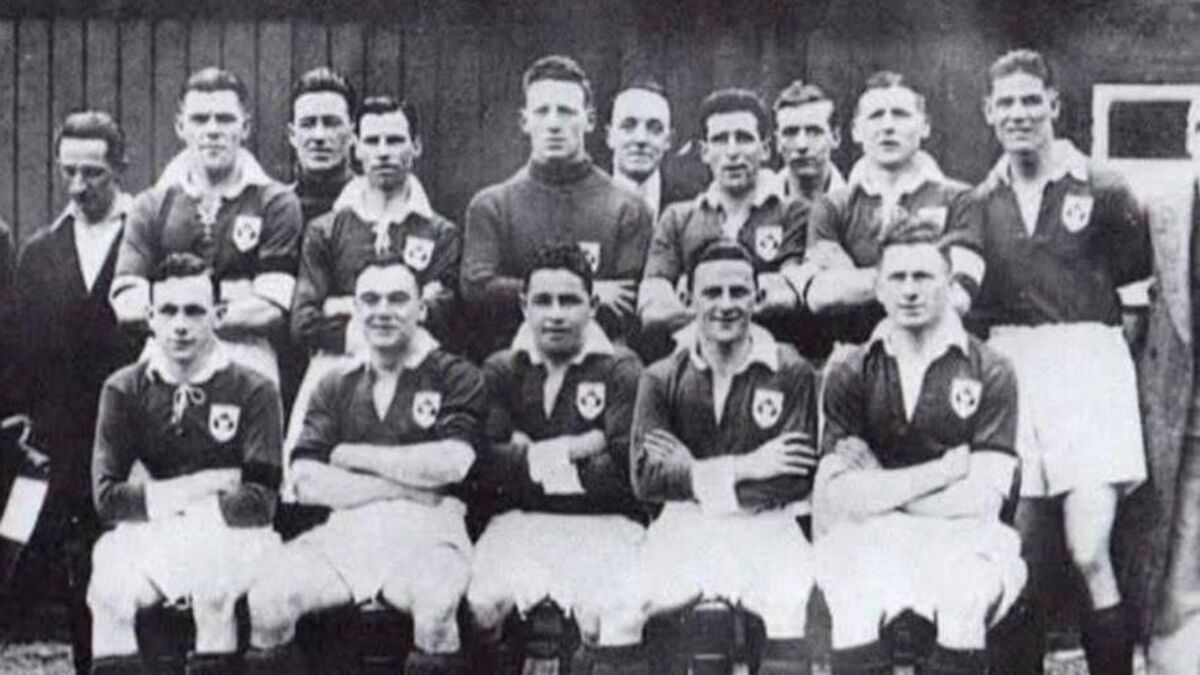
The first Irish team to play a World Cup game in 1934, which featured four Cork men - back, Miah Lynch, left, goalkeeper Jim ‘Fox’ Foley, third from left, and Tom Burke, fourth from left, and, front, Timothy Joe O’Keeffe, second from right
The boys in green have qualified three times in the event’s 96-year history - a golden 12-year spell between 1990 and 2002. There will be a record 48 teams taking part in the USA, Canada, and Mexico - but, sadly, Ireland failed to qualify.
Bud did you know that the first ever World Cup game played by an Irish team took place 92 years ago? And that FOUR of that team were from Cork, a record number for the Rebel County that has never been beaten in an Irish XI since?
After declining to participate in the first World Cup, in Uruguay in 1930, when a qualification process was introduced for the next one, in Italy in 1934 - the Irish Free State team threw its hat in the ring.
This country’s first ever World Cup game was thus a qualifier that took place against Belgium at Dalymount Park, Dublin, on February 24, 1934 - a thrilling 4-4 draw in front of 30,000 fans.
The quartet from Cork who played in that match were goalkeeper Jim ‘Fox’ Foley, full-backs Tom Burke and Miah Lynch, and forward Timothy Joe O’Keeffe.
Goalkeeper Foley - known as ‘Fox’ owing to his red hair - was probably the best known of the quartet, and has been hailed as the finest Cork goalkeeper of the 20th century.
Born in Cork in 1914, he starred for both Cork City and Cork United in an illustrious career which included stints at Celtic and Plymouth Argyle.
Foley won an U14 hurling medal with Geraldines in 1920, and later a minor championship with them.
He grew interested in soccer and his performances in the MSL attracted the attention of the big teams.
One of the six games he played for Celtic was against Hearts when the crowd hurled sectarian abuse at him.
After being called a Fenian and Papist by one spectator as he retrieved a ball, Foley kicked it in the face of his abuser and tried to run into the crowd to confront him, having to be pulled back by his team-mates. An angry mob raced onto the pitch to attack Foley and a spectator head-butted him before the police forced them back.
Foley was subsequently charged with assaulting the spectator and fined £2. A Scottish protestant minister paid it for him in a gesture of reconciliation.
Fox had seen it all before. While playing for Belfast Celtic in 1933, he had been the target of hostile threats from Linfield fans behind his goal, and the police had baton charged the crowd!
Unusually, Foley was one of three Cork keepers who kept goal for Ireland across 11 matches in a four-year spell in the early 1930s - the others being Mick McCarthy, of Blackrock, and Billy Harrington, of Cobh.
Foley sadly died in October, 1952, aged just 38, while living in Belmont Park, Ballinlough, leaving behind a widow and two sons. An Evening Echo tribute said: “His whole greatness on the soccer field no-one dared question.”
For right full-back Miah Lynch, that 1934 World Cup game was his sole cap for his country.
Born in Cork in 1907, he was a fine hurler in his early years, winning a juvenile championship medal with Geraldines, and following that up a year later with minor and junior football medals.
On the soccer front, he togged out for the short-lived Cork Bohemians in the 1930s - coached by Billy Lucey, who would go on to coach that Irish Free State team in 1934.
Lynch was said to have been good enough to play for Cork senior hurlers if he had stayed in the sport.
He did continue playing under an assumed name for Geraldines, but was found out and barred from the sport by the GAA.
Lynch worked in Hassett’s Garage on Cove Street and later for Ford on the Marina. He died in Glanmire aged 80 in August, 1987.
Forward Tim O’Keeffe was born in Cork in 1910 and began his soccer career with Cork FC in 1930. He went on to play for six more clubs, most famously at Waterford United, helping them to win the FAI Cup in 1937, where he scored in every round, including the winner in the final.
O’Keeffe concluded his playing career with Cork United in 1943, and sadly died that year, of cancer, in the Bon Secours Hospital, aged just 33.
In the 1934 World Cup match, he was selected at inside left, after he had played in that position for the first time a week beforehand in an FAI Cup game against Dundalk.
O’Keeffe was said to have size four feet, but could crack the ball with venom!
The final member of the Cork quartet was Tom Burke, a full-back from Cobh, for whom that game in 1934 was his sole cap.
Born on St Patrick’s Day, 1908, he played for Cobh Wanderers and later transferred to Cork FC with whom he won the 1934 FAI Cup - then known as the Free State Cup.
Remarkably, Dubliner Paddy Moore, who scored all Ireland’s four goals against Belgium that day in 1934, had played for Aberdeen the day before in Glasgow, and boarded an overnight boat to his native city for the World Cup qualifier.
Sadly, it was an all too familiar tale of World Cup woe for that Irish Free State team in 1934. They lost away to Belgium 5-2, and also lost to Hungary at home and Switzerland away in the qualifying phase, and failed to make the finals; a familiar tale of woe.



 App?
App?


