Concern at slow progress of Midleton flood scheme as new data shows reduction in spending on plan
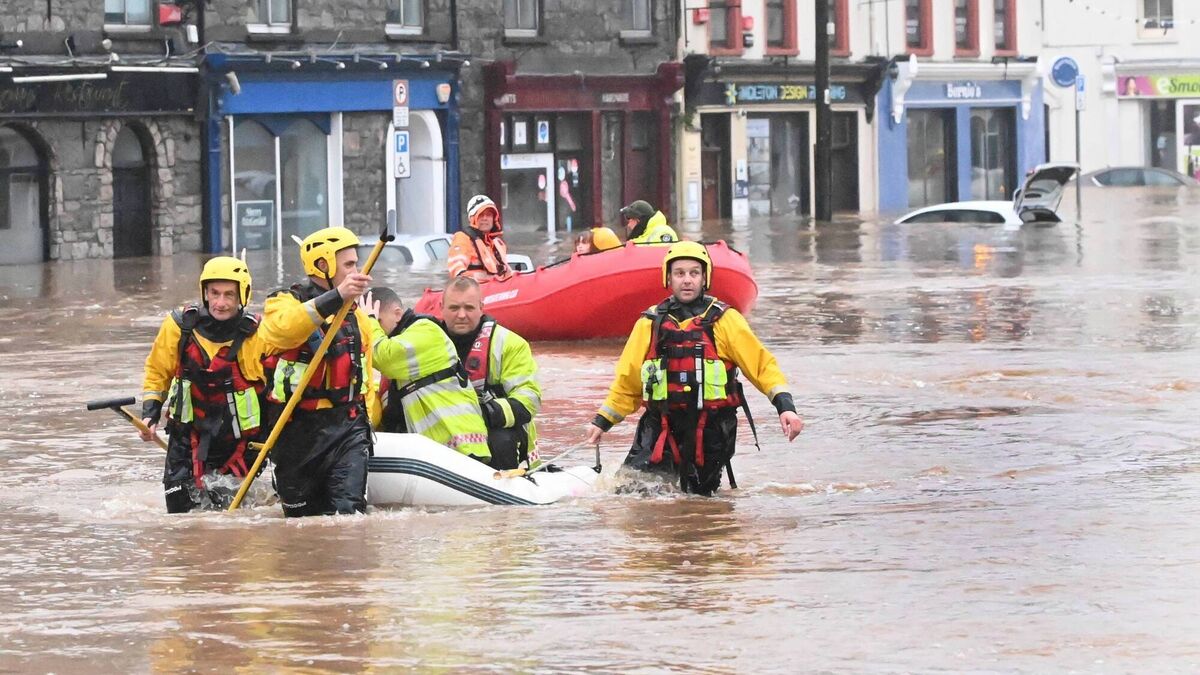
Midleton residents have expressed concern at the slow progress in the town’s much-needed flood scheme, as new data has shown a reduction in the money being spent on the plan. Pictured is the flooding on Main St in October 2023. Picture: Eddie O'Hare
Midleton residents have expressed concern at the slow progress in the town’s much-needed flood scheme, as new data has shown a reduction in the money being spent on the plan.
A local TD has also noted that nearly three years after the destructive Storm Babet, East Cork’s residents are still living with no commencement date for their schemes.
A total of €60m has been spent on overall Cork flood schemes in the last two-and-a-half years, but government data shows that investment in these schemes is likely to drop this year.
Data provided to Fianna Fáil TD for Cork North Central Pádraig O’Sullivan shows that the government spent €25.6m on Cork flood schemes in 2024 and €26.4m in 2025, but just €8.3m in 2026, up to July 2.
The spend this year so far represents a decrease of around 36% compared to an average six-month period in the two years previous.
Big schemes where work is still ongoing, but there has been a reduction in spend, include the Midleton Flood Relief Scheme, which is at stage two of planning.
A total of €4.1m was spent last year, but in 2026 to date, expenditure has dropped to €1.1m.
Caroline Leahy, of the Midleton and East Cork Flood Protection Group, said that they have been told by the government and council that the works will be complete in 2031 or 2032.
“But I think those timelines are both very ambitious based on how slow work has been,” she said.
“We’re being told money is not an issue, but there is a lot of red tape.”
Residents of surrounding areas like Castlemartyr, Mogeely, Rathcormac, Killeagh and Whitegate have been told that they are in tranche two, and that their scheme will not even begin until the main Midleton scheme is complete, due to insufficient engineers to run both concurrently, she said.
“Even when it’s sunny, flooding is always a concern – with all the extreme weather, will there be a knock-on effect in the winter?
“I’m pregnant with my first child at the moment, due in October. Initially when you get that news you’re delighted, then comes the thoughts of what if it floods when I’m heavily pregnant or with a newborn.
“The 2023 flood was so severe that in the middle of the clean-up in the aftermath we said at least they can’t let this happen again, they’re going to throw everything at it to fix it.
“We’re still in the same boat – nothing on the ground has changed to make us even safer.”
Planning yet to be submitted
Social Democrat TD Liam Quaide said that though spending can vary considerably depending on the stage a project has reached, “the figures do underline the much larger problem of how slowly flood protection is being delivered.
The Midleton scheme was previously due to be submitted for planning early this year but it hasn’t happened yet, he said.
“Whether expenditure is down because schemes have been completed, are stalled in planning, or have not begun at all, the real test is the protection being delivered to people’s homes.
“Nearly three years after Storm Babet, residents across East Cork are still living with no commencement date for their schemes. That is indefensible,” he said.
Government data shows that flood schemes for Bantry and Ballyvourney, both still at stage one, dropped from €895m and €118m expenditure last year to €226m and €49m this year.
Similar patterns were observed in the case of two stage four schemes in Morrison’s Island – where spend went from €7.2m in 2025 to €2.4m in 2026 to date and Glashaboy in Glanmire, which dropped from €9.4m in 2025 to €2.2m in 2026.
A contributor to the reduction in spend is that several schemes were completed this year, Bandon, Clonakilty, Douglas, Fermoy, Mallow and Skibbereen.
However, they are largely smaller schemes, covering just 14% of total expenditure cumulatively.
Spend is set to increase this year compared to the previous year in just three schemes – the Lower Lee and Ballinhassig, both at stage two, and Blackpool (Bride River) which was approved by government recently.
Mr O’Sullivan said: “Some of the projects are coming to a natural conclusion which has led to a decrease in expenditure in some areas, but we can’t afford long-awaited schemes to be stuck in a logjam.”

App?