John Dolan: My family Census riddle... Who the heck is James Mulligan?!
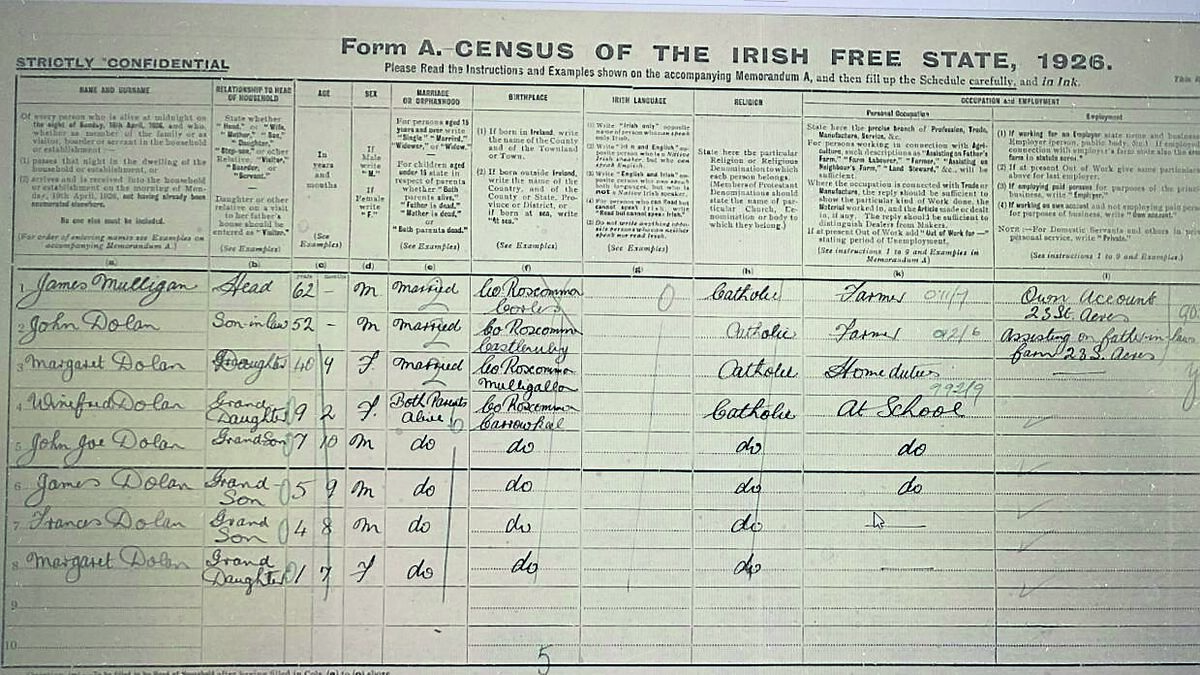
Because - and I hope this excites you as much as it excites me - I’ve just discovered that there’s a chance we are related.
Before I go on to enquire about your wealth, property holdings, and various last wills and testaments in your family over the last century, I had better explain myself, dearest cousin.
My connection to the Mulligans was only revealed to me when the 1926 Census was made public last week - and it came as a big shock, I can tell you!
I have done a lot of research into my family tree down the years, and my Irish lineage goes back to Mayo, via my granny, and Roscommon, via my grandfather.
Before I logged into the newly-released Census, I did a quick refresher because all those seeds, breeds, and generations - as my esteemed Echo colleague John Arnold calls them - can get mighty confusing very quickly.
Suitably armed, I headed to the Roscommon section of the Census, and quickly tracked down the Dolans in my family line.
There was my grandfather, aged seven, when he was known as John Joe, and there were his two sisters and two brothers.
Their mother, Margaret, was pregnant with a sixth child at the time - pfff, amateurs! - and married to my great grandfather, also John. (We do like the name John, us Dolans).
So, far, so predictable.
Reader, I was shocked.
Because Margaret’s maiden name wasn’t Mulligan, according to all my sources, it was Beirne.
Her parents were both called Beirne, and when she and John got married on April 30, 1916 - the day after the Easter Rising ended, remarkably - her father was down as Michael Beirne.
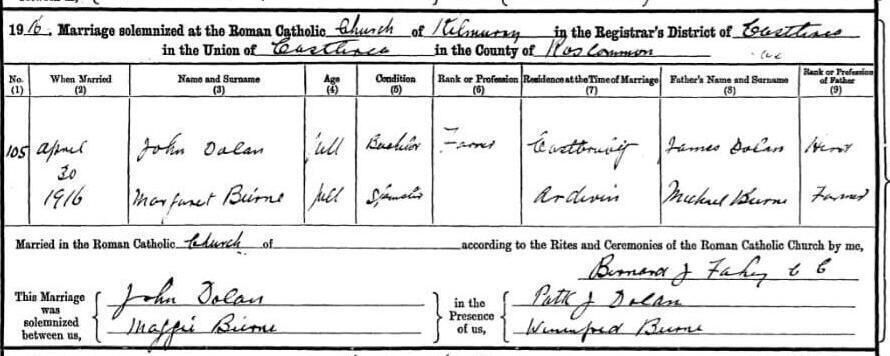
So, 10 years and almost six children later, who on earth was this James Mulligan? And where was Michael Beirne?
To add to the mystery, Michael Beirne does not appear in either the 1901 or 1911 Census, alongside his wife and family.
While I still know some relatives of my grandmother in Mayo - she lived to the ripe old age of 98 after all - there aren’t many older family members on my Dolan side known to me.
When I asked my two aunties, in England and in Roscommon, they could shed no light on this James Mulligan, merely insisting that their gran’s maiden name was Beirne.
My English auntie pointed out: “The records kept in those days were never the best.”
I can understand being wary of providing accurate details in the older Census records, in 1901 and 1911, when Irish people were suspicious of British officialdom, and perhaps had one eye on claiming their old age pension a few years early.
But this was 1926, when the Irish Free State had been established.
And, let’s face it, yes, mistakes can happen - but putting your name down in a Census as the father of a woman who is not your own is not a common or garden blunder.
My mind has been racing at the repercussions of this anomaly.
Who was Michael Beirne?
Who was James Mulligan?
And which of them was the father of my great grandma, Margaret?
Is Michael my great great grandfather, or is James? Am I a Beirne or a Mulligan?
It could be that a long-forgotten family scandal is at the root of this - because nobody can have two biological fathers - but these people tended to be humble, pious, and respectable grafters and you’d hate to jump to conclusions on that front.
So perhaps one of the men was a stepfather, who came to look upon Margaret as his own kin to the extent he put that down in the Census.
Another theory: Maybe Michael Beirne died, and his wife re-married James Mulligan. But if so, why isn’t she living in the same household as him and her daughter in 1926? Did she die too? There were wars, strife, and an epidemic in the years before the Census after all.
My grandad John Joe’s uncle was among those who lost their lives, being beaten to death by a rogue group of Black and Tans in Roscommon in what the local press said at the time was a hideous case of mistaken identity just as the truce was announced.
After this latest bombshell, I am going to have to root around the records again to see if I can solve this new family mystery of who on earth James Mulligan was.
He was definitely of reasonably well-off stock, as the 1926 Census stated he was farming his own land of 23 statute acres, and his ‘son-in-law’ was helping him farm it.
If only we could travel back in time to find out the truth.
If you have been engaged by the release of the 1926 Census online, a new book will help explain a lot of the background to it.
The Story Of Us: Independent Ireland And The 1926 Census, edited by Orlaith McBride, Director of the National Archives, and John Gibney, offers a valuable insight into the lives of the Irish people at the time.
One chapter, by Cormac Ó Gráda, examines the Muskerry Gaeltacht in 1926, and another provides a remarkable insight into life for the inhabitants of Cork city at the time.
That chapter focuses on the residents of long-gone Featherbed Lane - an entrance to it from Barrack Street still survives.
Here, there were 21 houses in April, 1926, with 47 rooms - occupied by 99 souls, 34 of whom were children aged under 14.
Without wishing to underplay the current housing crisis, those numbers really hit home how tough life was for our ancestors present at the birth of the State.






 App?
App?


