I’ll fly flag for an Ireland of the welcomes this St Patrick’s Day
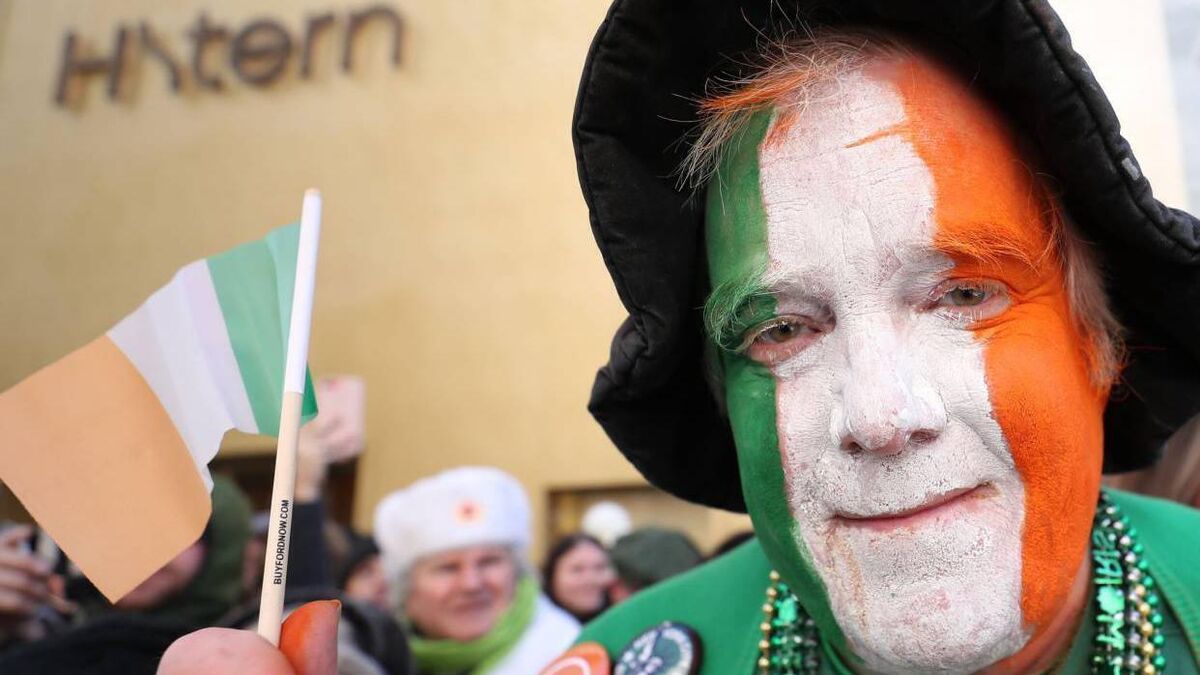
I hope you are reading an páipéar whilst wearing an Aran geansaí, drinking a cupán tae, and eating arán sóda.
Tis the lá to be bedecked in glas, celebrate all things Irish, and sprinkle the cúpla focal throughout your sentences.
Actually, ag cleachtadh / practising Irish is no longer a one day, one week or one month affair. Using Irish throughout the year has become a daily practice throughout the bliain for so many.
Sadly, I still haven’t quite mastered assembling coherent abairtí on my Irish language turas. But my vocabulary of random words and expressions is going from neart go neart / strength to strength. Even if the average Gaeilgeóir is mostly wincing at my mash-up of the two teangacha.
During Seachtain na Gaeilge, I was listening to Doireann Ní Ghlacáin - fiddler, sean-nós singer and host of the How to Gael podcast - chatting with Oliver Callan on the radio about the renewed love for Irish. As I sipped my coffee on Grand Parade, a double-decker bus emblazoned with a tricolour and the slogan ‘Bratach do Chách’ pulled up in front of me.
‘A Flag for All of Us’, eh? The use of the tricolour has become so fraught, given its recent hijacking by far-right and anti-immigration activists, that for a moment I wondered if this was a well-funded anti-immigration campaign or a genuine celebration of the national flag for everyone. ‘Faigh tuilleadh eolais ag tfmfoundation.ie’, the ad said. So I did.
The awareness campaign is led by the Thomas F. Meagher Foundation, a non-profit group that works to promote the original meaning of the Irish tricolour as a symbol of peace and reconciliation.
The organisation is named after Thomas Francis Meagher, the Waterford-born Young Ireland leader who first raised the tricolour in 1848. Meagher once said: “The white in the centre signifies a lasting truce between Orange and Green and I trust that beneath its folds the hands of Irish Protestants and Irish Catholics may be clasped in generous and heroic brotherhood.”
Under the slogan ‘The Flag of All of Us’, the foundation aims to keep that original message alive and relevant in modern Ireland. At a time when the tricolour is increasingly being co-opted by anti-immigration protesters, its original meaning as a symbol of people from different traditions living together in peace needs to be proclaimed loudly and clearly.
Recently, electricity poles and lamp-posts around some parts of Cork city have been festooned with tricolours.
How I wish these flags signified a celebration of our country which has endured oppression, famine, violence, and mass migration yet managed to forge a future where the majority, and sadly not everyone, live in relative comfort.
Instead, anti-immigration campaigners are flying flags across the country claiming they represent patriotism and pride, but with the subtext of ‘Ireland is for the Irish’.
Anti-racist campaigners say erecting tricolours on lamp-posts disrespects the flag and sends a message to immigrants that they are not welcome. These activists, as well as city councils around the country, have been removing flags attached without permission to public infrastructure.
The whole thing is a complete waste of time and achieves nothing.
Anti-immigration protestors’ arguments range from too much money being spent taking care of international protection applicants while Irish-born people face homelessness, to much darker racist messages.
The claim that Ireland shouldn’t house people seeking protection while Irish people are homeless might sound persuasive, but the housing crisis didn’t begin with asylum-seekers. It has been building since the financial crash, driven by years of under-building and policy failures that left supply lagging far behind demand.
Pitting vulnerable people against each other doesn’t build a single home.
That some people spend their time erecting tricolour flags when they could be doing something practical to help alleviate Ireland’s social problems is difficult to understand.
Rather than climbing ladders with handfuls of cable ties in the middle of the night, a far better use of that energy would be volunteering with organisations working on the frontlines of Ireland’s housing crisis.
Groups such as St Vincent de Paul, the Simon Communities, and Focus Ireland are constantly looking for volunteers - whether that’s cooking meals, helping with outreach, fundraising, or supporting families in crisis.
These volunteers don’t just talk about loving Ireland - they spend their time trying to improve it.
At a time when the global order feels increasingly fragile, there will only be more people fleeing war, climate disaster, and economic collapse. Ireland, a nation shaped by its own long history of famine, displacement and emigration, should understand that better than most.
Today, the St Patrick’s Day parade will pass down Pana, filled with children and adults from every corner of the city - and from many corners of the world - showcasing their talents and cultures and celebrating Ireland.
Just as in nature, diversity brings strength and resilience. Cork is a richer and more vibrant city because of the many cultures that now call it home.
I’ll be clapping and cheering, saying céad míle fáilte to everyone - because warmly welcoming people to our home is what Irish people do.






 App?
App?


