A cultural initiative that was a hit with Cork pupils
Gaeilge, global justice, and fostering hope for the future all form part of the Our World Awards, says Serena Ní Chorcoráin, a teacher at Gaelscoil Mhichíl Uí Choileáin in Clonakilty, who took part in the scheme
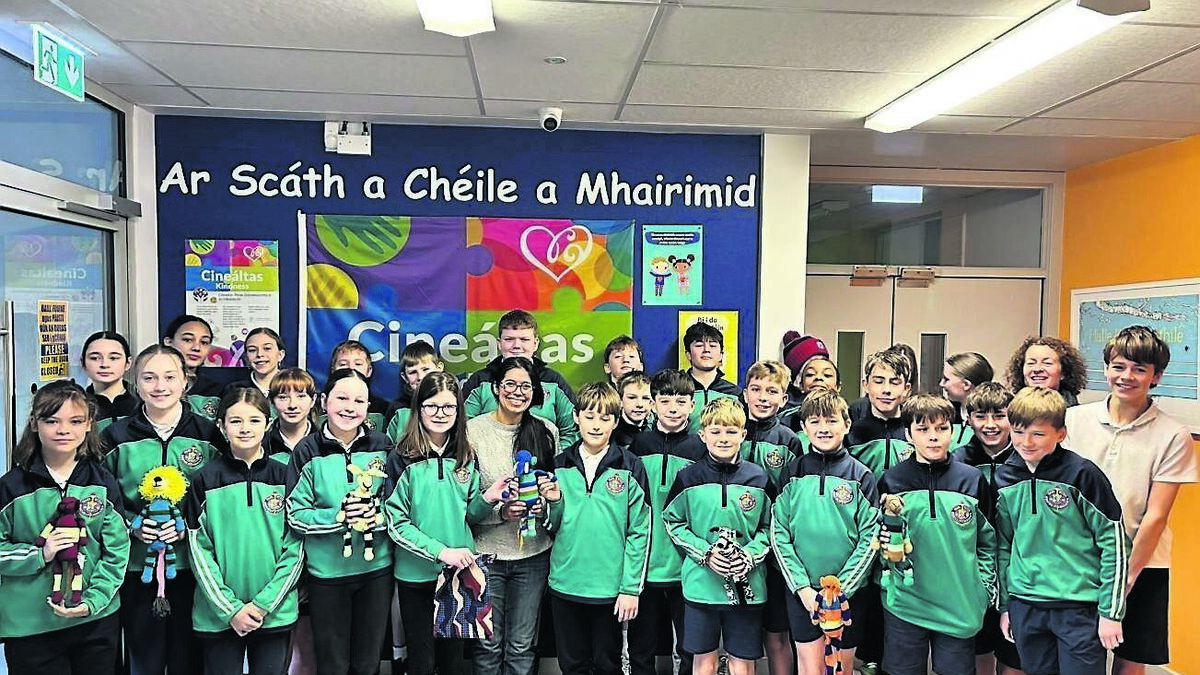
Fifth class at Gaelscoil Mhichíl Uí Choileáin, with activist Paula Ferro in January, as part of the Our World Awards scheme
Last year, I introduced my Rang 5 class at Gaelscoil Mhichíl Uí Choileáin to the Our World Awards.
This is a national programme that helps children learn about life in other parts of the world.
Through stories, videos, an interactive magazine and creative projects, my pupils connected with communities in countries like Mozambique.
Through it, we discovered how much we can learn from each other - and I learned just as much as they did.
The programme encourages children to explore global issues and think creatively about solutions. For our class, it also became an opportunity to bring Irish language learning into discussions about the wider world.
Together, we looked at how people in Mozambique are protecting endangered animals through a colourful crochet project, and we explored the challenges of living off the land for these communities, imagining how they meet their daily needs in very different circumstances.
The children naturally gravitated towards creative responses. They wrote letters reflecting on the stories from Mozambique, built clay villages representing life there, and ultimately collaborated to write a bilingual rap, Spriocanna domhanda! These Are The global goals!, celebrating the United Nations’ Sustainable Development Goals.
Seeing them connect so personally with these global stories through writing, art, and music was a joy, and I could see their curiosity and empathy grow with each activity.
Creativity played a huge role in how the children expressed what they had learned. From weaving stories into their rap to decorating their clay villages, carefully considering the homes, surroundings and daily life of the Yao people, they brought a local perspective to global issues.
It was wonderful to see them take pride in their own culture while learning to appreciate and respect cultures from around the world.
One of the most memorable moments for me was reading the children’s letters and reflections. Many spoke of the challenges they take for granted, like access to food or clean water, and spoke about wanting to help in any way they could.
Seeing them think so deeply about fairness and kindness reminded me of why it is so important to bring global stories into the classroom.
When the Our World Awards team visited our school to record a promotional video, the children were thrilled to share their learning on camera.
The excitement continued when our project was shortlisted for the National Finals in Dublin Castle. The anticipation of performing their rap on stage brought months of classroom work to life.
Some children even incorporated traditional Irish instruments, linking local culture with the global stories they had learned.
Winning an Iontráil Ghaeilge is Fearr (the best Irish language entry) was a proud moment for the class. Yet what struck me most was seeing the range of creative projects from schools across the country.
Each project reflected different ways in which children had connected with the lives of others and their own communities, proving that the programme nurtures knowledge but also empathy and imagination.
Even weeks after completing our project, the lessons stayed with the children. Conversations about sustainability, animal welfare, and food security continue to pop up in class discussions, showing that programmes like this inspire thought and often action that sticks beyond the classes themselves.
The learning didn’t stop in Dublin. Earlier this year, Paula Ferro from the Yao Crochet Project in Mozambique visited our school.
She shared how her work teaching people to crochet animals helps protect wildlife while supporting local communities.
The children were full of questions, fascinated by the real-life connections between their projects and the people they had learned about.
That visit cemented the lessons of global citizenship in a way that no classroom resource could achieve alone.
I would wholeheartedly encourage other classrooms, particularly Gaelscoileanna in Cork, to take part in the Our World Awards.
In a world that can sometimes feel divided, helping children understand life beyond their own communities fosters empathy, curiosity and respect.
By connecting their own experiences with those of children elsewhere, pupils gain a sense of their place in the wider world.
As I witnessed in my Rang 5 class, they learn that even small actions can make a big difference.


 App?
App?


