I love preserving and cherishing facts, tales, family trees and lore
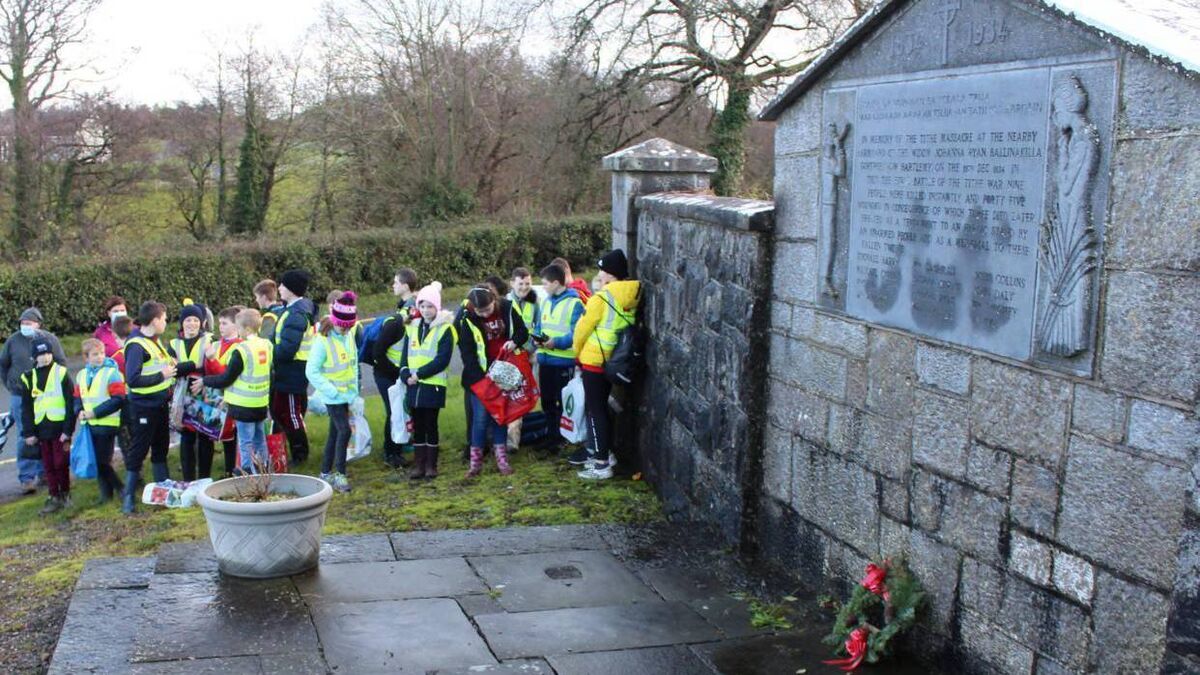
Local national school children at the Gortroe Tithe Massacre Monument in 2021.
Though we’re a small country here in Ireland, we have fierce diversity when it come to our traditions.
Some traits are explainable. The Willie Week is just over in Milltown Malbay in Clare, where thousands flock annually to the Summer School in memory of the great Willie Clancy.
He died 50 years ago so anyone under three score of years could have no memory of the master Clare piper, yet his name and his music live on in Clare and all over the country.
That’s tradition for ye - not something really ancient that has come through the Celtic mists of bygone days.
No doubt of course but our ancestors, whether they were Celts or Picts or Milesians or even, the Lord between us and all harm, Danes or Normans - even those peoples of fado, fado probably knocked tunes from drums, flutes and pipes.
So Willie Clancy lived in an area steeped in musical heritage. After being domiciled in England where there was a vibrant Irish music scene in the 1950s, he came home to his own place and his own people.
Kilkenny might win the All-Ireland this year, like they’ve done so often. Hurling was banned by the English Government under the Statutes of Kilkenny in 1366, but like the Catholic religion under the later Penal Laws, the best way it seems to encourage something was to declare it illegal!
Kilkenny is small county but why is the hurling ethos so strong there? Laois, Carlow and Wicklow aren’t far away yet these are in the ha’penny place in terms of hurling glory. Why is that the case? Why is Gaelic Football only a poor second in the Glens of Antrim and in North Kerry?
Eminent sports historians like Paul Rouse are not certain why hurling is still a ‘minority sport’ in so many places though it’s our national game.
Maybe, so but every single little aspect of tradition fascinates me, especially the way things were ‘handed down’ from one generation to the next. That oral tradition may be in danger in this social media age where people have so many time-saving gadgets, yet no-one has much time to talk!
Luckily, down the years a rich bounty of material has been harvested and can be tapped into by the generations to come - if they want to.
It’s all of 48 years since I took a borrowed tape recorder to the home of Johnny and Jerry Roche at Ballyda. That January night in 1975 I walked over and back the two miles and a bit to Roches. My intention was to just ask a few questions about the building of the ‘New School’ in the parish in 1904.
Jerry was born in 1886 -just 40 years after the Famine – he recalled hearing about people ‘ating stirabout made from yalla meal’. Johnny was 13 years younger than Jerry.
When their father died, their mother Mary ran a little shop in their two-roomed house selling ‘tay, sugar, tabaccy, fags, flour, Simcox’s bread and eggs’ - the Roches used go out the country in a covered car selling their groceries and often using a ‘barter account’ when swapping ‘shop goods’ for eggs and farmers butter.
The brothers spoke of famine and horse fairs, faction fighting, selling lambs, porter tents and hurling. Johnny, with his foot tapping on the flagstone floor, played some rousing tunes. Imagine my great-grandfather Daniel Arnold died in 1915 and Johnny and Jerry knew him well!
I was at a funeral in Lisgoold this day last week. Johnny Fitzgerald, of Garrycaheragh in Ballynoe, died the previous Monday and made his final journey in this life to the cemetery in Lisgoold where his family have been interred for generations.
Johnny was a proud Ballynoe man, a dyed in the wool St Catherine’s GAA player and supporter, though his roots are deep in Bartlemy soil.
Back in 1834, when the widow Johannah Ryan took a brave stand against the tyranny of an unjust and unreasonable Tithe Taxation system, she organised her neighbours and friends to offer passive resistance. All during the week leading up to December 18, the Tithe Collectors, led by Parson William Ryder, had gone to different local farms demanding their Tithes. Where farmers refused to pay stacks of corn or hay or sheep and cattle were seized.
On the evening of Thursday, December 17, a probably pre-arranged signal was sent out to rally help at the widow Ryan’s farm the following morning. It is possible bonfires were lit. We know the real signal was given by means of the repeated blowing of a hunting horn from all the highest points in and around Bartlemy.
The story handed down in this area, from father to son and so on, was that it was a young Fitzgerald boy from the townland of Fort Richard who blew that hunting horn.
In true spirit of co-operation, the country people gathered at Bartlemy Cross and at widow Ryan’s farm in Ballinakilla on the morning of Friday, December 18. It is estimated that around 300 came in answer to young Fitzgerald’s call.
It was a sad and bloody day, with unarmed locals and from neighbouring parishes being fired on by the large military force.
In the 1970s, I got to know Billy Barry - son of Patsy Barry NT, who was a Civil Servant in Dublin. He helped me hugely with historical research on our family, the GAA club and every aspect of local history - he valued tradition.
He recalled that, a century after the massacres, in 1934, there was talk about erecting a monument to mark the centenary. Ireland was still troubled with a bitter Economic War going on so nothing ever came of the plans. Thankfully, 50 years later a fitting monument was erected.
The role of the young Fitzgerald boy is forever etched in stone on that monument unveiled in 1984. He is depicted on the left hand panel with the hunting horn.
On his last journey from Ballynoe last week, Johnny Fitzgerald passed Fort Richard, where his father Patrick was born in 1906. His grandfather was John, born around 1860, and more than likely it was his father or uncle who blew that hunting horn back in 1834. After passing Fort Richard, the funeral cortege came on to Bluebell Cross where the Gortroe Tithe Massacre Monument stands. As the hearse passed the Monument, young Fitzgerald, who acted so bravely 189 years ago, saw his cousin Johnny en route to join so many of his kith and kin in Lisgoold cemetery. That’s tradition, going back nearly two centuries but still part of what we are today.
After the burial, I prayed at different graves of my own relatives. Right up at the back I paused at the burial place of the Murphys and Riordans of Killamurren. It was exactly 103 years to the very day since Paddy Murphy was born. In the last years of his life he gave me so much information on our past and traditions. I value those 50 pages of facts and tales and family trees and lore more than anything.
Like I said, it’s hard to define tradition, but we can only try and preserve and cherish every aspect of it.




 App?
App?


