Clock timers for showers! Another sign of how we’re now obsessed by the energy we use
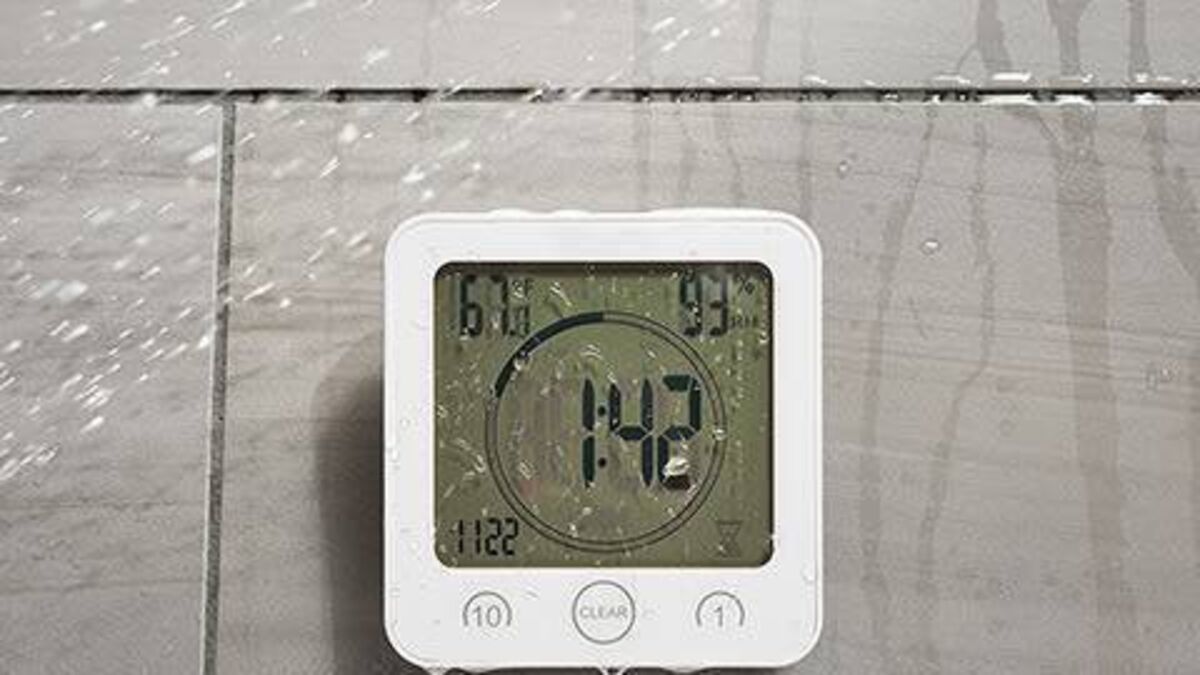
GADGET WHOSE TIME HAS COME! Shower clocks like this, with timers and alarms, are becoming popular in the face of energy price rises - powered by radio waves, they’re even selling them in the middle aisle of Aldi, says John Dolan.
BROWSING the middle aisle of Aldi this week, as you do, I spotted an item that reminded me of Victor Hugo’s famous quote: “Nothing is more powerful than an idea whose time has come.”
The object in question was an innocuous-looking clock - except it was much more than that, and spoke volumes about where we are as a nation in 2022.
It was a shower clock, with a timer and an alarm built in - and, yes, you guessed it, the idea is that people in a household can restrict their use of one of the dearest forms of energy in a fair and equitable way.
Or, in our case - yes, we did buy one! - restrict the usage of a recalcitrant teenage boy.
Word is, these gadgets, powered by radio waves no less, are selling like hot cakes, as we head into a winter of sky-high energy bills and possible power cuts.
There is just no escaping the onset of winter this year.
Have you put your heat on yet? The first time you crank up the boiler is often a talking point at this time of year. Just like we obsess about the grand stretch in the evenings in spring, we cast a cold eye on the shrinking days as autumn descends, and prepare to flick that switch.
That day will have special significance this year. Many of us will feel ike Ebenezer Scrooge-style misers as we fret about when to put on the heat, and for how long. The soundtrack in many houses will be reminiscent of that Cork indie classic - where’s me jumper?!
I’ve found in recent years that it remains mild up to Christmas, and even beyond. The coldest months now tend to be January up to March, and even April can be chillier than December.
Think about it: Would you rather be without a gansy when you’re Christmas shopping, or at the St Patrick’s Day parade?! Brrr!
We are all doing our bit to prepare. Aside from the shower clock, I have chopped up a load of logs for the fire, and squirrelled some away in case of a lengthy power cut, and will keep an eye on my kerosene level and aim to top it up as late as possible, in the hope the full tank costing perhaps €1,400 lasts the rest of winter.
We have already switched off our second freezer, and will try to make it through winter with the fridge compartment only.
We have placed a timer-controlled lamp in the hall, which will cut down on the glare and expense of three other bulbs, and I’m also starting to eye the tropical aquarium in a manner that is making the fish nervous!
Yes, every drop of oil, every puff of gas, will be savoured for the next six months, and every little saving will make a big difference when those dreaded bills drop.
The €600 bail-out per household pledged in the Budget will help, but will not come close to covering all the extra expense.
Have the Government done all they can to insulate us from the chill of high bills? Not quite. There is one more thing they can do that would make a huge difference in the months ahead. It’s quite straightforward too, and ironically relates to clocks: Don’t put them back in three weeks’ time.
Yes, something as simple as not tampering with clocks, watches, car dashboards, and cookers that Saturday night and Sunday morning of the Jazz Weekend will really make a difference.
In fact, one expert reckons it could save us €467 over the course of a year in energy bills. Wow.
That’s because forgoing the annual shift to what is called Daylight Saving Time will mean the brighter evenings will last longer, and reduce demand around the crucial peak time of 5pm when the grid is under most pressure.
Aoife Foley, Professor in Mechanical and Aerospace Engineering at Queen’s University Belfast, has estimated we would save €1.28 a day. That’s €467 annually, but for larger families like mine, the saving could be several hundred euro. It’s a no-brainer.
The flip side? Well, you won’t be getting the benefit of the extra hour in bed, which often comes in handy on the Jazz Weekend! Then again, any parent will tell you there’s no such thing as the extra hour once smallies come along.
It will mean darker mornings too, but what harm? The argument used to be that it was safer for children to walk to school in daylight, but most of them are cooped up in SUVs these days anyhow.
There is also the argument that we would be out of sync with both the UK - including the North - and the rest of Europe for at least six months, assuming they went ahead with changing their clocks.
OK, that could be a pain for those doing business with them, while we would need to be wary of things like UK soccer match kick-offs and UK TV schedules. But I don’t see that as a deal-breaker.
The habit of ‘spring forward, fall back’ twice a year is probably on the way out anyway, this is only speeding up the process.
In, 2019, the European Parliament voted in favour of removing Daylight Saving Time permanently from 2021. It followed an EU-wide survey in which the vast majority of respondents indicated they would prefer to scrap the process.
The last clock change was due to take place in Spring, 2021, but the proposal took a back seat as the world coped with Covid-19.
Looking back, it was the perfect time to make the switch really, when most of us were working from home and isolating.
However, the effects of the pandemic, with many working from home at least part of the week now, mean fewer of us than ever are working and living to the clock these days.
Remember when folk used to be fed and sat on the sofa by 7pm in time to watch the soaps, or when the country had all the washing-up done by 9.35pm to see the Late Late Show?
That era is gone, with pause TV and recording and the onset of streaming, when you can watch what you like, when you like.
In the modern world, there is just not the same need for us to be clock-watching.
Europe is also behind the U.S on this, which recently passed a bill to make Daylight Saving Time permanent, putting an end to the twice-a-year clock changes from 2023.
Over there, U.S senator Marco Rubio even claimed changing the clocks can lead to an increase in road accidents, heart attacks, crime, childhood obesity, and seasonal depression.
It was a century ago when the U.S and Europe took the drastic step of introducing this system, in a bid to reduce energy output when fuel was scarce. Well, fuel is again a very precious resource, and we can help ourselves by ending this practice.
Cork Senator Tim Lombard is among those who have spoken in favour of remaining on Daylight Saving Time this year.
“We are literally in an energy crisis. We need to start thinking outside of the box,” he said. “I think it’s a practical solution to a serious problem.”
He is right, but I fear our Government will revert to type and nervously await instruction from their Brussels masters on this, rather than taking the initiative.
Also, isn’t this an issue where our MEPs could be leading debate? You rarely hear from them these days, and their salaries of €105,000 are more than a TD, and far more than a humble Senator.
Scrap the clock changes. It’s an idea whose time has come.







 App?
App?


