Cork researchers demonstrate usefulness of drones in maritime security
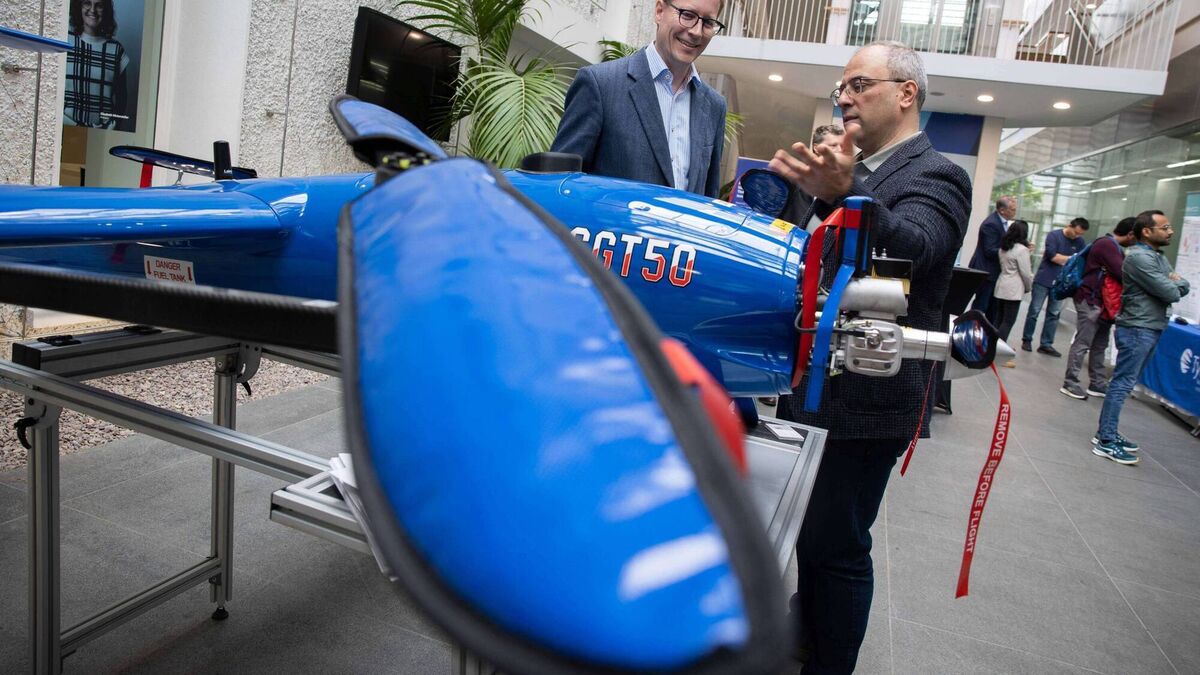
Professor Holger Claussen, Wireless Communications Laboratory, Tyndall, and Gokhan Celik, CEO, A-techSYN
Cork researchers have successfully demonstrated how advanced drone technology can help to combat drug smuggling and strengthen maritime security along the Irish coastline.
The Guard project, which includes input from the Tyndall National Institute at University College Cork, enables security agencies to rapidly identify, track and assess suspicious vessels that are operating in Irish and European waters.
Among the key features of the project include fully autonomous vertical take-off and landing drones, capable of reliable operation in harsh maritime environments and with a range of up to 800km.
Also featured as part of the project are robust low-latency multi-connectivity communications, including a gigabit millimetre wave link, for real time drone control and data transmission.
Automated flight planning and airspace permission management, to support safe operation in civil airspace, is another key innovation in the project, as is the use of AI-powered video analytics and automatic digital twin generation for the rapid interpretation of surveillance data.
The project also includes VR-enabled control interfaces that support intuitive human-in-the-loop decision-making during complex missions.
Overall, the project addresses long-standing barriers to large scale drone deployment, including regulatory requirements, operational complexity, connectivity challenges and adverse weather conditions.
Professor Holger Claussen, head of the wireless communications laboratory at Tyndall, and professor of wireless communications at UCC, said the project has the potential to transform how Ireland and other countries survey their maritime space.







 App?


