Marina sculpture marks 40th year of Cork's assistance after Chornobyl nuclear disaster
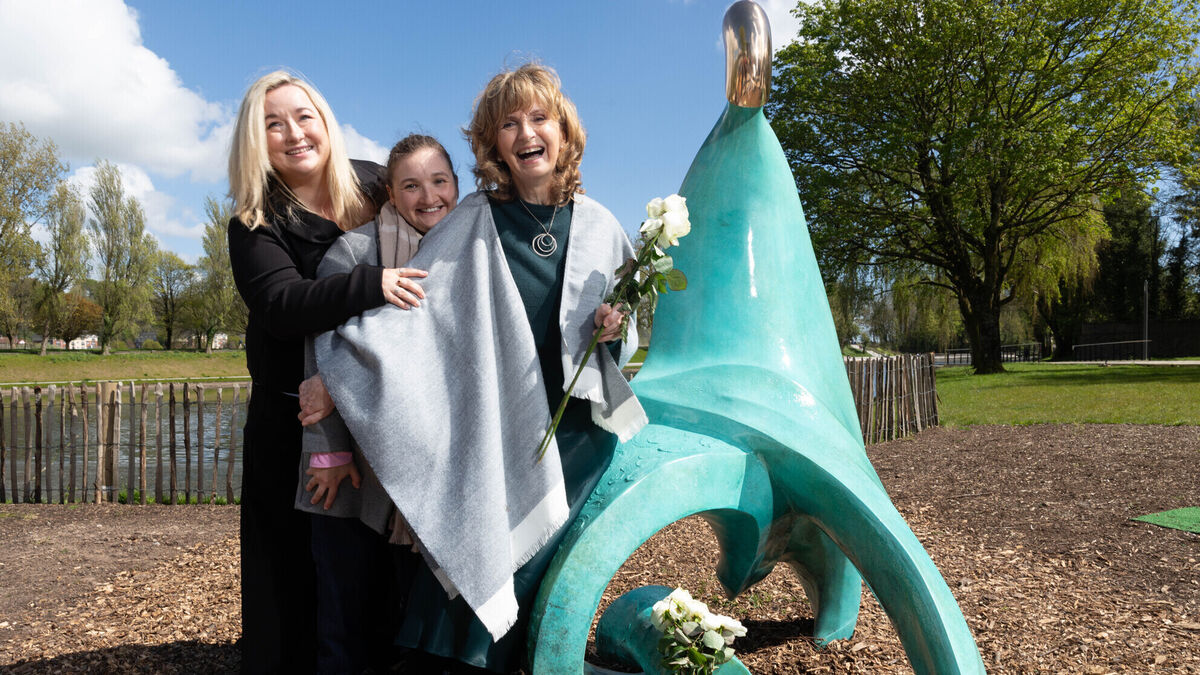
Adi Roche with Chernobyl Children Anna Gabriel and Raisa Carolan at the unveiling of the ‘Chornobyl Mother’ sculpture. Picture: Darragh Kane.
A poignant new sculpture “Chornobyl Mother” was unveiled at the Marina Park today to mark the 40th anniversary of the Chornobyl nuclear disaster.
The unveiling of the work by Irish sculptor Sandra Bell took place at the city’s newly-redeveloped Marina Park.
The ceremony brought together civic leaders, survivors, families and long-standing volunteers who have supported the Chornobyl Children International (CCI) response to the nuclear accident. The charity has delivered €110m worth of aid to affected regions.
Speakers reflected on the disaster’s lasting impact and Cork’s long tradition of international solidarity through its relationship with communities affected by Chornobyl.
The Lord Mayor of Cork, Cllr Fergal Dennehy, said Cork City Council was delighted to facilitate the installation of the sculpture through their partnership with the Cork-based charity.
“It’s positioning here, in the peace and tranquillity of the regenerated Atlantic Pond, stands as a powerful symbol of hope.
"As well as remembering the countless lives lost and touched by the 1986 nuclear disaster, we reflect, too, on the countless lives touched and transformed by Adi Roche and her charity, Chornobyl Children International, and its army of volunteers and supporters.
"Her vision has brought light into the darkest of circumstances, and Cork is immensely proud to stand with her and with all who continue this vital mission.
"We in Cork City Council are proud to play our part in recognising and supporting the extraordinary humanitarian work that she continues to lead from Cork.”
Serving as both a memorial and a symbol of resilience and future hope, “Chornobyl Mother” honours the innocent victims of the 1986 disaster and reflects the enduring suffering and strength of the women, families and communities affected across generations.
The deeply evocative work invites reflection on memory, loss and compassion, but also giving the light of hope to carry on.
Adi Roche, the voluntary CEO of CCI said that the sculpture gives form to memory and compassion.
“It ensures that the voices and experiences of those affected are neither forgotten nor overlooked.
The unveiling forms part of a wider programme of commemorations led by CCI.
This includes a media campaign, advocacy banners on Cork’s Connolly Hall and Dublin’s Liberty Hall, a Chornobyl Children’s Art Exhibition at Cork City Council, and a recognition ceremony at Áras an Uachtaráin next Friday.
A Post is also supporting the anniversary with a special two-week commemorative postmark.
Meanwhile, among the approximately 600 workers present on the site at the time of the accident, 134 received very high radiation doses and suffered from acute radiation sickness. Of these, 28 workers died in the first three months after the accident and another 19 died between 1987 and 2004 of various causes, not necessarily associated with radiation exposure.
Another 200,000 recovery workers involved in the initial clean-up work of 1986-1987 received doses of between 10 and 500 millisievert (mSv). By 1990, the number of workers involved in clean-up activities at Chornobyl rose to about 600,000. These workers are still at potential risk of late consequences such as cancer and other diseases and their health is being closely monitored on an ongoing basis.
In addition to causing radiation exposure, the accident caused long-term changes to the lives of the people living in contaminated districts, since the measures intended to limit radiation doses included resettlement, changes in food supplies and restriction on the activities of individuals and families.
The health of these residents also has been monitored since 1986, and has focused on investigating the association between the accident and late effects, in particular, of thyroid cancer in children.
A large number of children and adolescents in Belarus, Ukraine and the Russian regions most affected received substantial radiation to the thyroid from drinking milk contaminated with radioactive iodine in the first few months after the accident.
By 2006, more than 5,000 cases of thyroid cancer were diagnosed among those who were children at the time of the exposure.
By 2015 the total number of cases in the three impacted countries had reached 20,000.
The organisation is using the Ukrainian spelling of Chornobyl.





 App?
App?


