The Cork war hero who used to live in my old stone house
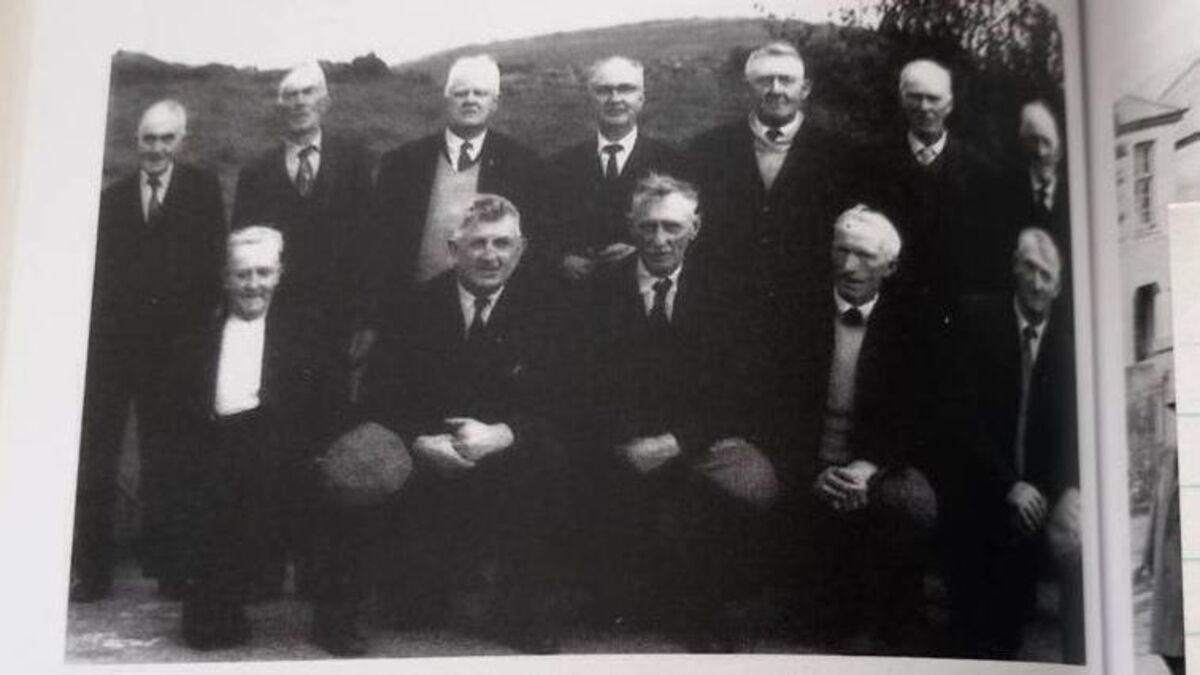
Daniel Harrington with fellow former Volunteers in 1962, back, from left, John C. Creedon, Donncha Eoin O’Sullivan, Dan Harrington, Francie Creedon, Patsy Lynch, Frank Kelly, Tommy Murray. Front, Mick (Dair) Murphy, Jamie Moynihan, Con Seán Jer Kelleher, Mick Leahy, and Jerry ‘Scholar’ Lynch
In the townland of Coolavokig, near Ballymakeera, in mid-Cork, stands an old stone house - my house. But before I resided here, a gentleman by the name of Daniel Harrington called this home.
He made his mark on Irish history and left a legacy that should never be forgotten.
Daniel was born in this house on June 29, 1891, and went to school at Coolavokig and on to national school at Renaniree in the Muskerry Gaeltacht.
Early in 1915, Daniel and about 50 other young men joined the Irish National Volunteers at Kilnamartyra. The officer in charge was a man by the name of Henry A Browne.
Surprisingly, the drill instructor was a serving officer in the British army by the name of John Browne. He happened to be home on leave and was happy to train the boys.
This company didn’t last, and, in the summer of 1915, a new company of Irish Volunteers was formed, based in Ballyvourney. No less than Terence MacSwiney rallied the young men while speeches from Sean Nolan and John Lynch of Macroom encouraged people to join up. Daniel and about 15 others did.
Nolan marched and drilled the men around the village and within six months there were more joining the Ballyvourney company and two more companies had been formed, one in Ballingeary and one in Kilnamartyra. They had a few shotguns and one .22 rifle.
Without officers, it was left to Dr Patrick O’Sullivan to take charge of the three companies.
Daniel said that the rebellion at Easter, 1916, was underway before they had even heard of it in Ballyvourney. A group from the Kilnamartyra company had mobilised on Easter Sunday to await instructions. They hoped to receive a supply of arms which were to be collected by Limerick volunteers from Roger Casement’s haul.
But, as we now know, that would never happen as Casement was arrested by British forces on Banna strand in Kerry and later hanged for treason.
The Kilnamartyra company waited until the Tuesday morning before heading home.
Daniel and his fellow volunteers were subdued by the events, but by early 1917 they had begun to re-assemble again. New companies were being formed and the numbers grew. Daniel became Quarter-Master.
By the end of the summer, they had many shotguns, a few revolvers and a .22 BSA rifle. The battalion strength grew to around 350 in 1918.
As the numbers grew, so did the RIC raids. The companies would halt travelling British soldiers and relieve them of the arms.
Ballyvourney ‘B’ company were at this stage using their own funds to buy shotguns from Brigade HQ in Cork.
These boys did on occasion get ahead of themselves and try daring raids, only to head home defeated and a little embarrassed! For example, a group including Daniel and his brother John headed into Macroom with the intension of stealing one of the cannons outside the castle gates to use to blow up the RIC barracks in the area.
The cannons proved to be too heavy for the likely lads and they had to admit defeat. Daniel later said, looking back, they had to laugh at the folly of it all.
In 1920, he and his company attacked Inchigeela RIC barracks. On the same evening, Carrigadrohid and Carrigtwohill were hit, Carrigadrohid was burnt to the ground but they didn’t get the weapons. In Carrigtwohill, the arms were seized and the barracks burnt. Daniel and his company were reprimanded by brigade staff for not completing their task.
Read More
On March 7, a new group tried. This time they numbered 70 men of the city battalion, who believed the Ballyvourney men to be soft.
Despite Daniel telling them that the barracks had barbed wire at a depth of ten yards, steel shutters on the windows, and the gable ends had loop holes, they proceeded with the plan to blow up the building with the use of guncotton, a replacement for gunpowder, and a battery, only to change their minds when they examined the building for themselves!
On April 4, Daniel and his fellow volunteers burned down the court-house in Ballyvourney. Their officer in charge, Dr O Sullivan, was badly injured along with two others.
They again tried to take Inchigeela barracks. This time with a plan to knock out the occupants with a drug mixed into poitín. This failed when the first officer became violently sick and suspected foul play. Inchigeela was becoming a hard nut to crack!
Having approached the sergeant at Inchigeela barracks several times and asking him to resign, the Inchigeela company ambushed him and shot him dead. His name was Monsell. A few days later, the garrison was evacuated to Macroom.
At a meeting of the battalion staff, it was decided to attack a military lorry that regularly travelled between Macroom and Ballyvourney. Daniel and Co decided on an ambush site near an area called Gatabawn.
The 30 men chosen were from ‘A’ company (Kilnamartyra), ‘B’ Ballyvourney and ‘C’ Coolea. They waited for three days in the hills before the lorry passed. Daniel was armed with a rifle they had bought from headquarters.
Michael Sullivan, an ex-British army soldier, carried a rifle taken from an RIC barracks ambush, the others had shotguns. The attack began.
The driver was hit immediately and the lorry swerved, striking the bank along the road, hitting a fence and travelling on for 50 yards. Daniel continued to fire until the lorry had turned the corner. They ran after it, observing the trail of petrol on the road. The military had gotten out and headed for Ballyvourney, taking their wounded with them, leaving a dead man behind.
Daniel waited in his home, my house, for what he felt would be the inevitable raid from the military, but none arrived. They stood firm in Ballyvourney that night, armed and ready. Nothing happened.
In fact, it would be two weeks before the British would take their revenge. They left a lorry, seemingly abandoned, at the side of the road. A crowd of children gathered around it and Company Quartermaster Bill Hegarty approached the children to send them away. The back of the lorry was full of soldiers who opened fire.
A soldier stood over the wounded Hegarty and fired straight into his head. A civilian, Michael Lynch, who came to his front door to see what all the commotion was about, was also shot dead.
Daniel’s brother John was involved in an ambush on August 17. The military had received a number of bicycles to use in the protection of travelling convoys delivering food and other goods to the barracks. John and fellow volunteers waited on the hills around Knockanure, about a mile and a half from Ballyvourney village, and ambushed the convoy.
During the heavy gunfire, several soldiers were wounded and lieutenant Sharman was shot dead. The miliary surrendered and the volunteers left with 11 rifles, a revolver, 12 bicycles, 600 rounds of .303, and several rounds of revolver ammo. The IRA suffered no casualties.
Two months later, the barracks in Ballyvourney was evacuated and would be burned to the ground by a local company.
The following month, November, the Black and Tans arrived into the village and began their campaign of violence.
In February, 1921, Brigadier Seán O’Hegarty arrived to train with the newly formed flying column of about 40 men. They trained for three weeks in the local area attended by all five companies. They were well armed.
They were joined by men from the 7th, bringing their numbers to 60. They had bombs, two machine guns, revolvers and 60 rifles. A shotgun section of around 20 men also joined them. Now they waited.
Every morning, they manned their positions. After a week, O’Hegarty sent a man into Macroom to pretend to be drunk and accidentally let slip to the soldiers where the IRA were. They took the bait and drove several lorries and armoured cars to the location. Scouts alerted the men to the progress of the military convoy.
From the first four lorries, the occupants dismounted and headed towards higher ground. Shots rang out and the soldiers retreated back to the road. The cars were now entering the ambush site and a burst of machine gun fire spun one of the cars.
The occupants of the convoy now headed for cover in the ditches and behind rocks. Daniel was in charge of the section overhead but was having difficulty in spotting the soldiers below. They were seen, however, by the Macroom men on the other side.
Daniel and his company moved to the eastern side of the military and Black and Tans and observed them taking cover in a labourer’s cottage from where they opened fire on Daniel and his fellow IRA men.
Reinforcements were now on their way from Cork city, Millstreet, Macroom, Bantry, Bandon and Killarney to assist the British so the men retreated.
Daniel, while having a meal in a safe house off the main road, was worried about the safety of the others in a house low in a hollow. Officer in Charge Patrick O’Sullivan left to warn them. Word came through that a plane flying overhead had spotted the men in the hollow and lorries were coming from Tralee.
The soldiers, instead of heading for the hollow, began marching in formation on the road. From Daniel’s position he could see them clearly, as could O’Hegarty from the other side. A battle ensued.
The IRA lost not one, the enemy sustained 30 casualties, including Major James Seafield Grant, a commandant in the RIC. Another casualty was Cadet Cleve Soady who is buried in the Church of Ireland graveyard in Macroom.
After the ceasefire, hostilities died down. People have told me since that Daniel Harrington was a quiet man who gave apples from his orchard to schoolchildren passing this house many years later. He died in 1963.
Daniel and his brother John are two of many that changed the course of Irish history and should always be remembered as true patriots of Ireland.



 App?


