The Cork heroes who built a post-war hospital in France
80 years ago, an extraordinary undertaking was launched among the ruins of one of the most devastated post-war towns in France. PAT POLAND pays tribute to the Irish men and women who worked at the Irish hospital at Saint-Lô, a significant number of whom came from Cork
The Cork heroes who built a post-war hospital in France

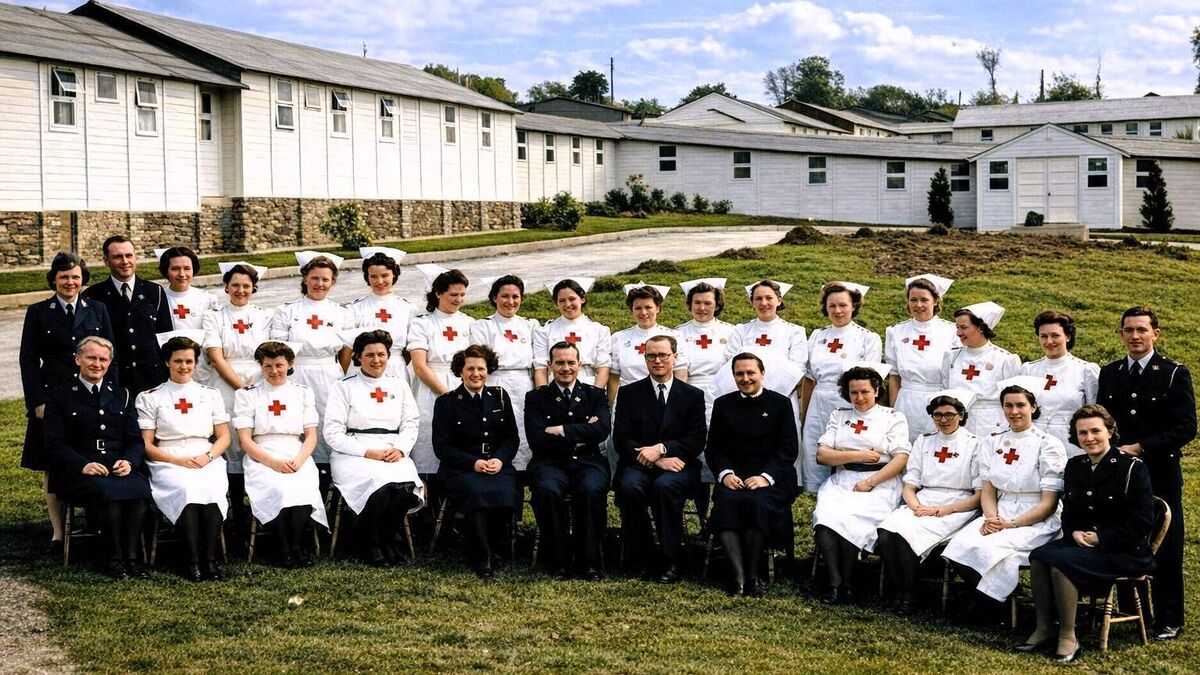
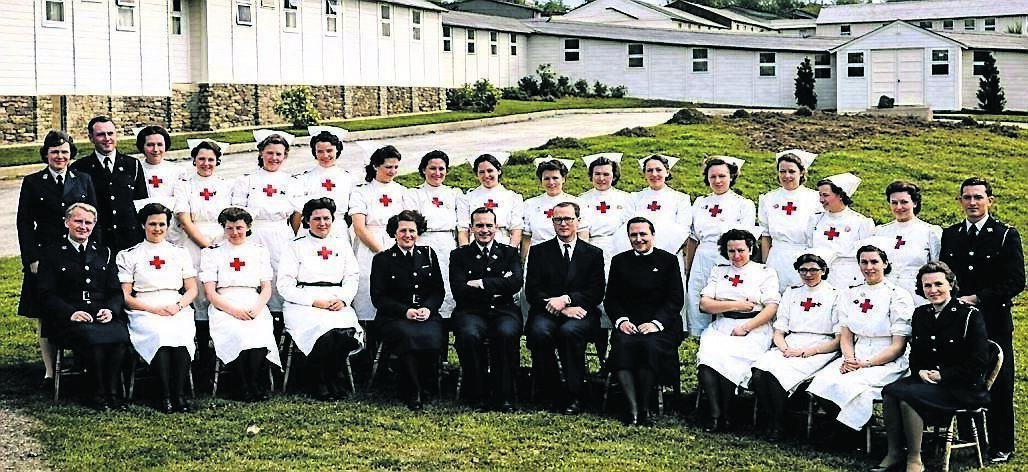
Some of the Red Cross staff at l’Hôpital de la Croix Rouge Irlandaise in Saint Lô

In the years after World War II, Saint-Lô in Normandy carried an epithet that was as brutal as it was accurate: the ‘Capital of the Ruins’.
The town had been all but wiped off the map in the aftermath of the D-Day landings in 1944. Streets, churches, homes, and the ordinary institutions that make a town were blown apart, levelled, or reduced to jagged shells.

Even after the guns fell silent, the misery continued: infection in temporary shelters, pregnancies without proper maternity care, injuries that never healed cleanly, and the slow grind of malnutrition, cold, and exhaustion.

It was into that landscape that Ireland - neutral in the war years, but not untouched by the moral weight of Europe’s catastrophe - sent a remarkable gift: a complete, working hospital built from wooden huts, staffed by Irish doctors, nurses and administrators under the Irish Red Cross, and offered free of charge to the people of Saint-Lô.

The official opening of l’Hôpital de la Croix Rouge Irlandaise took place on April 7, 1946. Its wards treated the wounded and the sick; its maternity service delivered babies in a town where so much else had been destroyed; and its presence became, for a brief period, one of the most tangible expressions of Irish humanitarian action beyond the island.

How did it come about? In wartime, offers were made to the Red Cross of all belligerent countries to send children to Ireland, and to accept a civilian hospital. The French Red Cross accepted both offers, and Colonel T.J. McKinney, Director of the Army Medical Corps and member of the Irish and French Red Cross, made the original survey of suitable areas.

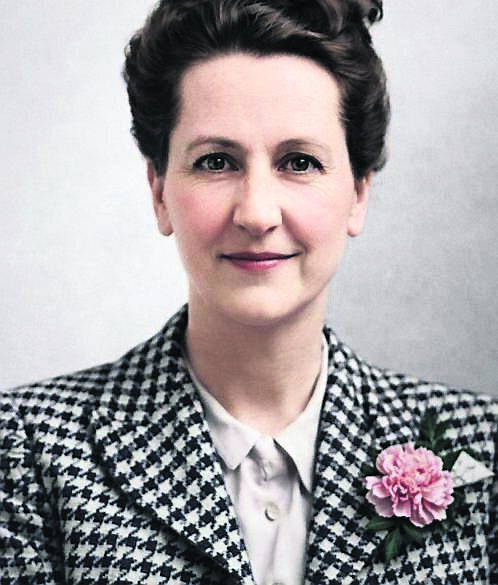
Miss E. Clare Olden of Cork, Secretary of the hospital in Saint-Lô, who found a husband in France

The selection was Saint-Lô, and there it was decided to establish a completely equipped 100-bed hospital staffed by Irish doctors, nurses, and administrative personnel.
The MV Menapia sailed from Ireland on August 14, 1945, with 170 tons of supplies. This included a general operating theatre, OP department, X-ray department, electrical generators, an autoclave, six ambulances, and a lorry. A supply of penicillin and blood plasma for transfusion purposes was carefully stored on board, while, more prosaically, 15 tons of turf briquettes were listed on the ship’s manifest.

The advance party comprised doctors McKee, Darley, Gaffney, Kitty Sullivan, and a cohort of nursing staff. On their arrival, not one hut was yet habitable, and they lived under the most punitive conditions with no running water, light, electricity, or furniture.

The interpreter/storekeeper was none other than Samuel Beckett, who would go on to great fame as a playwright and author. He had served with the Maquis, the French Resistance during the war, and had had to go on the run when his circle was betrayed.

As more staff from Ireland arrived, and with the assistance of the French (and eight Prisoners-of-War), by Christmas, 1945, the hospital was in able to accept its first in-patients. The first baby was born on Christmas Eve, his delighted French parents christening him ‘Patrick Noel’ in honour of the Irish.

For Cork people, the Saint-Lô hospital was not only a national story. It was also a local story: a tale that ran through Cork newspapers, Red Cross branches, and homes. Newspapers reported “a large proportion of the dressings and medical supplies with which the hospital is equipped” were made by Cork volunteers.

To understand why Saint-Lô mattered in Cork, you have to begin at home. During the Emergency, Ireland lived with black-out regulations and rationing, and with the anxiety of sea warfare and exploding mines off the coast, occasional air raids, and with the awkward reality of neutrality on an island where family and trade ties ran in every direction.

The official position of the state was to stay out of the conflict - but the public did not live in a vacuum. In spite of official censorship, they could still inform themselves about the war.

They heard the names of places they knew: Normandy beaches, French towns, and the battlefronts that were rewriting history. The Irish Red Cross provided a channel through which ordinary concern could become organised action. By war’s end, a practical question emerged: could Ireland contribute something concrete to relief on the continent without abandoning neutrality’s legal and political framework? The answer was a hospital.

The Red Cross explored the idea of setting up a hospital earlier in the war, but conditions - and the urgent needs of a civilian population - made it difficult. When the French Red Cross accepted the hospital offer, the project became an exercise in logistics as much as compassion: huts and equipment to be gathered and erected; staff to be recruited and organised; and a functioning medical service to be created, essentially from scratch, in a ruined town.

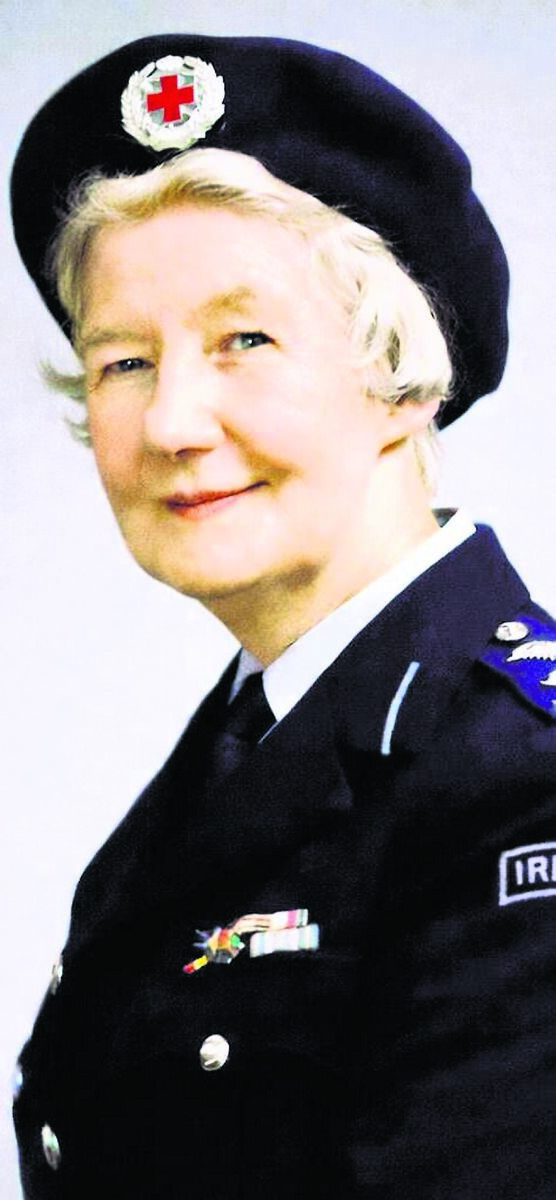
Leslie Bean de Barra, of Cork, who was at the forefront of the effort to advance the hospital project in France after World War II. The wife of IRA leader Tom Barry, in 1979 she was conferred with the International Red Cross’s highest honour, the Henri Dunant Medal

In Cork, the Saint-Lô story did not arrive fully formed as a piece of national legend. It arrived in small, practical bursts: a notice in the papers; a meeting of local Red Cross officers; a rumour that ‘one of our own’ had been selected for a particular post; an article about a ship sailing with doctors and nurses; and later, an announcement noting the hospital’s opening.
At the forefront of the effort to advance the hospital project was Leslie, bean de Barra, wife of the legendary Old IRA commander, Tom Barry, who lived with her husband over Woodford, Bourne’s store on Patrick Street. She was an early volunteer to the Cork Red Cross when the branch was formed in 1939.

A capable, energetic woman, noted for her meticulous planning, diplomacy, and attention to detail, Leslie (née Price), a Dubliner, came from a nationalist family and was active during the Easter Rising, the War of Independence and the Civil War, becoming Director of Cumann na mBan. On August 21, 1921, she married Tom in Cork, two of the principal guests being Michael Collins and Éamon de Valera. Just a year and a day later, the ‘Big Fella’ was dead, Dev’ was on the run, and Tom was incarcerated in Kilmainham Gaol.

Mrs Barry, as a member of the Central Council and Executive of the Irish Red Cross, was central to the organisation and planning of the new hospital. In the years ahead she would be President and Chairman of the Irish Red Cross, was instrumental in the setting-up of the VHI in 1957, and, in 1979 was conferred with the International Red Cross’s highest honour, the Henri Dunant Medal. She passed in 1984.

In practical terms, the hospital required experienced nurses, midwives, medical staff, and administrators. Cork had hospitals, training schools, and a strong tradition of voluntary service that made it a fertile recruiting ground.

Helping to pull all the various strands of medical and lay cadres together was the hospital’s Secretary, Miss E. Clare Olden of Cork, daughter of Mr and Mrs Charles Olden.

Charles, a senior partner with Atkins and Chirnside, Auditors, South Mall, had been another early volunteer to Cork’s wartime Red Cross and held the rank of Adjutant with the division. His daughter promptly volunteered her services to the undertaking, leaving for France in October, 1945. Her excellent French and book-keeping skills would prove invaluable to the project. For the young Cork woman, romance blossomed amid the ruins and she went on to ‘tie the knot’ with a member of the British forces stationed in nearby Bayeaux.

At the heart of the Saint-Lô hospital’s day-to-day success was its Matron, Mary Frances Crowley. Later celebrated as a pioneer in nurse education and as a key figure in Irish professional nursing, Crowley brought to Saint-Lô not only clinical skill but the ability to build a disciplined, functioning service in difficult conditions. Born in Wexford, she had strong ties to West Cork in her formative years.

The Matron’s job at Saint-Lô was relentless. This was not a hospital that could rely on stable supply chains or established buildings. It was created from prefabricated huts; staff were far from home; and the town around them was still devastated, and under reconstruction.

Red Cross staff at l’Hôpital de la Croix Rouge Irlandaise in Saint Lô

Mary Frances’ role involved organising nursing rosters, ensuring standards of hygiene, supervising maternity and general wards, and maintaining the morale and professionalism of staff living in a difficult environment. The later recognition awarded to the staff by France reflected the impact of their service - and Crowley’s leadership was central to that.

The physical act of creating the hospital was itself a kind of statement: a refusal to accept ruined places must remain ruined.

Irish personnel and local labour assembled a cluster of huts - a modest settlement of medical purpose - that could provide 100 beds and the essential services of a general hospital.

The 25 huts were arranged in groups of three, connected by a long corridor giving access to all the wards, the kitchen, operating theatre, X-ray department, OP department, dispensary and laboratory, the whole complex being centrally heated.

The Cork Examiner reflected “that, to the inhabitants of the most desolate of towns destroyed during the war, the hospital seems like an oasis in the midst of their very drab existence”. It noted, without a trace of irony, that they even had glass in the windows!

One of the hospital’s most moving legacies was the number of births associated with it. Later summaries often note that around 180 babies were born there in 1946. In a town whose population had lived through destruction and displacement, those births became living symbols of recovery.

Cork’s contribution to the Irish hospital at Saint-Lô is best understood not only as a matter of how many Cork names appear on a staff list (important though that is), but as a civic relationship: Cork as a place that heard the call, helped staff and sustain the mission, and has continued to claim the story as part of its own record of service.

The final word on the Irish hospital at Saint-Lô must go to Dr Paddy McNicholas. On the day of the official opening on April 7, 1946, the French authorities pulled out all the stops to honour the Irish in every way imaginable.

The town - or what remained of it - was decked out in the tricolours of Ireland and France, colourful loral arrangements were everywhere, and dignitaries were a dime a dozen. Seven long speeches were delivered. The French sent their best Naval Band from Cherbourg to provide the music for the day.

Dr McNicholas recalled: “The French naval band, unaccustomed to the liquid refreshments sent in caseloads by Jameson and Guinness from Dublin, drank the Irish whiskey neat, and by the end of the evening they were all laid low on top of, or underneath, the tables!”

Postscript: In 2015, on the occasion of the 70th anniversary, a granite memorial, on which the names of the staff at the l’Hôpital de la Croix Rouge Irlandaise are inscribed, was unveiled at the site of the former complex at Saint-Lô.
More in this section

The Pubs of Cork: 'I saw the pub for sale during the pandemic, I ended up buying it' The Pubs of Cork: 'I saw the pub for sale during the pandemic, I ended up buying it'
Cork entrepreneur embarks on new challenge with fitness business  Cork entrepreneur embarks on new challenge with fitness business 
Cork student: ‘Look for the opportunities and step out of your comfort zone’ Cork student: ‘Look for the opportunities and step out of your comfort zone’

Sponsored Content

The power of the G licence The power of the G licence
Happy couple receiving new house keys from real estate agent Time to get to grips with changes in rental laws
Boatbuilder turned engineer proves alternative paths can lead to success Boatbuilder turned engineer proves alternative paths can lead to success
Contact Us Cookie Policy Privacy Policy Terms and Conditions

© Examiner Echo Group Limited

Add Echolive.ie to your home screen - easy access to Cork news, views, sport and more