€600 electricity bill pushed me to get solar panels
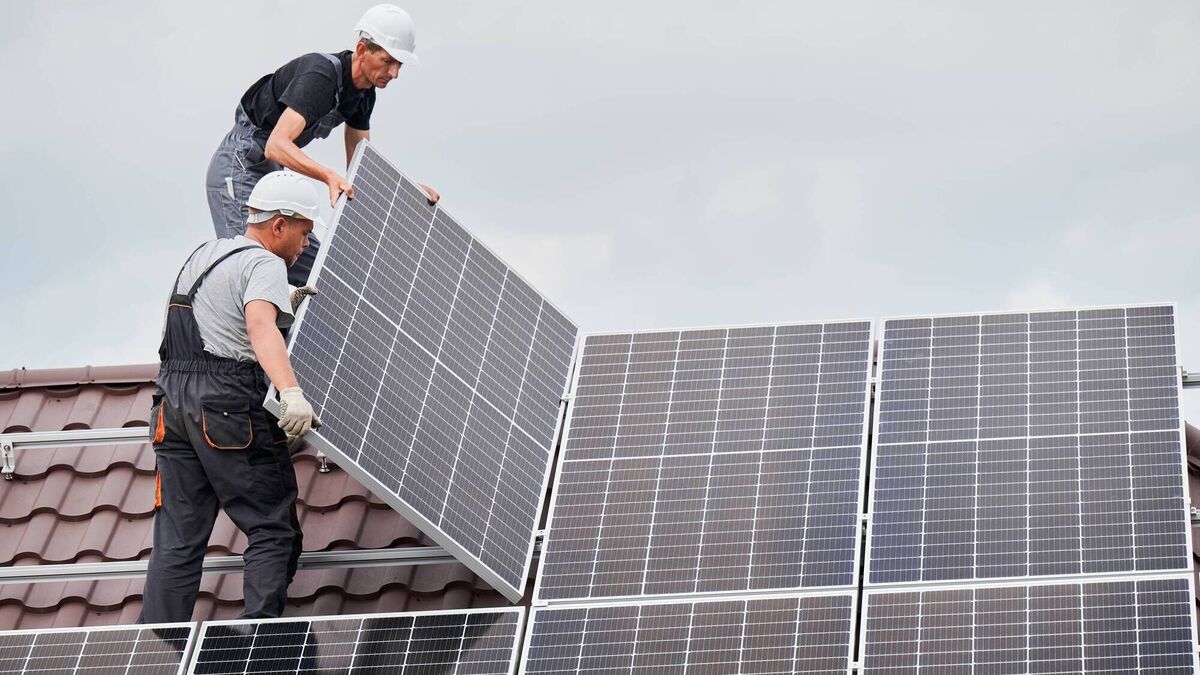
Men technicians mounting photovoltaic solar moduls on roof of house. Builders in helmets installing solar panel system outdoors. Concept of alternative and renewable energy.
THERE it was, residing in my inbox. Unopened, and daring me to read it.
With electricity reaching new price heights, every bi-monthly bill made me wince, flinch, and occasionally consider how bad life would really be without it, a Dickinson existence of candle stubs and open fires.
Last February’s bill was an eyewatering €600. It was the brutal force needed to push me out of inertia and act for the sake of my finances, sanity, and the planet.
Fortune was on my side, with SEAI grants available and the VAT relief on solar panels introduced in May, 2023, the investment became slightly more accessible, knocking €3,400 off the total cost.
The research was a considerable undertaking for this significant purchase of panels. How well does it work in Ireland? Do I need a battery? How much? How long do they last?
As a completely new technology for me, I had a lot to learn and things to consider. Here is what I discovered along the way:
Is it worth getting panels in Ireland?
Overall, daylight levels in Ireland are very good. In fact, the solar energy we get is very close to countries like Germany and Austria, where PV solar panels have been popular for many years.
Fortunately for us and our frequently cloudy skies, solar panels (also known as Solar Photovoltaic (PV) panels) can convert the diffuse sunlight that passes through the clouds into electricity; even on the cloudiest days, solar panels will generate some electricity.

A surprising fact about solar PV panels is that they work best at low temperatures. In many ways, our temperate climate works well with panels, and it is worth remembering that light, not heat, is needed to power panels.
If you want to number-crunch, and see if it is a worthwhile investment, the SEAI has a useful calculator:
https://www.seai.ie/tools/solar-electricity-calculator/
How do they work?
If you’ve ever looked up close at a solar panel, you’ll see it’s made up of small squares called solar cells. In these cells, light is absorbed and knocks electrons loose. These electrons flow, creating a direct current that is converted to the type of electricity we can use in our homes (alternating current) by an inverter.
Once the electrical demands of the household are met, any excess electricity produced can be stored in a battery or other storage solution like your hot water immersion tank. Excess electricity is fed to the grid, and PV owners are paid what is known as the Clean Export Guarantee (CEG), a feed-in tariff.
This tariff is paid at a ‘competitive market rate’ from your electricity supplier, however, it still makes the most economic sense to use energy generated within the household before exporting.
That means reviewing some of your most automatic decisions around when to turn on the washing machine, dishwasher, etc.
Do I need a battery, too?
This all depends on the size of the system you plan on investing in. While it is a considerable cost, the battery stores excess energy generated by the solar panels that can be used later, reducing the energy needed from the grid and ultimately lowering electricity bills.
How long do they last?
The whole system typically has a design life of over 20 years. There are no moving parts, so it usually presents few challenges.
Is there any maintenance required?
With PV panels, the most important part of maintenance is to keep the panels clean. If there is a build-up of dirt or residue on them, it will affect the performance of the panels.
In Ireland, the rain will help keep the panels relatively clean, but especially during the summer months, it is recommended to clean the panels.
The most effective way to clean your PV panels is with soapy water with a non-abrasive sponge. Always follow the manufacturer’s instructions. It’s also recommended that you get your installer to check connections, etc, every three to five years.
Am I eligible for an SEAI grant?
From January, 2024, the grants are capped at €2,100, a slight reduction on the previous top rate of €2,400, which is a consequence of the long-awaited Clean Export Guarantee kicking in.
Suitable applicants are eligible for €800 per kWp up to 2kWp and €250 for every additional kWp up to 4kWp.
All homeowners, including private landlords, are eligible for this grant as long as the home was built and occupied before December 31, 2020, and they have not received previous funding for Solar PV at this MPRN.
How much can I expect to save, and how long before it pays for itself?
It’s a calculation with a few factors to consider, including roof orientation, energy use in the home, system choice, etc. Suppliers welcome the opportunity to furnish the details of how much can be saved over the lifespan of the system.
After grants, my 5.2kW panels, battery and inverter cost €7,690. My provider calculated that this will pay for itself in less than five years, and over its entire lifespan, generate net savings of €31,300.
While I was able to secure a loan to install this system, and I applaud the VAT relief measures and grants that have been introduced, I feel we can go further to support those on the lowest incomes, and in particular, one-parent families and senior citizens. No-one should be made to choose between a warm house and a hot meal, but for many living below the poverty line, that is a reality.
Energy poverty has reached new heights in recent years in Ireland. An ESRI report published in June, 2022, found that an estimated 29% of households in the Republic now qualify as experiencing energy poverty, defined as spending more than one-tenth of its net income on energy.
Targeted support would mean that this initiative would not only accelerate Ireland towards a more sustainable green energy supply, but also create greater equity for those who need it most. This could be in the form of interest-free loans for investing in this sustainable energy source and targeted 100% grant schemes.
For now, the SEAI does offer a Fully Funded Energy Upgrade Scheme for those on certain welfare payments, and this can take the sting out of bills for insulation and window upgrades.
Since their installation, I’ve joined the solar panel cult of people who obsessively check the skies and then their app, like a nodding dog, to see the satisfaction of a battery filling, house energy being supplied, and the triple win, when it is also sending energy to the national grid, the ultimate passive income stream. My latest electricity bill, in the dark depths of winter is €200 less than this time last year. It’s a great start, and one set to improve further as summer rolls around.
It’s popularity continues to grow unabated, with almost 60,000 residential homes now donning solar panels – and 500 houses are connected to the grid weekly, it’s a leap forward for sustainability, and like all the changes we make, usually it takes a trigger to jumpstart it.
On that note, how bad was your latest bill? More than one million Irish homes have roof space and orientation suitable for ten solar panels. Could yours be among them?







 App?
App?


