My pilgrimage to the 330 holy wells of Cork
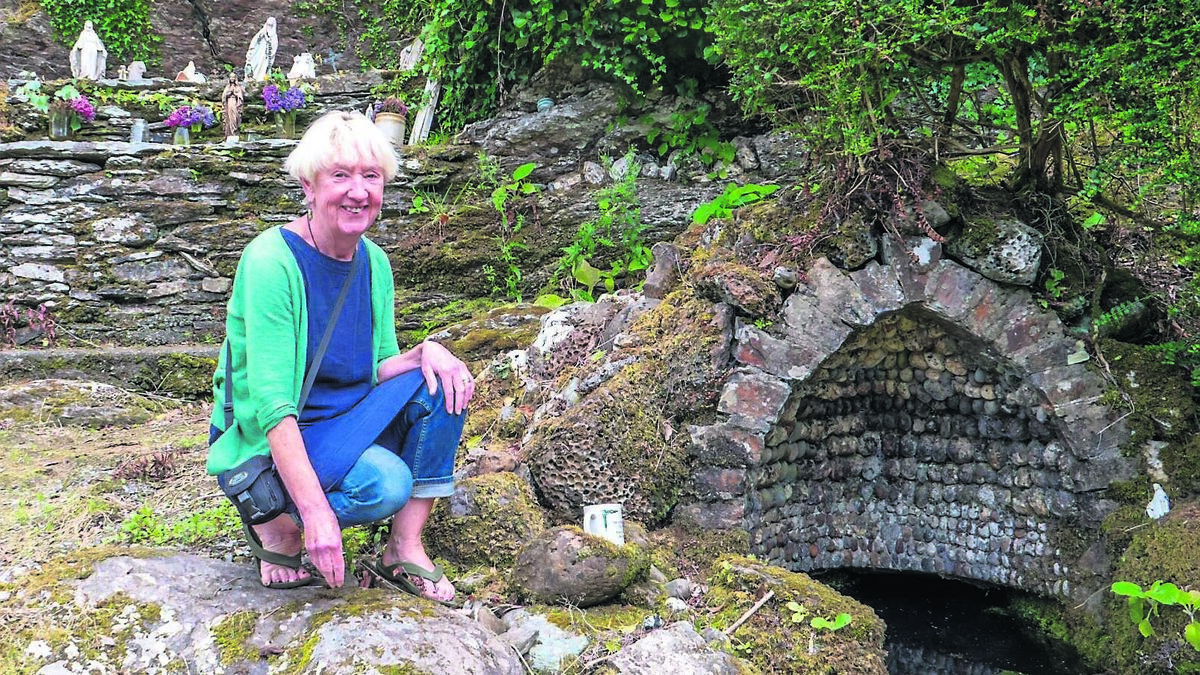
Amanda Clarke at Lady’s Well in the townland of Beach near Bantry, which she visits regularly
SOON after settling in Ireland, about 30 years ago, Amanda Clarke and her husband, Peter, witnessed an ancient Irish tradition of pilgrims ‘doing the rounds’ at a holy well.
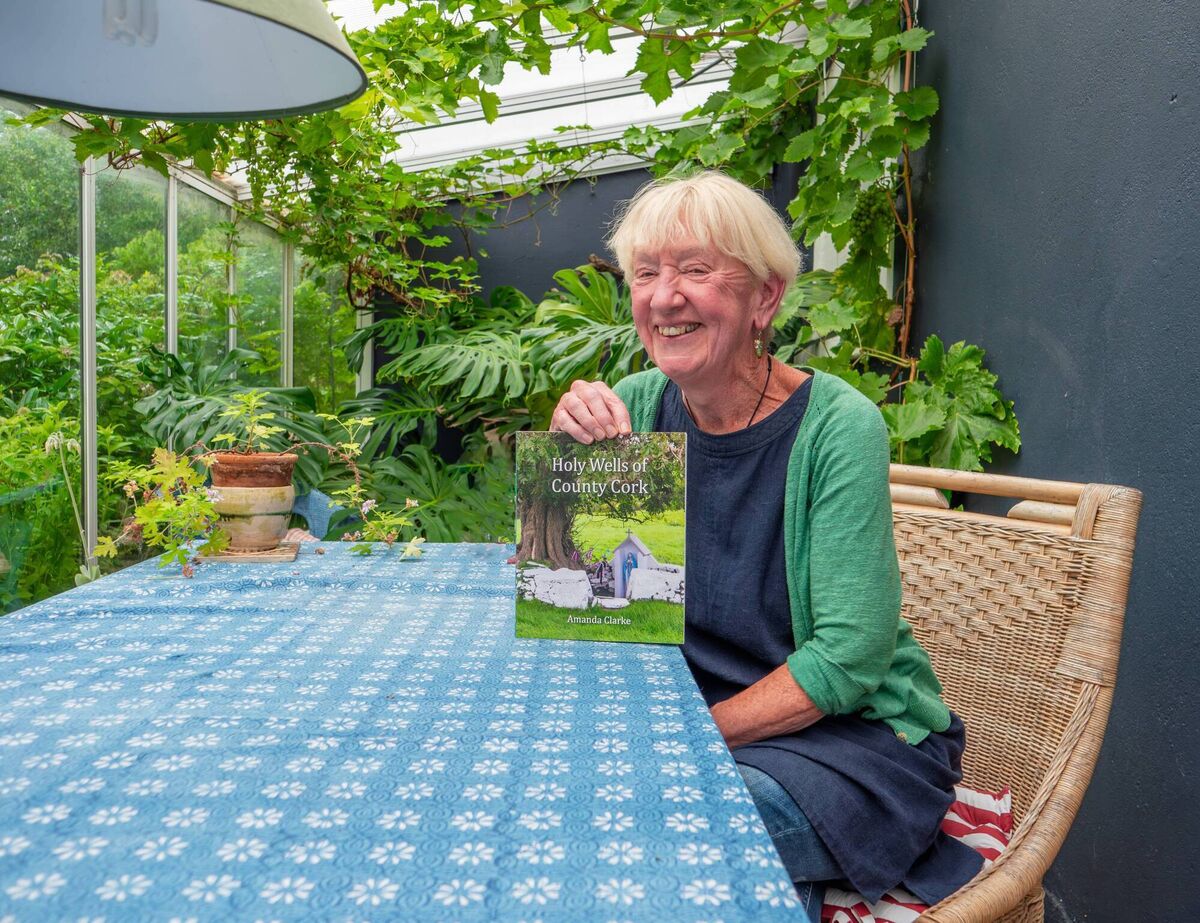
Seeing this with fresh eyes, it led to her eventually taking it upon herself to travel the length and breadth of Cork to document as many of the county’s holy wells as she could find.
Her meanderings are now the subject of her first book - Holy Wells Of County Cork - the first book dedicated to holy wells in Cork - which was launched at Working Artist Studios in Ballydehob in West Cork last Friday.
It was during a Pattern Day in 1998, at St Crohan’s holy well near Caherdaniel, along the Ring of Kerry, that Amanda first saw locals who had gathered to ‘pay the rounds’.
‘Paying the rounds’, or ‘doing the rounds’ as it is often called, is a Christian ritual with roots in the Pagan tradition, where one walks around the holy well in a clockwise direction, in line with the sun; praying that resolution will come to a particular intention or problem in your life.
Amanda looked on in amazement. She had not seen this type of thing before. She and Peter had relocated to Ireland from the UK and were not yet au fait with the nuances of Irish Christianity.
Yet, this seemingly strange ritual that they witnessed was set to be ingrained in their lives for the decades that followed.
“When I first got to Ireland, I was staying in Caherdaniel and I saw a sign in the local Post Office saying ‘Pattern Day, All Welcome’,” recalls Amanda, who lives on the Sheep’s Head in West Cork.
“I thought, that’s very interesting, I don’t know what that is. And I went out and had a look.
“It was pouring with rain and a lot of people were walking around this quite small hole in the ground, a puddle in the ground, and I thought, wow, what’s going on here?
“I was made very welcome. That piqued my interest, and now I understand exactly what was going on,” Amanda said.
‘Not all who wander are lost’ - the famous quote by J.R.R Tolkien sits beneath the main heading on Amanda’s website - she is clearly comfortable navigating the highroads and byroads in search of the easy, and the not-so-easy-to-find monuments.
The website - holywellsofcorkandkerry.com - is where she documents her findings.
It was on St Brigid’s Day in 2016 that she fully dedicated herself to finding and documenting the 358 holy wells of Cork. She managed to record 330; not too shabby.
For various reasons, the remaining 28 were lost to the sands of time.
“I would look at the ordnance survey map, the current one, and then I’d look at the historic maps, and there are the archeological surveys online, for Cork, which is brilliant,” said Amanda.
“And that lists all the wells and it’s got a little bit of information about the wells, and it has grid referencing.

“And while I was researching, the schools’ folklore collection from the 1930s came online, and that is a fantastic resource,” Amanda added, referencing the National Folklore Collection UCD Digitization Project.
“All the school kids were invited to interview older members of their communities about certain subjects, and one of those was holy wells”.
Scattered among both fine pastures and inhospitable lands, sometimes on public or private property, each well has its own folklore and ‘cures’ believed to be associated with them.
Oftentimes, the wells that are attached to privately owned property will have a ‘well keeper’, a property owner who voluntarily looks after the upkeep of the well.
This blend of colourful folklore, along with the occasional tale of a spirited well keeper, means Holy Wells Of County Cork will bring the reader “on a journey with me”, says Amanda.
“It is a very personal book,” she adds. “One of the themes that came up was, what is a holy well? Because you, as people, and sometimes they haven’t a clue because it’s quite hard to define.
“I then looked at the cures said to be attached to the wells, there are over 30 attached to the wells in the Cork area.
“I then looked at the saints as many of the wells are dedicated to them, and I discovered that there are over 60 saints across the wells in Cork, and a lot of them are very local so they have very interesting stories.
“And then I looked at what you do when you go to each well, what rituals and folklore, what happened on the pattern day. Each well would share the pattern day, but each well would be slightly different,” Amanda explained.
As we began to wind down our conversation Amanda interjected, saying: “Wells are very much considered to be alive. They are often described as active (if they still receive pilgrims) and very much have personalities of their own.
“Should a well be disrespected, it may dry up, or move somewhere else, or cause trouble for the disrespecter - especially in North Cork!”
Her mission to track the wells of Cork has seen her scale the odd obstacle, or sometimes go to great lengths to avoid a farmyard bull or or deal with treacherous weathers.
The following excerpt from her book indicates what makes it all worthwhile for Amanda.
“Sometimes, there are surprises lurking at the end of muddy boreens. Lady’s Well, Tobar Mhuire, at Rockspring, was visited at the end of a long, damp day and expectations were low. I was unprepared for the sight that greeted me and gasped out loud.
“The spring was large and percolating, an illuminated shrine to the Blessed Virgin Mary, adding an otherworldly air, with religious pictures, statues and other offerings clustered around the shrine and on trees. The whole place radiated serenity.”
Amanda said that “visiting Holy Wells appeals to everyone; the religious, the spiritual, the non-believer, the curious”. It’s hard to argue with that.
Holy Wells Of County Cork was part funded through a grant from Cork Heritage and printed at Carraig Print Litho Press in Carrigtwohill.
The launch last week was opened by the author of Ancient & Holy Wells of Dublin, Gary Branigan.

App?