Cork physiotherapist: ‘The resilience of the body continues to amaze me after 30 years’
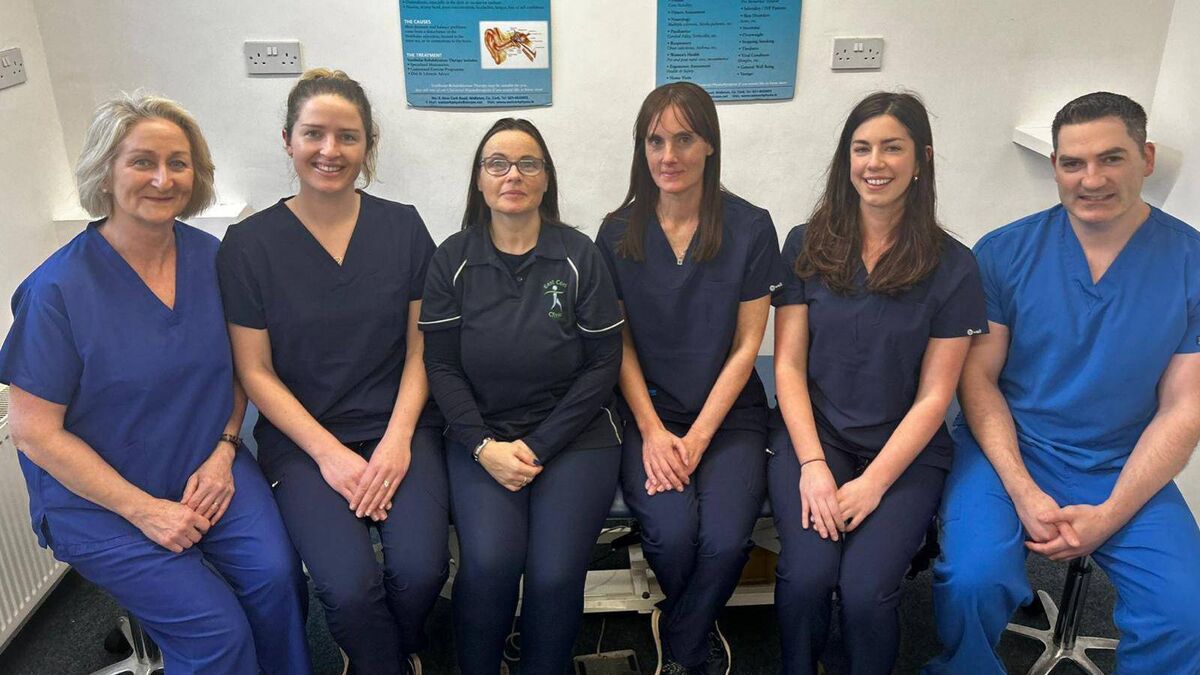
The East Cork Physio team: Sheila Barrett, Kate O’Connor, Emma Fitzgerald, Emer Maher, Carol O’Brien, and Mark Canning.
When Sheila Barrett opened her Midleton physiotherapy practice in 1996, she was working on her own.
“It was just me,” says the mother of six, reflecting on her three decades spent helping the people of East Cork to recover from injury, manage health conditions, and improve mobility.
Thirty years on, the East Cork Physiotherapy, Balance and Acupuncture Clinic has grown and evolved, with Sheila’s practice now home to a team of six. Patients come to the clinic to receive treatment for a wide range of conditions.
The first half of Sheila’s career was focused on musculoskeletal physiotherapy - “your typical neck, back, sport and rehab, post-hip replacements and so on,” she explains – and she also qualified in acupuncture.
About 20 years ago, she became interested in an innovative new therapy coming out of the United States.
“I came across an interesting article that caught my attention,” says Sheila. “It stated that physio can effectively treat vertigo. I was totally intrigued. And following on from this article, I ended up specialising in it because I found it so interesting – I went to Emory University in Atlanta to train in vestibular rehabilitation therapy (VRT).”
Patients frequently come to Sheila saying that they have a diagnosis of vertigo.
“But vertigo is a symptom, not a diagnosis,” she explains. “People suffering from problems with their vestibular system will usually have vertigo – the illusionary spinning of their environment – or dizziness, or they might have balance problems or difficulty concentrating. And these are life-altering symptoms because they can limit people’s ability to partake in life – they find it difficult to walk or go to work or do sports, and so forth. They’re afraid to go out
“The truth is, once you get an accurate diagnosis and you implement proper treatment, you will always improve and sometimes cure (the problem)”.
With innovations like VRT, physiotherapy is a profession that is, as Sheila puts it, “constantly evolving, constantly changing”.
She adds: “I suppose that’s why I still love my work. If I go into work tired, I actually come home buzzing. My kids always say, ‘oh my gosh, work really does your heart the world of good.’ And it does”.
In her 30 years of practice in East Cork, Sheila has seen a lot of advancements in physiotherapy, but the chief principles, she tells me, remain the same.
“The basic care of another human being, like listening to them and showing kindness and genuine care – they are core aspects that remain the same”.
Closer to home, something that hasn’t changed in a long time at Sheila’s clinic is its administrator – Emma Fitzgerald.
“For the last 25 years we’ve been working together,” says Sheila, “and I’ve been blessed beyond all belief because she’s so kind and genuinely caring for our patients.”
When reflecting on her career, Sheila cites the importance of having a good working relationship with colleagues.
“There’s only six of us in the clinic, so it’s really important that each of us gets along with each other.”
A sense of humour helps too, as is the case between Sheila and her longest-serving colleague Emma: “For 25 years, every single day we’ve had a laugh about something. Never a cross word.”
Sheila hasn’t always worked in East Cork.
Her career as a chartered physiotherapist spans 40 years, and she has spent time in the USA and Zimbabwe, countries with vastly different health systems.
“We had greater access in the States to specialised equipment and services. In Zimbabwe, I worked with an aid organisation where resources were very limited – in the outreach clinics we were treating children on straw mats under trees. But because physiotherapy is such a hands-on profession, we were able to effectively treat those kids.”
In Sheila’s view, the core of good physiotherapy “lies in the skill and the compassion of the physiotherapist,” meaning that “patient care remains universal” regardless of setting or resources. Patients everywhere also have the same goal. “Whether they’re suffering from pain or injury or possibly a disability,” Sheila continues, “the desire to regain independence is universal”.
This perseverance of patients is something that has inspired Sheila in her years of practice. People have become more empowered when it comes to their own health. “Gone are the days where the medical person knows it all,” says Sheila. “It’s good that patients read up about things, and we would always send information to the patient on their condition. It ends up being a team effort – the patient and the physio working towards the end goal.”
Thirty years of treating patients in East Cork means thirty years of injuries, chronic conditions, and more. Sheila has observed, however, a shift in the kinds of issues being treated in the clinic in that time:
“Thirty years ago, injuries were more due to physically demanding work such as farmwork, or housewives at home pulling and hauling heavier loads. Whereas today, we’re seeing more problems due to sedentary lifestyles and certainly prolonged screen use as well.
“Patients are coming in with neck and back pain, but instead of acute trauma from heavy manual work, it’s now from sustained positioning and not moving which results in headaches, posture problems, and a lot of repetitive strain injury.”
Sheila and her team are also increasingly witnessing the link between mental and physical health, with stress contributing to a range of issues. “The constant go, go, go of modern life,” she says, “has a negative impact on body function. Very oftenm people will come in with an acute neck or back problem, and they’ll say, ‘great - I need this like a hole in the head. I’m under so much pressure’. And this is very much the physical manifestation of an emotional overload.”
Our increasingly sedentary and stressful lives – and over-reliance on screens – may be contributing to a myriad of health issues, but modern life isn’t all doom and gloom, according to Sheila.
“At the same time, people are staying active for longer in life. I used to find that people who got old almost more or less threw in the towel, but nowadays many of my patents in their seventies and eighties are keen to be active in sport, walking, golfing, gardening. And we very strongly encourage that.”
In her 30 years of practice in East Cork, is there anything that has surprised Sheila?
For Sheila, this is one of the most rewarding parts of the job. “Seeing somebody get back to doing the things they love to do. I tell people the reality of their situation – not sugar-coating, but being realistic and giving them practical hope. And with their perseverance and hard work, they can get there.”
The many patients that have come through the doors of East Cork Physiotherapy, Balance and Acupuncture Clinic over the past 30 years continue to motivate Sheila every day.
“From the day I opened, I really felt so privileged that people were actually coming and trusting me with their health and wellbeing. And now, 30 years on, I must say, I’m equally appreciative to every patient that crosses that threshold.”
No doubt her patients are just as appreciative to Sheila for her 30 years of hard work, enthusiasm, and passion for providing the best possible care to the people of East Cork.




 App?
App?


