Project promotes growth and integration in Cork city
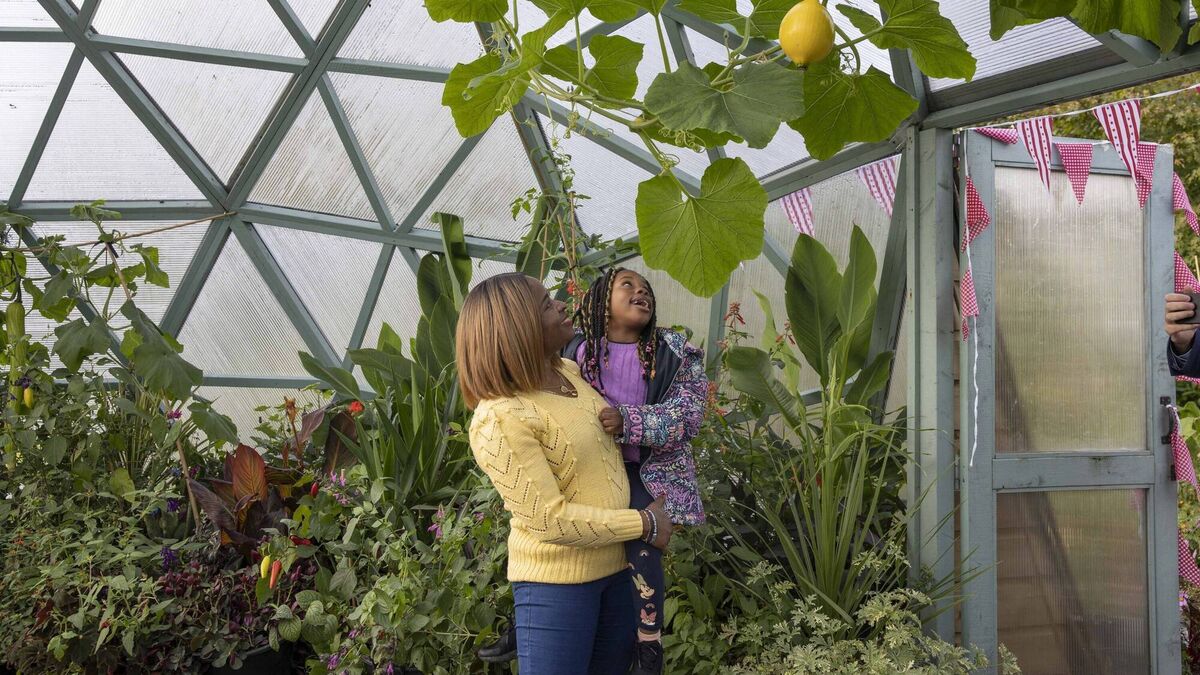
Deborah Oniah and her daughter Mona at the launch of Cork Migrant Centre’s International Garden Geodome. ‘ Picture: Clare Keogh
GARDENING can be a universal language, allowing people from diverse backgrounds, and with different languages, to find a common ground to connect.
This was one of the premises behind the International Garden, a Cork Migrant Centre outreach project, which has grown exponentially over the past year.
Established in September, 2022, the International Garden project provides a safe space at Ardfoyle Convent, Ballintemple, for families living in Direct Provision Centres and newly-arrived Ukrainian families in Cork. It is a place for these families to grow food from their own countries, in solidarity with others living in the local community.
“We talk about integration and cultural sensitivity a lot; but what do those words mean? Really, what does a human rights perspective mean? In truth, it means valuing people; it means people living with dignity.”
Dr Naomi, Masheti, programme coordinator of Cork Migrant Centre, believes that the Geo dome garden in Ballintemple is doing something very special.
“Integration cannot be a charity model where you tell people to stay put and eat what you give them. It cannot be about ordering people to stay where they are, and to eat what you give them. What we are doing here is recognising people’s power. People here are growing food like they did in Zimbabwe or the Congo. This is true cultural sensitivity,” she said.
The beginning
Dr Masheti said the whole project felt like a dream, their desire for the space keeping them going through many challenges.
“It was reactive to begin with, arising from Covid, people in direct provision were so restricted, sharing very limited spaces. Most people can walk around their home or into their garden. In lockdown, people in direct provision were in one room. They also had to stop coming to Nano Nagle for social events, which was very hard. Seeing people online and suffering, it was hard.”
Dr Masheti spoke to many of the women who shared a desire to be outside in order to meet safely and so the whole project began with the search for an outdoor space. A call was put out on Twitter (now X) and soon they were linked up with a horticulture school near a convent in Ballintemple.
“The nuns were so good about it and so we got an allotment. Then Nelson Abbey came on board who was really eager to help refugees. He rang out of the blue at just the right time and he has been wonderful ever since. We had the allotment but no capital so we came together at exactly the right time. We were completely aligned.”
Planting the Seeds
Dr Masheti knew the convent was very private so they kept the project to just seven families.
“We got the initial capital to start the garden; we also connected with a company called REMITLY, who sent volunteers and that really helped. We were so lucky to have the horticulture school on site because they were telling us how to do everything. People had their own experience but very different ways of farming. Apple and Dell also got involved then, sending volunteers in to help us.”
The group started to create polytunnels so they could seed the plants and move them. Then a group in Mahon Point were looking to move their geodome.
“We expressed our interest and after a few months, we got it! We had to do a lot of funding to get it put up again and to include water taps. The students in the horticulture school were hugely instrumental in all of it,” said Dr Masheti.
Full Bloom
One year later and this project, which started from humble beginnings with a few allotments, has bloomed into a full-blown Geodesic Dome. This Geo-Dome, made from recycled materials, will allow participants to grow tropical plants and vegetables that would not survive or thrive in Irish weather.
“The geodome sounds like a perfect example of what community spirit can achieve,” says Dr Masheti.
“People are mixing from all parts of the world. A lot of the families from direct provision are from different countries in Africa and then volunteers from Dell and Apple were from other places like Europe and South America. Some people didn’t have great language but it didn’t seem to matter.”
What Dr Masheti noticed most was the galvanising effect it had on and between families. Some children also came along so it quickly became an intergenerational project. People from the big corporations brought their children at the weekend, so again, it was a cultural melting pot.
She also believes it is empowering for the families in direct provision, allowing a degree of independence and autonomy.
“They are able to say, this is a plant in Congo and this is how we grow and cook it. Food is a wonderful way to integrate.
“The nuns from Our Lady of Apostles were wonderful. Many of them had spent much of their lives in other countries, often in Africa.
“It was so interesting to hear them using the African words for food in Nigeria, Congo, places they might have lived in for 20 years. They love to see people around, place buzzing with people, want to say hello, and chat; it brings life into the compounds.”
Dr Masheti also believes the Geodome is having a positive impact on the people in the school of horticulture.
“We couldn’t do it without them. They teach us so much. They are also a marginalised group in society, many of the people in the school are just trying to get back on their feet.”
Family Flourishing
“These women come on Wednesdays and return to their families with food to cook with whatever vegetables they have, whatever they have grown.
“The plants grow quickly in the polytunnels, particularly in summer when the weather is good,” she explained.
In fact, the allotment is now producing a surplus of food. Mums and babies meet on Friday morning in Nano Nagle and they have started bringing the food to the other mums, so they can also cook it and share it with their families. Families as far out as Macroom are benefitting from the allotment.
“There are two women who come from South Terrace to work in the allotment. They walk there and return with vegetables. It has a huge impact on their mental health, to be able to walk with purpose.”
The allotment is continuing to grow in potential.
“It is a lovely place to sit on a rainy day and and Nelson Abbey has provided us with lovely chairs. We can have workshops in there now, sharing cooking and planting ideas.
“We’d like to put a kettle in thereat some point so people can make a cup of tea, and maybe a hotplate for cooking demonstrations.”
To the Future
The International Garden Project has been created in collaboration with SHEP, the SMA, Horticulture LTI, Green Spaces for Health, Community Gardaí, Cork City Council Social Inclusion office, Johnson Controls, Apple, Dell and the Resident Sisters at Ardfoyle Convent, where the garden is located.
This year, the gardeners have enjoyed local success by participating in the Cork on a Fork Festival with a market stall in Emmet Place selling produce grown in the garden. The aim for the International Garden is to continue to be a melting pot of cultures where people can come and learn from one another.
Fundraising continues to be a huge issue and Dr Masheti is grateful to those who offered generous support. People coming from direct provision had to be transported to the site and back, and often needed food as they stayed there for long stretches. Soil, fencing, all of it costly. They would also love more funding to put solar panels in place.
“This is true diversity and integration,” says Dr Masheti. “We have people from different countries all over the world talking about how they plant and cook in their countries. The differences melt away. One person might be from a corporation, another from direct provision, but they are each experts in their own country and their country’s food.
“Everyone is equal in this expertise. It is an exchange, a place of mutual respect. There is no power imbalance where one person knows all and another know nothing. Everyone is doing the knowing and learning together.”


 App?
App?


