Throwback Thursday: A toast to the lost pubs of Cork
This week in Throwback Thursday, JO KERRIGAN remembers the pubs that have closed up in Cork city, including The Viscount, The Celtic, and Bantry Bar. 
Throwback Thursday: A toast to the lost pubs of Cork

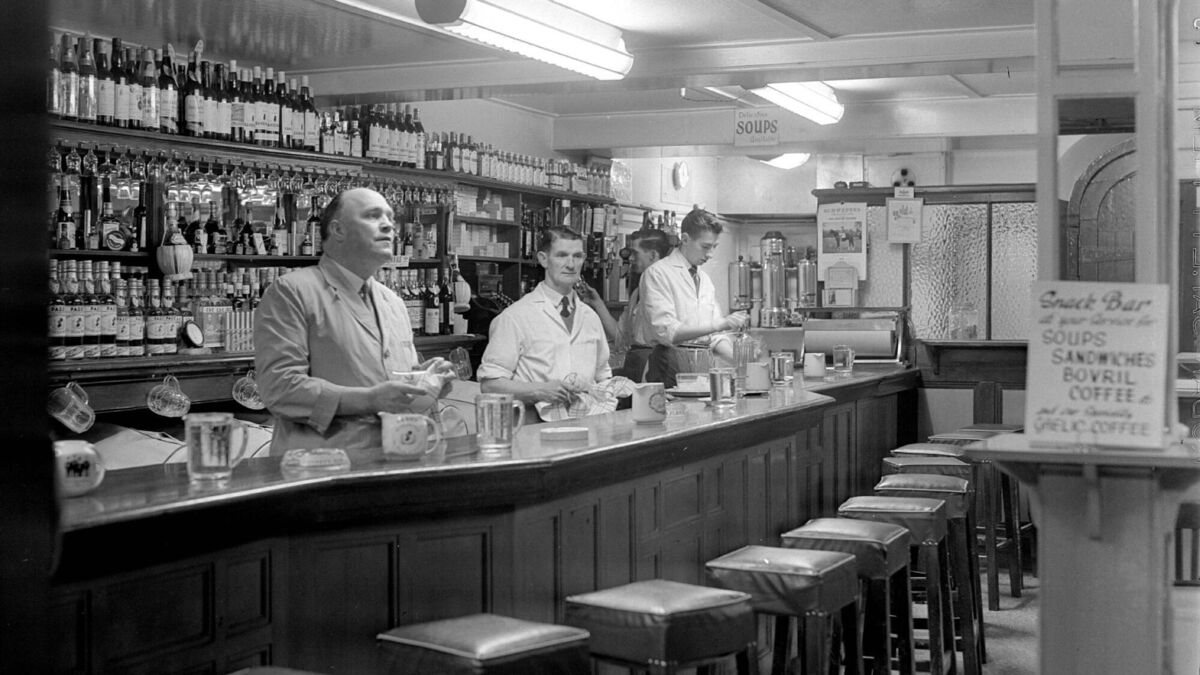
The interior of Kealy’s Bar in Faulkner’s Lane, off Patrick Street, Cork, in April, 1959. It was a popular haunt for students, and printers who worked at the nearby Echo and Examiner building

A recent report showed there had been a rapid decline in the number of pubs in Ireland, with 2,205 premises - or one-in-four - closing their doors since 2005.
On the official list, Cork ranked very high, with a whopping 33% going out of business.

As of April this year, there are apparently 55 pubs in the city itself, with 51 of those run as single owner-operators. Wonder how many there were 50 years ago, in 1966? I must ask the Pubs and Bars of Cork City and Suburbs group on Facebook if they have any idea. There are some great old establishments pictured and discussed on their excellent site, which does so much to keep the old memories green.

The Viscount in Bishopstown, for example, and The Celtic on Evergreen Street. The Hollyhill Inn on the northside, known affectionally to locals as ‘The Flying Bottle’. The great old Bantry Bar on Lavitt’s Quay. And so many more. Keep up the good work, lads!

We can remember with regret quite a few of the old pubs ourselves. Kealy’s, of course, that stalwart of Faulkner’s Lane (even the lane itself has disappeared now, for heaven’s sake, lost somewhere beneath the nice, tidy and trendy Opera House Lane), where students packed in side by side with off-duty printers and delivery men from the Echo and Examiner further down the narrow alleyway.

When this writer first heard that Mary Hopkin song, Those Were The Days, it was Kealy’s that came immediately to mind.

‘Once upon a time there was a tavern

Where we’d sit and raise a glass or two,

Remember how we laughed away the hours,

Thinking of the great things we would do?

Those were the days my friend, we thought they’d never end…’

But end they did for Kealy’s, although nobody quite believed it until they saw the rubble descending and the new world arising, with fashionable international fashion stores replacing barrows, the thump of barrels being unloaded, bundles of The Echo being thrown into vans, and above it all the great thunder of those old printing machines in the Examiner office above.

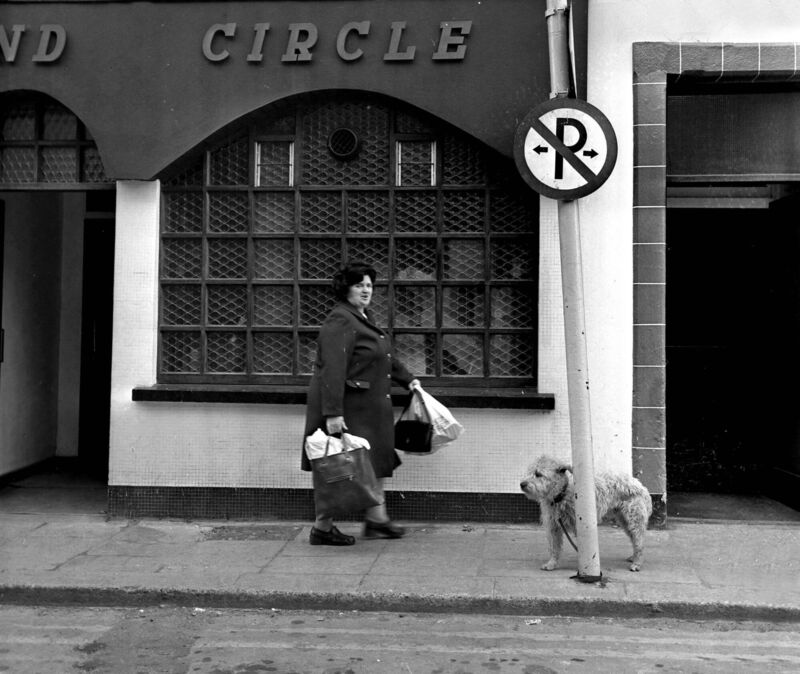
A dog waiting for his master outside the Grand Circle Bar in Drawbridge Street, Cork city, in May, 1977. It was demolished in 2007. 

Grief it is that even the big Patrick Street entrance to that fabled place is gone, replaced by a plaque and a statue of an Echo boy, so that we don’t quite forget. As if we could!
Of course, Le Chateau is still there, although the Green Room upstairs, where ladies could sip coffee while the menfolk drained pints down below, is also well gone. Along with The Old Bridge, The Leprechaun, Stella’s, and so many other venerable tea-and-cake establishments.

At least the Mutton Lane Inn by the English Market is still with us, and still claiming to be one of, if not the oldest pub still operating in the city. Great atmosphere of an earlier Cork in there.

(Incidentally, the oldest pub in Ireland is up at Athlone. Ath-Luain, Luain’s ford across the river Shannon. Been going since around 900AD, when one Luain, who would guide travellers across the shallow ford here for a consideration, started offering a jug of punch or a horn of ale from his little wooden hut. Today, it is called Sean’s Pub and has the relative distinction of once being owned by Boy George. Just thought you’d like to know in case you are ever up that way.)

There was actually a Mooney’s pub here on Cook Street once, if we are not mistaken, the only one outside Dublin opened by that historic family. It used to be said that the most expensive pint in the country was at the College Mooneys, outside Trinity, and by heck were they right!

The least expensive pint in the late 1960s in Cork was at a pub in Glanmire where you could still get a pint of Beamish for 2/6.

The Cook Street Mooneys later became a music and record store when the Dublin crowd pulled in their horns and decided to stay in De Capital, away from all dem culshies.

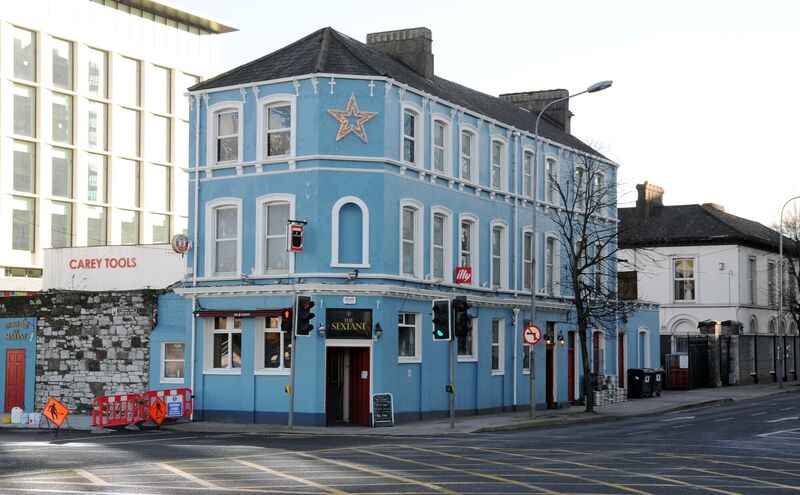
It is only recently that The Sextant Bar on Albert Quay was finally pulled down, amid much local mourning, to make way for yet another huge high-rise apartment block - 24 storeys, if you can believe it.

This new block is in an area that once resounded to the shouts of dockers unloading cargo boats, the jingle of harness and the jolting of drays as horses took goods and produce away to their final destinations, and all the bustle of a busy port.

The Sextant was one of the last of those famous dockland pubs that had a special licence to open early in the morning, so that tired men coming off the night shift could have a reviving pint and chat wearily among themselves before heading home.

Our old dockland pubs deserve a book all to themselves. If there already is one and I’ve missed it, please do tell me!

(That new 24-storey apartment block on Albert Quay does remind us of a Yes, Minister episode where permission is sought for an extra six storeys on an already massive new development. They end up gaining an extra nine, by thoughtfully allowing space below for a community-run urban farm. Yield a little to get quite a lot.)

But to return to this whole business of pubs closing all over Cork city and county. A good thing too, some of you may say: there is far too much drinking going on, and it’s time it was reduced.

Others, who relax with a beer or a glass of wine at home in the evening while watching television, can’t see what the problem is. But there is one.

For many of those living alone, both in the city and across the countryside, the local pub was the one place they could go to meet friends, be sure of a welcome, and spend an hour or two chatting and exchanging news.

The Sextant, which was demolished to make way for a tower block. Picture: Denis Minihane.

A lone farmer could look forward to finishing his work on a Friday or Saturday night and heading down the long lane towards that welcome light. Pushing open the door, he would be hailed by name, invited to join a group, asked what he was having...

If you live the hard lonely life all week, a place like that was more than pleasant, it was a lifesaver.

To lose that comfort, that much-anticipated few warm hours each week, takes away the one thing on which that man could rely – finding like-minded company to share his worries and lessen his sense of being alone in the world.

With every country pub that closes, somebody’s window on an outside world is firmly shut.

What we need here is an organised system of night transport to and from rural pubs. It would bring good business, and it would do wonders for country folk. Does any public house run such a service? Please do let us know.

What was great about the old city pubs was that, on different nights of the week, an individual or a group might offer homegrown entertainment, playing the piano perhaps, leading a sing-song, or even making up a band from the clientele.

Joe Mac, are you still delighting the crowds at Canty’s on Pembroke Street? More power to you, boy!

And what was that singing pub up beyond Dillon’s Cross? The Cotton Ball! That is still going. Many’s the night in the 1960s that it resounded to the latest folk hits being belted out by a happy crowd.

What else was going on in Ireland back in those heady days, besides singing pubs, when we were cautiously emerging from the grimmer times of the ‘40s and ’50s, and wondering if we too might just sneak a little of the fun they seemed to be having in England and America, with all this pop culture and beat bars and all.

Well - on August 1, 1961, Ireland applied for full membership of the European Economic Community. The UK had also agreed to join, although not without expressing considerable doubts. Doubts that were more than shared by President Charles De Gaulle in France, who felt that England would be bound to cause trouble, arguments, hassle. Wonder where he got that idea?

On New Year’s Eve the same year, President Éamon de Valera opened Radio Telefís Éireann, at a champagne reception in the Gresham Hotel on Dublin’s O’Connell Street. In his speech, Dev admitted to feeling somewhat afraid of this new technological achievement.

“Like atomic energy, it can be used for incalculable good, but it can also do irreparable harm,” he said. Doubtless anticipating useful news and weather programmes, but surely never dreaming of The Young Offenders and full weekend runs of Fair City.

At the end of June, 1963, President John F. Kennedy came to Ireland on a state visit. He flew in to Collins Barracks in Cork, and came down through the city, standing up in an open-top car and receiving a rapturous reception. Bet you remember exactly where you were on that momentous day. As you do on that tragic evening the following November when the appalling news of his assassination reached us from Dallas.

In February, 1965, our then Taoiseach, Seán Lemass, actually went up to Stormont to meet Northern Ireland prime minister, Terence O’Neill, marking the first signs of a thaw in cross-border relations since partition. Maybe as a result of that, an Anglo-Irish Free Trade Area Agreement was signed by Britain and Ireland in November of the same year, with Britain abolishing import duties on most Irish goods, and Ireland cutting import duties on UK goods by 10%.

March 8, 1966, saw a Great Big Bang on Dublin’s O’Connell Street when Nelson’s Pillar was blown up by the IRA. The army removed the remainder of the column a week later, not very effectively as it happened, with crowds nevertheless cheering and clapping as this sign of English colonisation fell.

There was even a popular song to be heard in all the pubs:

‘Up went Nelson in old Dublin.

Up went Nelson in old Dublin.

All around O’Connell Street, the stones and rubble flew,

When up went Nelson and the Pillar too!’

The Swinging Sixties took a little time to spread to Cork, but there was a definite if gradual change being noticed.

Ford, Dunlop, Sunbeam, all were thriving, and employing thousands. The department stores began to stock newer and more exciting things, the grocers to offer luxuries hitherto unavailable (even cheap, screwtopped, bottles of wine!

TV was still black and white, the distinct pong of Goulding’s fertiliser still spread across the city when the wind was from that direction, there were still ragged children to be seen in the Marsh and the narrow laneways off Shandon Street, but the time-honoured custom of ‘doing Pana’ was growing into a formal passegiatta on a Saturday afternoon, when you could see the most daring mini skirts, the coolest hussar jackets on display. We were on the way up.

What do you recall of the Swinging Sixties at last reaching Cork? Or is there a pub, now gone, that you still have fond memories of? Email jokerrigan1@gmail.com or leave a comment on our Facebook page: www.facebook.com/echolivecork.
More in this section

Throwback Thursday: Do you recognise any of these extras from the Moby Dick film set in Cork?  Throwback Thursday: Do you recognise any of these extras from the Moby Dick film set in Cork? 
Throwback Thursday: 'Five generations of our family have gone on holiday to Courtmac’ Throwback Thursday: 'Five generations of our family have gone on holiday to Courtmac’
Throwback Thursday: Responding to a 22-year-old letter with memories of Moby Dick Throwback Thursday: Responding to a 22-year-old letter with memories of Moby Dick

Sponsored Content

Big Beach Clean 2026: Final call to join 7,000 Clean Coasts volunteers  Big Beach Clean 2026: Final call to join 7,000 Clean Coasts volunteers 
CS Skoda September 2026 In every hidden detail, Tapestry for Ireland captures who we are
When it comes to supporting education for children with special needs, every little helps a lot When it comes to supporting education for children with special needs, every little helps a lot
Contact Us Cookie Policy Privacy Policy Terms and Conditions

© Examiner Echo Group Limited

Add Echolive.ie to your home screen - easy access to Cork news, views, sport and more