Cork soldier whose brain was stolen by the Nazis
After dying while being held as a Prisoner of War in World War II, Youghal man Patrick O’Connell suffered a final indignity - and now efforts are being made to trace his family, says JOHN DOLAN
Cork soldier whose brain was stolen by the Nazis

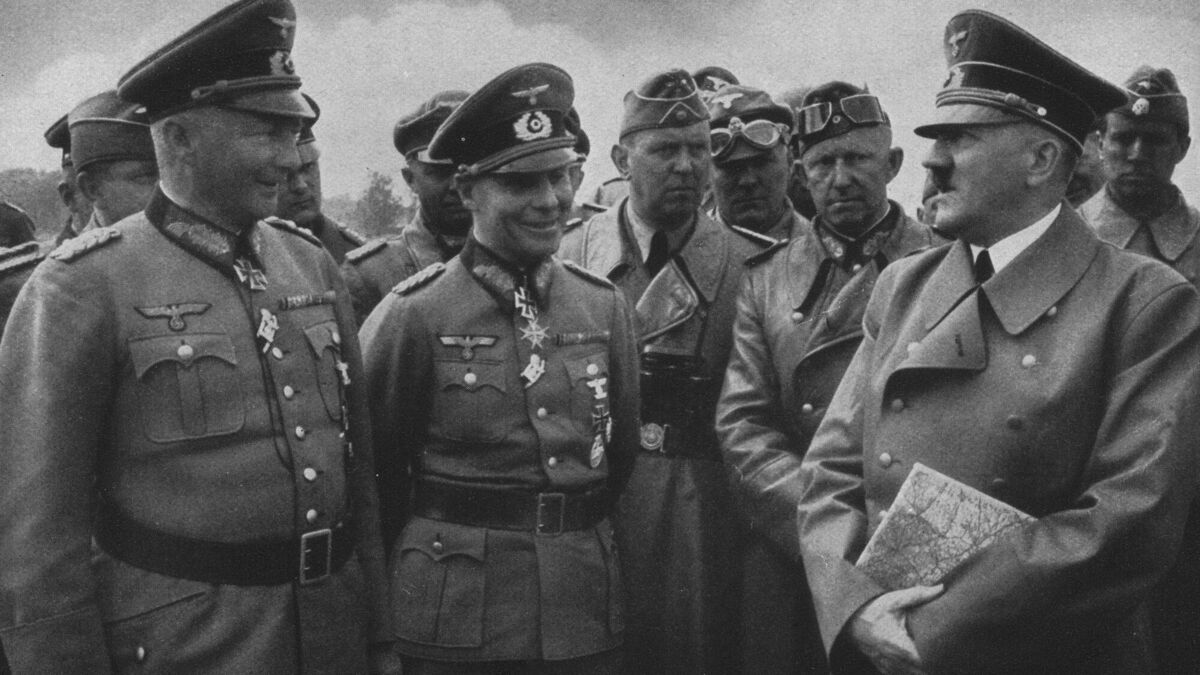
Adolf Hitler with Field Marshal Gunther von Kluge (left) and Commander of the 7th Panzer Division Erwin Rommel in France around 1940. Youghal soldier Patrick O'Connell was captured by Rommel's troops in France that year. Picture Hulton Archive/Getty Images)

FOR Cork soldier Patrick O’Connell, World War II was a traumatic, harrowing experience - and after his death, he was even denied the basic human right of being allowed to rest in peace.
The Youghal man, while briefly living in London in his early twenties, had joined the Royal Irish Fusiliers, who were dispatched to France to defend it from the Germans early in 1940.

But his regiment was overrun by the 7th Panzer Division under Major General Erwin Rommel, and on May 23 - four days before the famous evacuation of Dunkirk - Patrick was captured by Nazis.

After a few months in captivity, the Corkman, whose tuberculosis had previously been well-managed, suffered a flare-up and it was found to have spread to his lungs, body, and brain.

In March, 1941, he underwent surgery, which failed, and he died on April 24, aged just 25.

Just another victim, albeit indirectly, of the travails of war, that should be the end of the story. Except it wasn’t.

Back in Youghal, Patrick’s parents, Timothy and Mary Ellen (nee O’Dwyer), his older brother Daniel, 28, and younger brother, Thomas, 12, were given the devastating news he had died and been buried in the Olympischestrasse Cemetery in Berlin.

What they didn’t know - and what none of his family ever found out, as far as is known, is that Patrick had had his brain removed by Nazi medical researchers after his death, and had been buried without it.

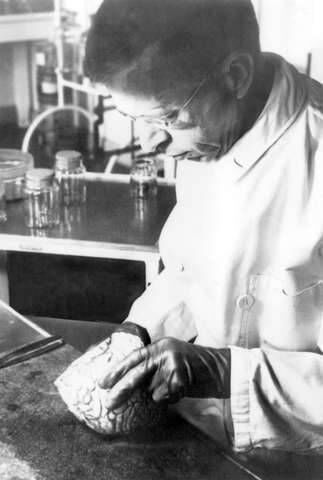
NAZI BELIEFS: German doctor Julius Hallervorden in his lab. He illegally, unethically arranged the removal of the brains of hundreds of dead people in World War II for medical research, including that of Cork soldier Patrick O’Connell. Picture courtesy of archives of Max Planck Society, Berlin

This gross indignity was illegal, unethical, and contravened the Geneva conventions regulations on the treatment and honourable burial of prisoners of war.

******

Medical experiments on both the living and the dead were not uncommon in Nazi Germany.

Most infamously, Dr Josef Mengele - dubbed the Angel of Death - performed experiments on the bodies of prisoners at Auschwitz , before and after they were killed in the gas chambers.

In Patrick’s case, his death from TB was of interest to Dr Julius Hallervorden, head of the Neuropathology Department of the Kaiser Wilhelm Institute for Brain Research.

A member of the Nazi Party, he later admitted to knowingly performing much of his research on the brains of executed prisoners and participated fully in the sinister euthanasia programme run by the Third Reich.

Hallervorden allegedly told one Jewish Holocaust refugee: “Look here now. If you are going to kill all those people, at least take the brains out so that the material can be utilized. They asked me,’How many can you examine?’ and so I told them... the more the better.”

He is thought to have illegally obtained at least 700 brains.

In Patrick’s case, an autopsy ruled tuberculosis of the brain as the cause of death, and the organ was removed, to aid Dr Hallervorden’s research into the illness.

The Corkman’s brain was cut into sections, examined, photographed, and retained in a medical collection in the Edinger Institute in Frankfurt until at least the mid-1960s, where records are lost. It is possible the brain is still in the collection.

As for Patrick’s body, it was exhumed and reburied in May, 1959, in the Berlin 1939-1945 War Cemetery. His family in Youghal were asked by the British army what memorial they would like for the grave site. They chose a simple cross and the inscription ‘In proud and ever loving memory of our dear son Patrick, R.I.P.’

******

It is a harrowing story, but there may yet be a closure of sorts.

This year, the Holly Bough was contacted by Dr Aisling Shalvey, of the German National Academy of Sciences in Halle, who is hoping to track down relatives of Patrick, and other families whose loved ones suffered a similar plight.

Originally from Kerry, and with relatives in Douglas and Crosshaven, Aisling is a historian who, since 2016, has been working, with others both in Germany and internationally, on a project about the victims of medical research during the Nazi era.

She has a database of victims, but explained: “Medical records are often quite impersonal, so where possible we try to find family members to provide photographs, personal memories and details to bring some form of individuality and dignity back to these people.

“So far, we have found a number of victims from various backgrounds, but I was most surprised when an Irish prisoner of war was among them.”

When the project is finished in October, 2024, Aisling is planning a memorial service for the victims and will invite surviving family members.

She has put out a call to Holly Bough readers to see if they know of Patrick’s surviving family, who might be able to attend that service, and reveal more about the Corkman’s life.

She said: “In order to track down his family, I am now relying on the local connection - someone who may have played sport with him, or gone to school with him, or was a neighbour, who might have some information on the family or on Patrick himself.

“While this is of course a sad story, it is also heartening in some ways to know these people are not forgotten. It is our hope someone will come forward to provide us with details, and hopefully, provide some sense of closure to the family.”

The project is part of the ongoing healing process in Germany over the past 80 years.

As late as the 1980s, body specimens that had been taken without consent were kept in the country’s teaching and research collections. Student protests and a change in the academic atmosphere of neuroscience finally put an end to the practice.

However, it was clear that many of the remains were still in collections and still identifiable.

Aisling added: “So far, we have more than 30,000 victims in our database, many of whom have been definitively identified, and several of whom we have contacted their family members.

“Victims include people who were killed in the so-called ‘euthanasia’ of the sick and disabled in institutions, allied prisoners of war, concentration camp victims, those who were executed for ‘crimes’ such as having relationships with Jewish people, as well as psychiatric patients.”

Searching for Private O’Connell: Can you help?

HERE is what we know of soldier Patrick O’Connell - and what initial research by the Holly Bough has found out.

He was born a Catholic in Youghal on June 26, 1915. His older brother, Daniel, was born in 1913, and married and had children, who may still be alive. Daniel died in 1987.

Patrick’s younger brother, Thomas, was born in 1928 and is possibly still alive. He is thought to have married a Youghal woman, Anna Whelan, and they moved abroad - possibly to the U.S.

Patrick’s service number was 7043120, his PoW number was 7749, and his grave number in Berlin is 9.H.23.

The Holly Bough reached out to veteran Youghal contributor Mike Hackett, who came up with a few nuggets of information.

He said: “Daniel O’Connell was well known to me - he lived in McCurtainstown in the Strand - adjoining the Cosy Cafe - when I was young.” A 96-year-old woman told Mike that Dan’s mother, Mary, had a brother, a Commander O’Dwyer of the British Navy, who came to live in Youghal in retirement. He was also a senior manager in the Harland and Wolff shipyard in Belfast.

This may have been Engineer Commander Daniel P O’Dwyer, who attended Christian Brothers School, Youghal, and later lived at Carrigside, Youghal. He was awarded an OBE, and died on November 7, 1981, at Youghal District Hospital.

Mike believes there are no relatives of those O’Connells or O’Dwyers alive in the local area.

Can you identify Patrick? Email hollybough@theecho.ie or aisling.shalvey@leopoldina.org
Read More

More in this section

Throwback Thursday: Memories of Kent station ...and the man who missed seeing the Beatles Throwback Thursday: Memories of Kent station ...and the man who missed seeing the Beatles
Remembering Con and my brief stint as Jack’s gaffer in Cork Remembering Con and my brief stint as Jack’s gaffer in Cork
Throwback Thursday: I bought my house in 1978... for £14,200 Throwback Thursday: I bought my house in 1978... for £14,200

Sponsored Content

City Tiles and Bathrooms: Latest trends and timeless colours City Tiles and Bathrooms: Latest trends and timeless colours
Step into nature during National Biodiversity Week Step into nature during National Biodiversity Week
55 years of Cork Simon Soup Run: The light that has never gone out 55 years of Cork Simon Soup Run: The light that has never gone out
Contact Us Cookie Policy Privacy Policy Terms and Conditions

© Examiner Echo Group Limited

Add Echolive.ie to your home screen - easy access to Cork news, views, sport and more