Striking ambulance workers ‘prepared for the long haul’
By Cillian Sherlock, Bairbre Holmes and Claudia Savage, Press Association
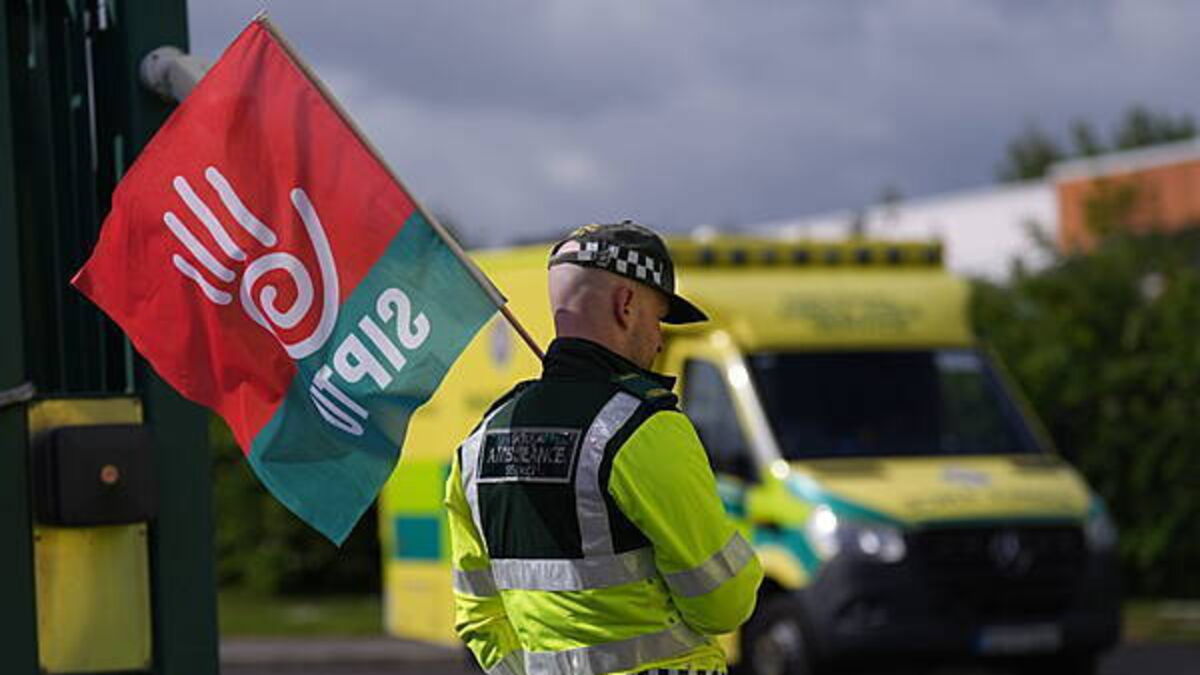
Picketing ambulance workers have said they are “prepared for the long haul” after they began 24-hour strike action over a pay dispute at 8am on Tuesday.
Siptu and Unite union members at the National Ambulance Service are involved in the work stoppage, which followed work-to-rule action on Monday.
The Department of Health has said it is “regrettable” the strike has gone ahead and that the industrial action would have a significant impact on service capacity.
The unions say qualifications, clinical responsibilities and operational duties of emergency medical technicians (EMT), paramedics, advanced paramedics, paramedic specialists and paramedic supervisors have expanded significantly in recent years.
They also say a 5% increase recommended under the benchmarking II process has not been delivered.

Speaking to reporters in Dublin after the strike began, Taoiseach Micheál Martin said: “It is not satisfactory for patients or the people generally that a first-responder service should be mired in industrial action of this kind.”
He urged unions to re-engage in dialogue, adding: “It is the only way this will get resolved.”
Domhnaill Joyce, an EMT in the National Ambulance Service and a Siptu shop steward, called on the Taoiseach, along with the HSE and minister, to intervene.
“At the end of the day, Micheál Martin is the man who actually set up the HSE. This was his brainchild,” he said.
“We want him to intervene and to call a halt to this.”
Siptu ambulance sector organiser John McCamley told Press Association that union members have “gone through every process that you can imagine” to resolve the dispute, but “unfortunately, we feel that we’ve been unheard and we have to take this action”.
He said an independent report in 2020 recommended that their members “should have enhanced high scales because of the upskilling and changes that have taken place in the National Ambulance Service over the last 15 years.
“Unfortunately, the HSE and the Department of Health haven’t implemented this report.”
The strike involves pickets at ambulance depots which began at 8am, including at Davitt Road in Dublin South Central and in Dundalk.

Workers on the picket lines say while they love their jobs and want to put patient safety first, they need to be listened to.
Speaking in Co Louth, paramedic Tony Murphy, who is based at Dundalk Hospital, said: “I love my job, I’ve been doing my job for 26 years, it’s a job where you’re helping people and making a change, dealing with the public in their time of need.
“It’s an excellent career, I’ve loved every minute of it, but unfortunately today this is a low point, being forced to the gate.
“We haven’t been listened to, we have taken on a lot of new responsibilities and new roles, new drugs.
“We had the promise that we’re going to get pay for those, and remuneration, and the recognition of the role.”
The HSE has warned there “will be delays responding to non-life-threatening calls for ambulances” on Tuesday into Wednesday.
It advised people to “consider if another healthcare option might be suitable”.
Unions have agreed contingency plans with the HSE to ensure that patient safety is prioritised during the dispute.
Murphy said: “I am a duty crew today, so that means I’ve got my radio on me, and if this radio goes off we will leave the picket line, I will go and do a call.

“That’s been dealt with by the operations resource centre and with the strike committee.”
Further work stoppages are scheduled for May 19th and 26th, with additional action planned during June if the dispute is not resolved.
Paula Lawless, a paramedic and shop steward for Siptu, said morale at the Dublin South Central ambulance station was at “100%” and they were “absolutely” in it for the long haul.
“The long haul is the long haul, whatever it takes. Hopefully it won’t come to that, but we’re all prepared for the long haul.”
As she spoke, dozens of passing vehicles beeped their horns in support of the protest at the protest on Davitt Road.
Striking ambulance workers are “happy to be out, but they’re not happy to be here”, she added.
Lawless said over the past 15 years “our skills have been upgraded and the pay hasn’t”.
She said while the change in the role has made the job harder, it has considerably improved patient care, adding: “The patient always will come first and you’ll give them whatever they need and the best care you can give them at that time.”
Brendan Byrne, regional officer for Unite the Union, was on the picket line at Dundalk ambulance station.

He criticised a lack of action following a report by both the HSE and the Minister for Health Jennifer Carroll MacNeill.
“Six years ago in 2020 there was an independent report done and as far as we’re concerned the HSE hasn’t implemented that report or engaged in implementing that report in any way, shape or form in a serious manner,” he said.
“The report said that there should be consideration given, in terms of the pay bands and pay grades, to the extra duties and the upskilling our members have achieved.
“We remain open to do that, but the inaction by the HSE and the minister has led us to where we are.”
Sinn Féin health spokesman David Cullinane accused the Government of failing to deal with long-running problems in pre-hospital emergency care services.
He called on the health minister to engage with workers and implement an agreed pay and grading modernisation plan.
He said: “The minister for health cannot stand back while ambulance workers are forced into industrial action.
“The minister must intervene directly, engage meaningfully with workers and ensure that ambulance workers get the respect, recognition and safe staffing that they deserve.
“The minister must take workforce planning seriously and implement a real workforce plan to train and retain the paramedics our communities need.”