Northern Irish peace process given to British ‘on a plate’, Adams tells court
By Danny Halpin and Callum Parke, Press Association
The Northern Irish peace process was given to the British government “on a plate”, Gerry Adams has told the High Court.
Adams is giving evidence on Tuesday in defence of a legal claim brought against him by three victims of bombings in England by the Provisional IRA in the 1970s and 1990s.
John Clark, a victim of the 1973 Old Bailey bombing in London; Jonathan Ganesh, a 1996 London Docklands bombing victim; and Barry Laycock, a victim of the 1996 Arndale shopping centre bombing in Manchester, all allege that Mr Adams was a leading member of the Provisional IRA on those dates, including of its Army Council, and are seeking £1 in damages.
We put together a peace process. It was given to John Major’s government, if I may use the expression, on a plate
The former Sinn Féin president denies the allegations and is defending the claim, telling the court that he had “no involvement whatsoever” in the bombings and was never a member of the Provisional IRA.
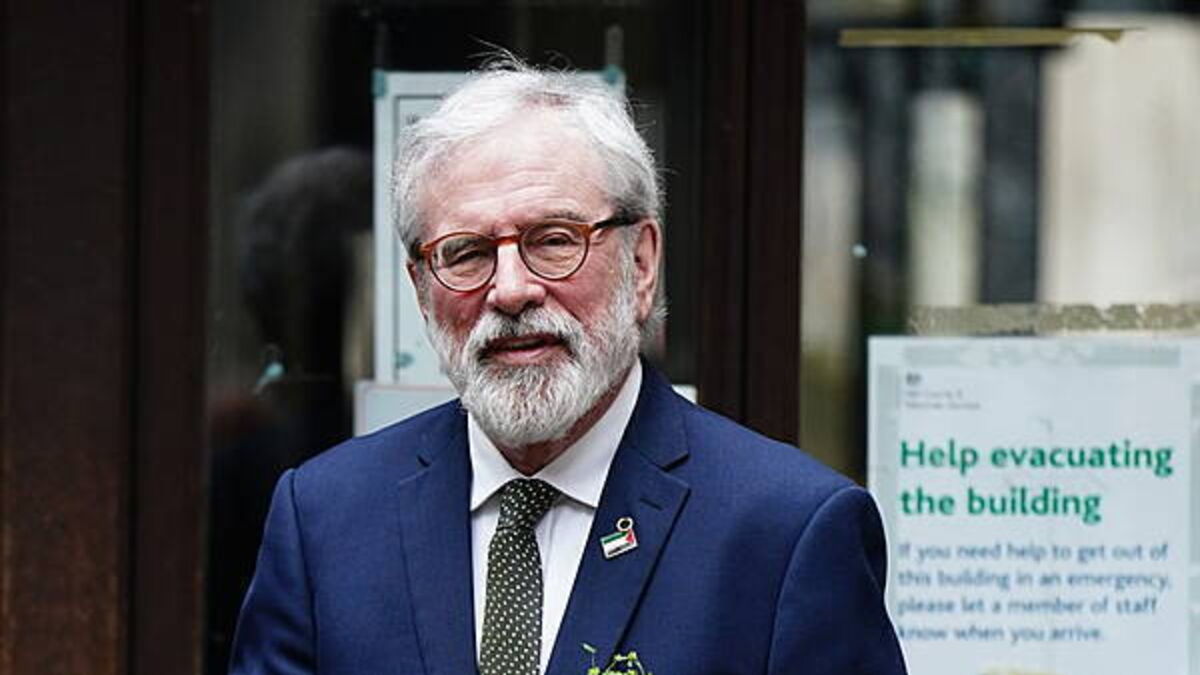
Adams, wearing a dark suit and tie, a shamrock and a badge of the Palestinian flag, began his evidence by wishing the judge, Mr Justice Swift, “a very happy St Patrick’s Day”.
Later on Tuesday, Sir Max Hill KC, for the victims, suggested during cross-examination that Mr Adams used bombs as a way to get the British government to the negotiating table.
Sir Max said: “I am asking whether you accept that bombing Britain has worked for you, Mr Adams.”
Mr Adams replied: “No. We put together a peace process. It was given to John Major’s government, if I may use the expression, on a plate.

“He was handed this put together by people in Ireland with help from our friends in Irish America.
“There is no reason whatsoever in any person’s language why the people who live on the island of Ireland cannot be free from British rule.”
Adams said later: “I think it’s OK to have friendly relationships with your neighbours, but we don’t want our neighbours living in our house, living in our home.”
When asked whether he had disdain for John Major’s government, Mr Adams said: “It’s done, it’s gone.
“I have learnt that you have to live in the nows, you can’t live in the past, you have to live in the future.”
He continued: “A united Ireland is not inevitable.”
He added: “I hope to live in a united Ireland, but if I do not, I will go to my grave content that I have played a role in bringing about a united Ireland.”
He also said: “We are not at the end objective yet, but we have peace.”

Adams has claimed that while he was a member of Sinn Féin, and was the organisation’s president from 1983 to 2018, he “was never a member of the IRA or its Army Council, and I never held any role or rank within the IRA”.
He told the court that he never took an oath of allegiance to the Provisional IRA, and attended talks with the British government in London in 1972 in his capacity as a member of Sinn Féin.
Adams then denied Max’s claim that he was “rewriting history”.
Earlier on Tuesday, Adams told the court that while he did not distance himself from the Provisional IRA, he was glad the organisation had “left the stage” and that there were “dastardly things that were done that should never have been done”.
In his witness statement, he also said that he “had no involvement in or advance knowledge” of the three bombings.
Anne Studd KC, for the bomb victims, previously told the trial that being a member of Sinn Fein and a member of the Provisional IRA was “a distinction without a difference” for some individuals, including Mr Adams.
Studd also told the court that Mr Adams had “a foot in each camp” of the military and political sides of the Irish Republican movement.
The barrister continued that Mr Adams was “directly responsible for and complicit in those decisions made by that organisation to detonate bombs on the British mainland in 1973 and 1996”.
The trial before Mr Justice Swift is expected to end later in March.