One chart shows why Ireland could be among hardest hit by Trump's tariffs
Tomas Doherty
United States president Donald Trump is expected to impose sweeping new import taxes on Ireland and other global partners, which could escalate a trade war, increase prices and upend a decades-old world order.
Mr Trump is likely to target European Union countries, including Ireland, with tariffs of about 20 per cent. Tariffs are taxes applied to goods imported from other countries.
Ireland is among countries vulnerable to changes in the global economy proposed by president Trump, with a significant proportion of employment, tax receipts and exports all directly dependent on a cluster of US multinational firms.
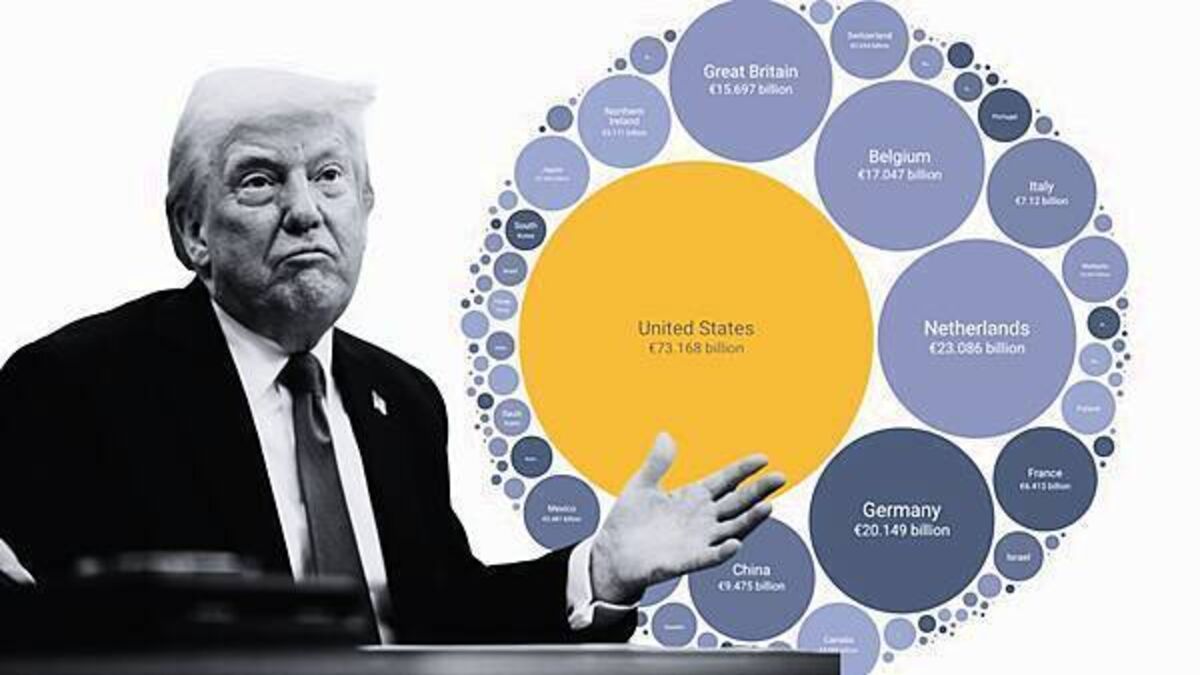
In the chart below you can see all of Ireland's trading partners in 2024 sized by the value of trade, with the US dwarfing other countries.
The US accounted for €73 billion of Irish goods exports last year, up by €19 billion on 2023.
EU countries received more than €88 billion of Irish goods in 2024, an increase of €7 billion compared to 2023.
Of this, €20 billion went to Germany, €23 billion went to the Netherlands and €17 billion went to Belgium.
Analysis co-authored by the Department of Finance and the ESRI think tank suggested that tariffs for goods entering the US could cost the Irish economy more than €18 billion in lost trade.
It also warned that a prolonged trade war between the EU and US would pose a risk to the public finances.
There are growing fears that any tariffs announced by president Trump could also impact the pharmaceutical sector, which has traditionally been exempt from import taxes.
Medical and pharmaceutical products accounted for 45 per cent of Irish goods exports in 2024, with a value of almost €100 billion – the bulk of these products were manufactured by US pharmaceutical giants based in Ireland.
About 45,000 people are employed in the Republic’s pharmaceutical companies, while some €58 billion in pharma and chemicals were exported from Ireland to the US last year.
The world's 10 biggest drugmakers, including US companies Johnson & Johnson, Pfizer and Merck, all have large plants in Ireland.
Taoiseach Micheál Martin said the threat of tariffs was the “most serious issue” to face the Irish economy, adding that the scale of impact will be very significant.
“I think the old order is changing, and it’s regrettable we are in a Europe of increased protectionism,” he told the Dáil on Wednesday. “That is not good for Ireland. It’s not good for open economies.”