John Arnold: My pilgrimage to Gaeltacht to celebrate Dónal, bard and poet
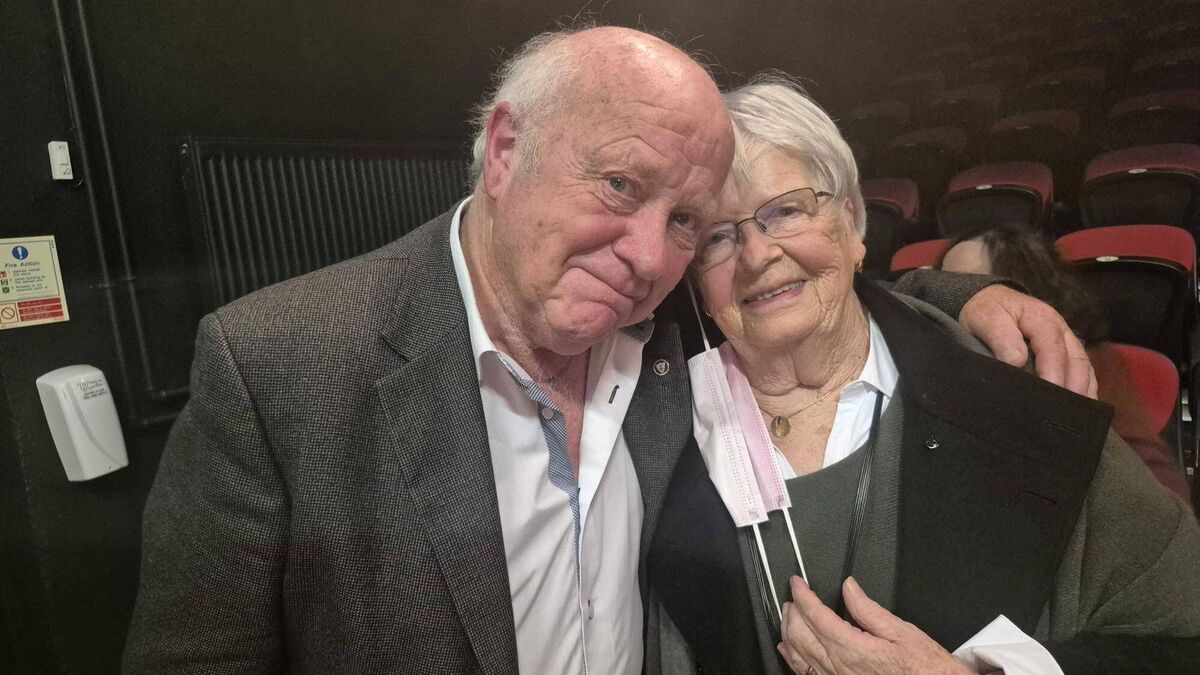
John Arnold with Margaret Lehane, wife of the late Dónal, in Ballyvourney for the launch of Ar Bhruach na hAbhann.
I drove down to the Muskerry Gaeltacht village with Jerry Galvin. Though ‘exiled’ in Fermoy with decades, Jerry is a born Béal Átha an Gaortadh man agus tá an Gaeilge binn, ceolmhar aige fós.
Though he’s an Uíbh Laoire man, he has great ‘meas’ on the Naomh Abán people.
The cause of our westward sojourn was to remember, recall, and celebrate Dónal Ó Liatháin.
Born in Coolea in 1934, Donal grew up in an Irish-speaking family and parish I gceart-lár an Gaeltacht.
He attended National School in his native Coolea - his mother Cáit and uncle Pádraig Mac Suibhne were amongst his teachers there. Known as An Suibhneach Mean, Pádraig was himself a poet and writer trí Gaeilge and was hugely influential on young Donal.
After a cúpla bhliain in the nearby teacher training Coláiste Íosagáin, Donal took himself to the big smoke of Baile Átha Cliath. Here, in St Patrick’s, Drumcondra, the young gaeilgeoir qualified as a teacher.
After a year in Killenaule, Dónal Ó Liatháin NT took up his duties in Bartlemy National School in January of 1955 - two years before I was born.
A fine Gaelic footballer, Donal played with his home club initially and then wherever his teaching took him - he won a Co. SF title with Fethard in 1954. He played Junior and Senior Football with Fermoy and maybe two Junior games with Bride Rovers!
After a three-year absence, the Bride Rovers Club was re-started in December, 1964, at a meeting in Bartlemy Hall. Donal was appointed rúnaí . He also served as secretary of the Muintir na Tíre Guild here for a few years.
He was a native speaker of Irish, of course, and ag labhairt Gaeilge was as natural to him as breathing. Maybe I had a love of the language from an early age too, but Master Lehane enkindled and encouraged that passion. By god, he could be passionate, and explosive too!
In fairness, in all my years in National School, I never heard him utter an expletive and he wasn’t one for ‘effing and blinding’, but when the temper rose in him he’d raise the voice about four decibels and shout ‘Well blazes, Kate’!
Using the stick in the classroom was allowed back then. He often ordered some of the sixth class boys to go out and cut a stick for him! No use bringing in a weak bit of a fir branch or an alder that would easily break - it had to be fit for purpose!
I recall one day, when the Master was out in the yard, two lads got his fine stick out of the press, broke it in two, and threw it into the fire. There was ‘blazes, Kate’ on the double when he saw the remains of the stick go up in flames.
He had strong suspicion on two lads - both named John, a few years older than me, mind. There was kind of an inquisition with the boys in the dock. To the first John, he asked, ‘Did you break the stick?’ To which John answered, ‘I didn’t burn the stick’. Then he asked John No 2, ‘Did you burn the stick?’ To which John replied, ‘I didn’t break the stick’ .
Over and hether it went, with the lads answering the question they weren’t asked! Eventually, the Master gave up, but we all got extra ‘lines’ to do.
Two years after Donal had wed Kilkenny-born nurse Margaret Byrne, they purchased a site to build a house in Knockadroolen, Rathcormac.
There’s a grand phrase in Irish, ‘Ní mar a shíltear a bhítear’ – I suppose the closest in English or Scottish is ‘The best-laid schemes o’ mice an’ men aft agley’ – the words of Robert Burns; things don’t always turn out the way they’re planned.
In the summer of 1968, while back home in Coolea, Donal learned of a teaching position to be filled in Coláiste Íosagáin. He applied and, no better buachaill, he got the job.
So, on October 16, 1968, the Lehanes bid ‘slán’ to Tobar Phartaláin - we had a big ‘do’ for them in the hall in Bartlemy.
Just five years before that, one John Reidy, a.k.a Seán Ó Riada, wishing for total immersion in Gaelic culture, had moved to Coolea. With An t-Athair Donncha Ó Conchubhair, he started the Coolea Choir -Cór Chúil Aodha. On his return to his Gaeltacht dúchas, Dónal was soon with the Cór. Singing, composing songs, writing poetry, agallamh beirte (two-person conversations), as well as teaching.
Gan dabht Sean agus Dónal became the best of friends - bhí an- chairdeas eatarthu. Great minds do think alike, and both men had a fís, a vision, a dream for their own paróiste and for the preservation and growth of all things Irish.
During the years before Seán’s death at the age of just 40 in 1971, the bond and friendship grew so strong it entwined muintir Uí Liatháin and clann Ui Riada.
Last Saturday night, it was a ‘Teach Lán/Full House’ sign at the beautiful Ionad Cultúrtha i Baile Mhúirne. The occasion was the official launching of a wonderful book, (On the River Bank) - a collection of poems, songs, and other works of Dónal Ó Liatháin.
Donal Lehane died in 2008, just four years before that he’d been back to Bartlemy for the National School Centenary - what a weekend.
So now muintir Uí Liatháin have gathered some of his work - all ‘as Gaeilge’, and what lovely Irish he had.
I’m OK at caint as Gaeilge, but wouldn’t be that great at reading Irish language literature, but this book is go hálainn ar fad.
Launching the book on Saturday, Peadar Ó Riada was very emotional. He knew Dónal since he was a child, and from the day Seán died in 1971 himself and Dónal had continued and built that friendship. They worked together on so many projects over the years. Peadar set a lot of Dónal’s work to music and numerous Oireachtais prizes came to the Muskerry Gaeltacht.
Peadar explained that Dónal Ó Liatháin. was both a poet and a bard -a rare enough duality. With a quiver in his voice and tears in his eyes, Ó Riada spoke of the inspiration and boundless energy which Donal had, and of course the fun - the word ‘craic’ was probably invented to describe Dónal Ó Liatháin.!
We met Margaret and the family and the oíche was spent with everything done in the lilting Irish of the Muskerry Gaeltacht.
The work of Gael Scoileanna and Ciorcal Gaeilge all over the country is go breá but tis only when you experience the ‘pure drop’ of life in a Gaeltacht that you can really appreciate the truth of the saying, “Tír gan teanga, tír gan anam” - A country without a language is a country without a soul.” - Padraig Pearse.
So often when I write ‘below in the room’ the only sound I listen to as background music, to inspire me when necessary, is Ó Riada’s majestic Mise Eire. Gan dabht I’ve heard it hundreds of times, but it always gives me that feeling of pride in our culture, our history, our music and song, and especially our language.
From now on, I’ll read a poem each night from and have Ó Riada accompany my thoughts and musings. Dónal and Seán would like that.




 App?


