'I'm developing a 3D-printed powered prosthetic hand...here's my advice to students with an idea'
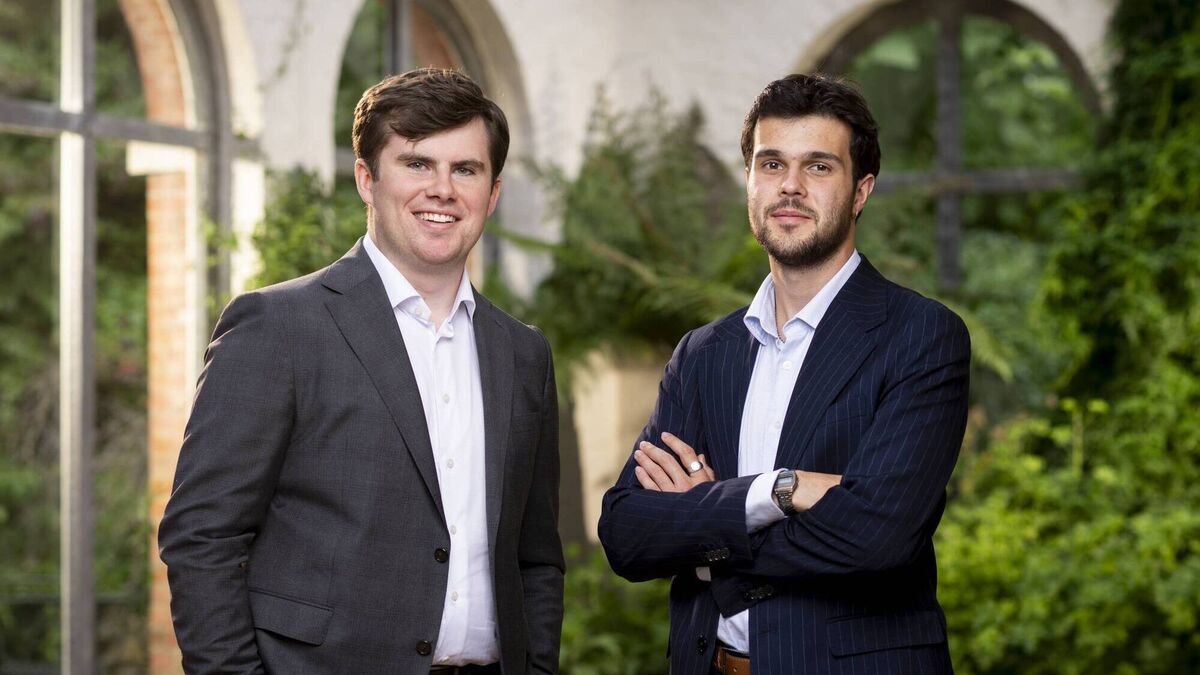
Seán Barrett (left), a former electrical engineering student at MTU, and William Hartley, co-founders of ReAble Labs
My interest in 3D printing started long before ReAble Labs existed.
Back around 2008 or 2009, my father bought a 3D printer. It cost about €30,000 and stood roughly 6ft tall. At the time, the technology felt almost futuristic. I was fascinated by the idea that you could design something on a computer and then watch it become a physical object. I could not have known then where that interest would lead.
Last October, while I was studying electrical engineering at Munster Technological University, I began working with William Hartley, a medical student at Trinity College Dublin, on what would become ReAble Labs.
We came at a specific challenge from two different directions - engineering and medicine - but with a common question: could we use technologies such as 3D printing, electronics and digital design to make advanced prosthetics more accessible?
Today, we are developing a 3D-printed powered prosthetic hand designed around affordability, customisation and repairability. We are still at an early stage and working towards our first fittings, with significant engineering, clinical and regulatory work ahead.
That is important, because one of the biggest things I have learned about starting a company is that having an idea and having a finished product are two very different things.
The first version is rarely the answer.
Start-up stories can sometimes sound deceptively simple: someone identifies a problem, has a breakthrough idea, develops the solution and builds a company. Our experience has been much more iterative. You develop something, test it, discover what does not work, change it and repeat the process.
With a medical device, that process is especially important. Something can work technically and still not be the right solution for the person who ultimately uses it. Questions about comfort, reliability, fit, clinical practice, maintenance and accessibility matter just as much as whether the electronics or mechanics work. A visit William and I made to the National Rehabilitation Hospital reinforced that for us.
Seeing the prosthetic fitting process at close quarters made it clear that some of the biggest challenges in prosthetics are not purely technical. They are about the individual who will wear the device, how it fits into clinical practice, and whether someone can realistically access and maintain it.
For an engineer, that is a valuable lesson. You have to be willing to let evidence change your thinking. When something is not working, the answer is rarely to become more attached to the original idea. You have to go back to the problem, talk to people who understand it better than you do and test your assumptions.
Teething problems do not necessarily mean an idea is failing. Often, they are how you discover what the idea needs to become.
Being a student can be an advantage. When William and I started ReAble Labs, neither of us had decades of experience in the medical-device industry. I was a student in MTU. That brings obvious challenges. There are major gaps in your knowledge when you begin working in a technically complex and highly regulated sector. But being a student can also be an advantage.
You are already in a learning environmen, surrounded by people with different expertise. You are used to encountering something you do not understand and figuring out how it works. What matters is recognising what you do not know and finding people who do.
The environment around you matters too. Student Inc. at MTU was the perfect environment to help William and I develop the idea. Programmes like that are valuable as they make entrepreneurship tangible. An idea does not have to remain something discussed after a lecture or worked on at home. You have access to people who can challenge it, question your assumptions and help you understand if it has the potential to be something real.
That reflects a wider emphasis within MTU on nurturing entrepreneurship among students and graduates, something explicitly identified within its Research, Innovation and Entrepreneurship strategy.

The past year has taken ReAble Labs further than either of us expected when we started. We have had opportunities to pitch the company, test the idea in front of experienced entrepreneurs and mentors, and refine how we communicate the problem we are trying to solve. One of those opportunities was earning a place on the Hult Prize Global Accelerator where we had the opportunity to pitch for a $1million Hult Prize in London. While we didn’t win the $1 million, those opportunities still matter. They create momentum and force you to become much clearer about your product, your business model and why your approach is different.
But for us, success cannot ultimately be measured by competitions, pitches or headlines. It will be measured by whether we can build something that clinicians trust and that makes a meaningful difference to the person using it. That is why, despite the progress we have made, we still see ReAble Labs as an early-stage company with a lot left to prove.
If I could give one piece of advice to another student sitting on an idea, it would be not to wait until you feel completely qualified to pursue it. You probably never will. That does not mean rushing forward without understanding the risks, particularly in an area such as healthcare. It means accepting that expertise can be built, collaborators can be found and ideas can improve.
Start with the problem rather than the company. Build something small. Put it in front of people who will tell you what is wrong with it. Find people whose knowledge complements your own. Use the supports around you, particularly while you are in university.
And when something does not work - because something inevitably will not - treat that as information rather than defeat.
Less than a year after William and I first began working on ReAble Labs, the company already looks very different from the idea we started with. I hope it looks different again a year from now. Because if we are listening, testing and learning properly, it should.

App?