Trevor Laffan: The moral dilemmas prompted by the issue of assisted dying
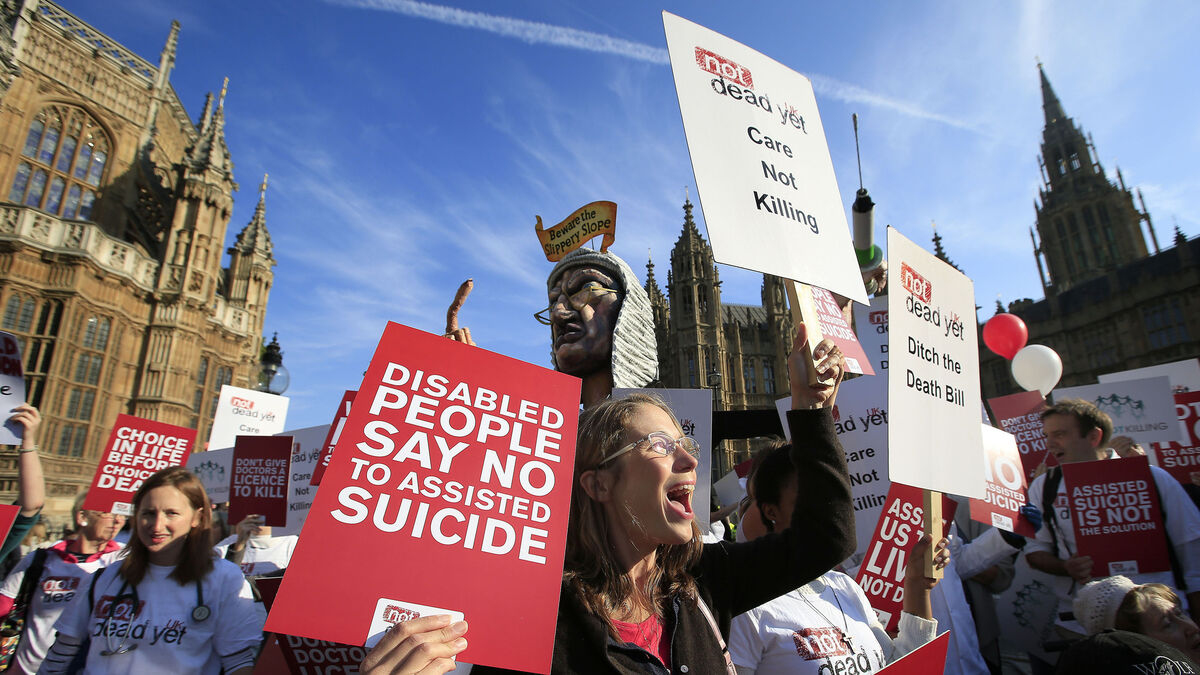
Protesters outside the Houses of Parliament in London as MPs debate and vote on the Assisted Dying Bill in 2015. The Bill was defeated and assisted dying remains illegal in the UK , as well as in Ireland
The gist of it was that he had been asked by a friend of his to do him a favour.
Apparently, this guy was terminally ill, and time was running out, but he wanted to go out on his own terms. He didn’t want to be a burden to his wife.
When he reached the stage where he was unable to look after himself or the pain became too much, he wanted to have a Plan B in place.
He was aware of the Dignitas organisation in Switzerland which provides advisory services regarding end-of-life choices. Assisted dying in other words.
As the name suggests, they aim to ensure a life and a death with dignity for their members within the limits of the possibilities available to them, and as appropriate in individual cases.
The terminally ill man being discussed on the radio decided this was for the route for him, so he asked his friend to arrange it.
There was one drawback though; his wife was against the idea which left the friend with a problem. If he agreed to help, he would be in conflict with the wife. If he turned his friend down, then that was the end of their friendship.
This man bit the bullet and went ahead with making arrangements. He even travelled to Switzerland to see what was involved and what was required to get the ball rolling. He gathered as much information as he could.
He must have been suffering from a certain amount of turmoil but, in any event, he was spared from following through with the arrangements when his friend died naturally sooner than expected. Problem solved.
That whole discussion got me thinking about how I would react if I found myself in that situation.
I was asked to make enquiries about the Dignitas option for a friend once and I did what I was asked to do. I made my enquiries, put a dossier together, sealed it in a large envelope, and left it on the kitchen table for him.
We never discussed it again and, as far as I was concerned, I was only acting messenger for someone who had no experience with the internet. I have no idea if the envelope was ever even opened.
It didn’t matter either because, like in the previous story, nature intervened and resolved the matter.
I sat with my mother in hospital when the doctor explained to her that there was nothing more that could be done for her. She was terminally ill and, when she asked how long she had left, he said that nothing was certain, but he suspected it would only be a matter of months.
She didn’t bat an eyelid.
He asked her if she had any questions and she merely shrugged her shoulders and said: “There’s no point.”
She came to live with me for those last few months and we had many conversations, but we never discussed her predicament. It was just business as usual, and maybe that was easier for both of us.
I did have an unexpected and difficult conversation with a friend of mine years ago on the way to the hospital. Deena was terminally ill and I was bringing her for one of her many visits to the CUH.
En route, she suddenly announced that she wanted me to deliver a eulogy at her funeral.
I was completely taken aback. How do you respond to something like that?
I think I stuttered and stammered for a bit, before I finally gave in just to end the conversation.
It was a privilege though to have been considered, and an honour, albeit a sad one, to have delivered the eulogy on the day of her service.
So, to return to the question of assisted suicide, I’m pretty certain I would help a friend if I was asked, provided it was being arranged professionally with an organisation like Dignitas.
I’m not sure how that would work out if the family were opposed to the idea. Hopefully, I will never be put to the test. I don’t know how I’d react if I were to receive a terminal diagnosis. I don’t know either if I would ever consider assisted suicide as an option.
I don’t want to find out either, but I am certain that having to rely on round-the-clock care would not be my idea of living. I’m not sure I could cope with that.
So, there might come a time when I need an organisation like Dignitas. In that case, I’ll need an assistant. I already have someone in mind, and it could be you. Don’t let me down.







 App?
App?


