John Arnold: At an ancient Cork well, I took a moment to ponder and reflect
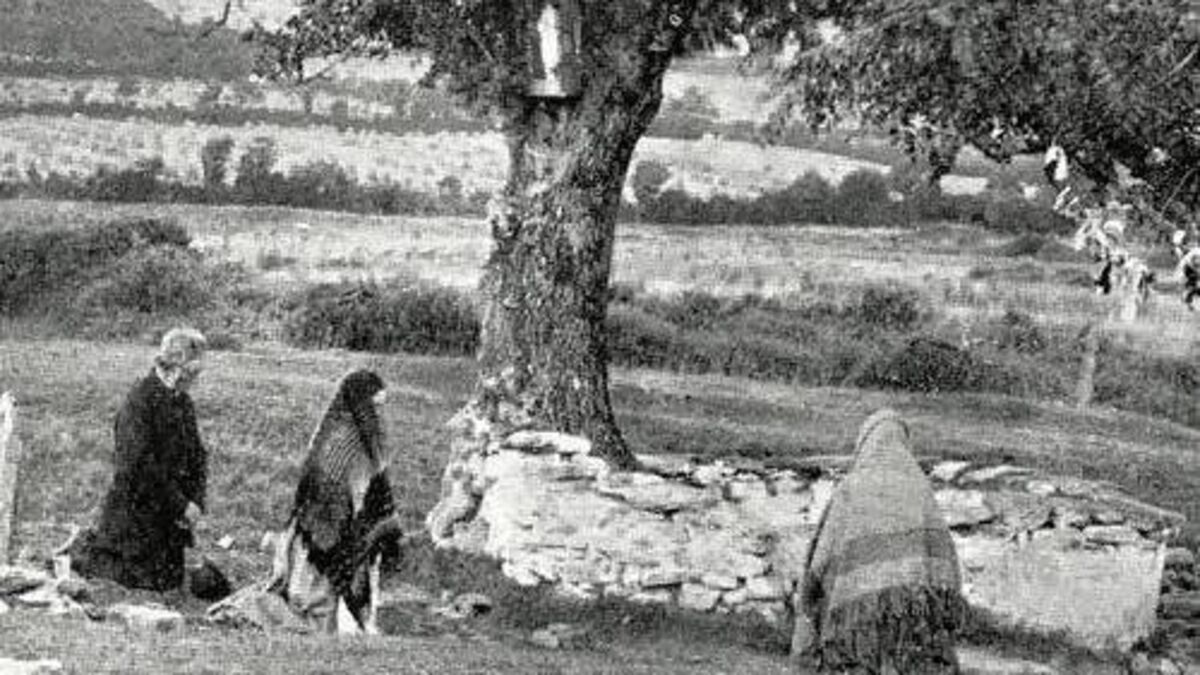
Our Lady's Well in Kilteskin, Aghada, where a service was held last Saturday
If one takes out the Irish/English Foclóir (dictionary), well - take your pick!
The word áit is simple enough - a place - the ‘fada’ makes all the difference! Áit is a place but without the fada, ‘ait’ can mean strange, unusual or odd!
In Matthew’s Gospel, he wrote that Jesus went to a quiet place on his own and ‘when evening came, he was still there, alone’. In today’s world we’d probably say he was ‘chilling out’ or having a digital detox!
No man is an island, and we know that ‘ar scáth a chéile a mhaireann na daoine’ (we live in the shadow of one another) - even the Bible told us ‘it was not good for man to be alone’.
All this is very true, but now, more than ever, we, as human beings, need time on our own.
I’ve travelled to Lourdes on my own in November or December for the last 14 years. For a town thronged and bursting to the seams from February ’til October, winter time there is so, so different. No tourists, no pilgrimages, nearly all shops, pubs, hotels, cafes, and restaurants closed until springtime.
Thousands of people today are lonely, living in towns and cities. They have hundreds, maybe thousands, dwelling in close proximity, yet they have no connection or interaction with neighbours. That’s loneliness, and of course it pervades also in many parts of rural Ireland. It’s sad and has increased in modern times.
In the past, we relied on neighbours for help with work, for ‘the loan’ of a shovel or a wheelbarrow, but with people wanting to more independent, the ‘I’m alright Jack’ ethos seems to have grown.
Getting back to the definition of áit iargúlta, it can be a hidden, quiet, out of the way, remote or lonely place. Go deeper and the place could be wild, desolate, uncouth, even isolated - now there’s a basketful of English words and phrases for two little Irish words.
Thrice this past week, I’ve been to a place which could well be termed an ‘áit iargúlta’, and really enjoyed the experiences.
On Thursday, I walked a mile or so along an up and down road. It was a road - as we know the meaning of the word - for a while, then a track. Here and there a little stream ran across the way and gurgled away to eventually join the sea.
Fuchsias and montbretias (we always called ’em mombreeshias!) were everywhere along the ditches. The mixture of scarlet red and fiery orange was a gorgeous colour scheme, supplied and maintained by nature for our enjoyment.
The day was sultry as I trod along enjoying the sounds and smells of the Irish countryside. I had never been to Sherkin Island before and how I loved my few hours there.
Until the soldiers of Cromwell wreaked havoc here in 1650, the religious community flourished. I imagined, last Thursday afternoon, as I descended the hilly road, I could hear distant echoes of the Matins and the Lauds of the monks of long ago.
Yes, Sherkin is an offshore island, but the ferry trip from Baltimore is but a short journey. In times gone by that watery expanse ’tween mainland and Sherkin ensured it was a place of quiet and solitude.
It’s somewhere I yearn to return to again - maybe in wintertime when all is peaceful and still.
Years back, ‘Church Holidays’ like the 8th of December and the 15th of August were to the farming and rural communities what bank holidays were to people who had ‘paid jobs’. We always observed them, and still do so.
That’s why, after 9.30 Mass at home last Saturday, August 15, I set off for the heartlands of East Cork. Down through Ballincurrig, Lisgoold, and Midleton, and skirted by Ballinacurra. I turned off at White Well Cross - down and up narrow country roads - and soon I was in the townland of Kilteskin.
Joan was in National School with me, and has for many years been in matrimonial exile in this beautiful part of the normally lush East Cork countryside. She sent me an invite to come to see the ancient ‘Tobar Muire’ (Our Lady’s Well) on her family farm.
During the National Folklore Collection done in National Schools in the 1930s, a pupil from the nearby Gyleen NS wrote:
Those words, penned nearly a century ago, were prophetic indeed as on Saturday more than 100 people gathered by the white-washed well just like their ancestors had done in times gone by.
Mass was celebrated by retired Bishop John Buckley, who spoke of the importance of upholding old traditions, and recalled that when times were tough, in the era of the Penal Laws, people clung to their faith.
There was a crowd by the well on Saturday singing, praying, and talking in the open air. I heard a buzzard circling in the sky as crows and smaller birds went about their daily routines as cows in the nearby field grazed, oblivious to the crowd.
The ash tree by the well could be 300 years old - if only that tree could talk, what stories it could tell!
Sunday evening entailed a shorter journey - to the hill country near the borders of Fermoy, Rathcormac, and Ballyhooley parishes. Up a grassy boreen we went, and there on the hillside was Carraig an Aifreann.
All over the country, on mountains, valleys, glens and other áiteanna iargúlta, there are dozens of rocks or boulders which served as crude altars for Mass to be said when churches were either burned down or had their doors barred.
As we walked up the slope to the sacred stone, I thought of Liam Clancy singing about another quiet and lobesome spot in County Kerry.
As it was down the centuries, the Rosary was said by the Carraig on Sunday. Cromwell complained one time: “When I bring these fanatical Irish before the muzzles of my guns, they hold up in their hands a string of beads, and they never surrender.”
Sometimes, it is good to be alone with oneself - a time to reflect and remember and, you know, now and then, it’s nice to give thanks for what we have and recall those gone before us who had so little.






 App?
App?


