John Dolan: Why DO we pay so much for chocolate in Ireland?
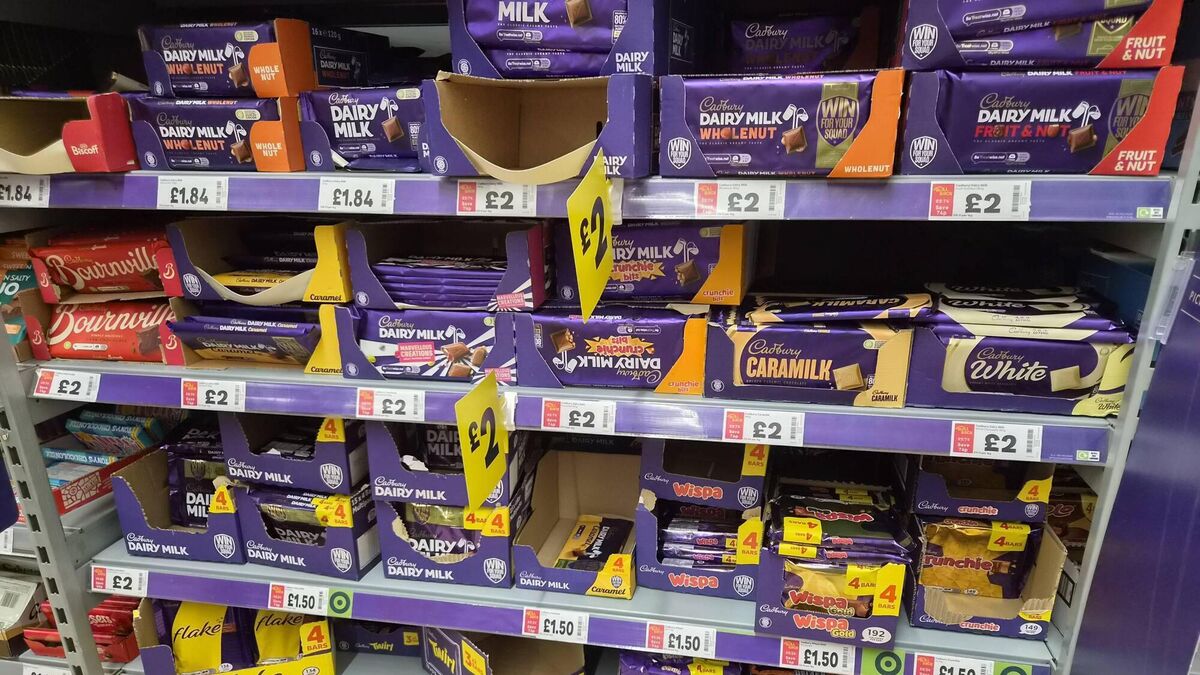
Various chocolate prices at an Asda supermarket in England. Even with the currency difference, the UK prices are far cheaper than here in Ireland, says John Dolan
Take meat. A family-size packet of mince or chicken breast fillets used to be around €6, now it’s routinely a tenner.
Pringles. I seem to recall they were 99c each for an age - nowadays, in my local supermarket, you might find them on offer at €1.74, or on full price at well over €3, with a special offer of two for €4. A stinging increase all the same.
Potatoes. The price of €4 a bag has stuck in my head, but now they cost €6-7, if not more.
The last few years have seen hefty rises in the cost of living across the board, of course, down to a range of factors.
But there are certain items whose prices, for some reason, have never registered with me. Milk, for instance, and bread. I’m sure they have gone up in price in recent years too, but I couldn’t tell you by how much. I guess that’s because the rises have been moderate, and they remain relatively cheap, and a necessary part of any shop.
Chocolate in Irish supermarkets is no longer relatively cheap, and for that reason, I no longer deem it a necessary part of my shop. As a result, my life is a teensy bit poorer.
Sure, I look out for bargains and special offers in the goodies aisle, but if even they don’t tempt me, I move on to the next aisle. I ain’t paying that, I fume.
And I’m not alone. Of all the goods that have gotten more expensive in recent years, chocolate seems to be the one that sticks in the craw the most, anecdotally.
There may be a deep psychological reason for this. Chocolate is a treat, and one that really shouldn’t break the bank.
There is a reason why it is usually placed strategically in a super-market, after the fruit and veg, the pasta and cereals and all the other staples have been collected - or right there by the tills when you are unloading. It’s a little reward for you and the household.
Is the rising price of chocolate as big an issue in other countries?
The other weekend, I took a trip to England for my mum’s 80th birthday and had a spare hour or two to browse the local Asda supermarket.
When I got to the chocolate aisle, I felt a wave of nostalgia. Here, in sterling, were the prices I remembered I used to pay in the shops here in Cork in euros.
And, yes, the currency does account for some of that - but only some. It struck me that UK consumers are paying far less than we are in Ireland for our sweet treats.
I took a photo of the UK prices and, when I got home, I looked up the equivalent prices online for the same goods here in Ireland.
Read them and weep, chocolate fans...
Cadbury makes chocolate both in the UK and Ireland, so let’s compare their Dairy Milk Fruit & Nut, 180g, bar.
In the UK Asda, they were on sale for £2 (€2.30), with the label stating this included a 74p discount.
In Ireland?
The Dunnes Stores website said they were available for €4.30, with Supervalu charging €4.
The same bar costs €3.95 in Tesco Ireland - while in the UK Tesco the fruit and nut treat was on sale for £2.75 (€3.18).
In Aldi, you could get a 95kg Cadbury’s Fruit and Nut for €1.99 - but note that is almost half the size of the standard 180g bar mentioned above.
Some supermarkets, like Aldi, have own-brand versions which are invariably cheaper, but we’re comparing like for like here and branded goods.
Irish consumers appear to be routinely paying up to €2 more for the same product in this instance.
How about a packet of four Double Decker chocolate bars, also made by Cadbury?
These cost £1.50 (€1.74) in the UK Asda I was in, a saving it claimed of 74p. In Dunnes, they were advertised at €2.50, “was €3.90”. They were also €2.50 in Supervalu and €2.49 in Aldi.
The same four-pack of Double Deckers cost €3.15 in Tesco Ireland, while on that store’s UK website, they were just £1.79 (€2.07).
Again, a mark-up of well over €1 compared to the UK.
Advertised as a premium or luxury brand, Lindt Excellence had a wide range of different flavours of chocolate in the Asda store in the UK, all priced at £3 (€3.47) - a saving, it claimed, of 48p on its usual retail price.
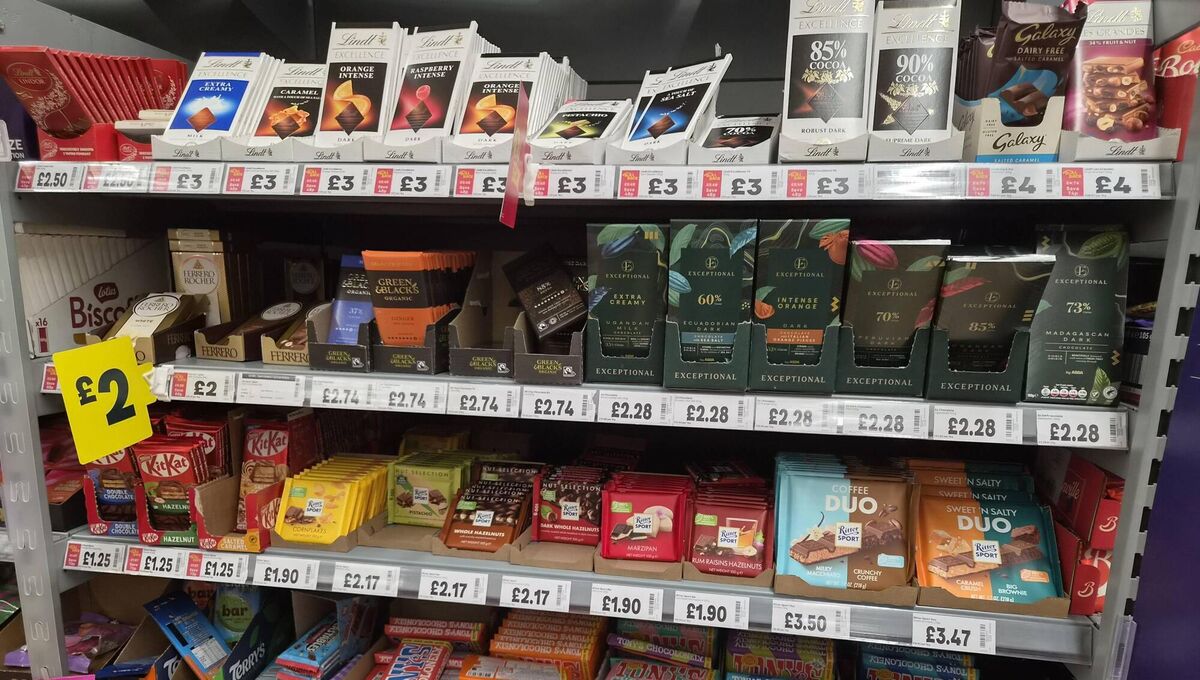
Here in Dunnes Stores, it was actually comparable, at €3.50, but the label said it “was €4.85”. Indeed, the same bar did cost €4.85 in both Supervalu and Tesco Ireland. However, the Lindt Excellence bars in Tesco in the UK were only £3.50 €4.05).
Finally, I did a price comparison on the popular Nestlé KitKat, for a packet of eight of the bars.
In the UK Asda, they were £1.75 (€2.03), “down from £2.18”, the supermarket stated.
In Dunnes, they were advertised at €2.50, “down from €3.75”, and also €2.50 at Supervalu.
However, Tesco Ireland was charging €3.75 for the item - while in Tesco UK, they were only £2.20 (€2.55).
Another case where, even with the currency conversion, we are paying substantially more.
They are classed as “non-essential luxury goods” by the State (clearly not a sweet tooth amongst those bean-counters!), and VAT is 23%, while in the UK the VAT rate is 20% - not enough of a difference to justify these price comparisons.
Yes, there is a squeeze on chocolate products because of global cocoa shortages, and this is exacerbated by the rising costs of lots of other things such as transportation.
But, again, does this justify the chasm in price for the same goods in Ireland and the UK?
I like to think we have a fairly competitive supermarket industry in this country, which exerts a downward pressure on prices, and I acknowledge that they do still need to turn a profit, as do the chocolate manufacturers.
Indeed, in February, the parent company of Cadbury, Mondelez International, released what were described as muted predictions for 2026, and warned that it expects a subdued year ahead, because price increases are turning away cost-conscious shoppers who are already wary of rising living costs.
And there’s the rub.
Then again, there is a reason why so many of us deprive ourselves of the stuff at Lent for 40 days - and tuck in the rest of the year. We enjoy it!
Nobody expects chocolate makers and supermarkets to soak up all the increased costs of recent times, but is it time customers were given a break?







 App?
App?


