Trevor Laffan: I witnessed Chernobyl horrors..the threat has not gone away
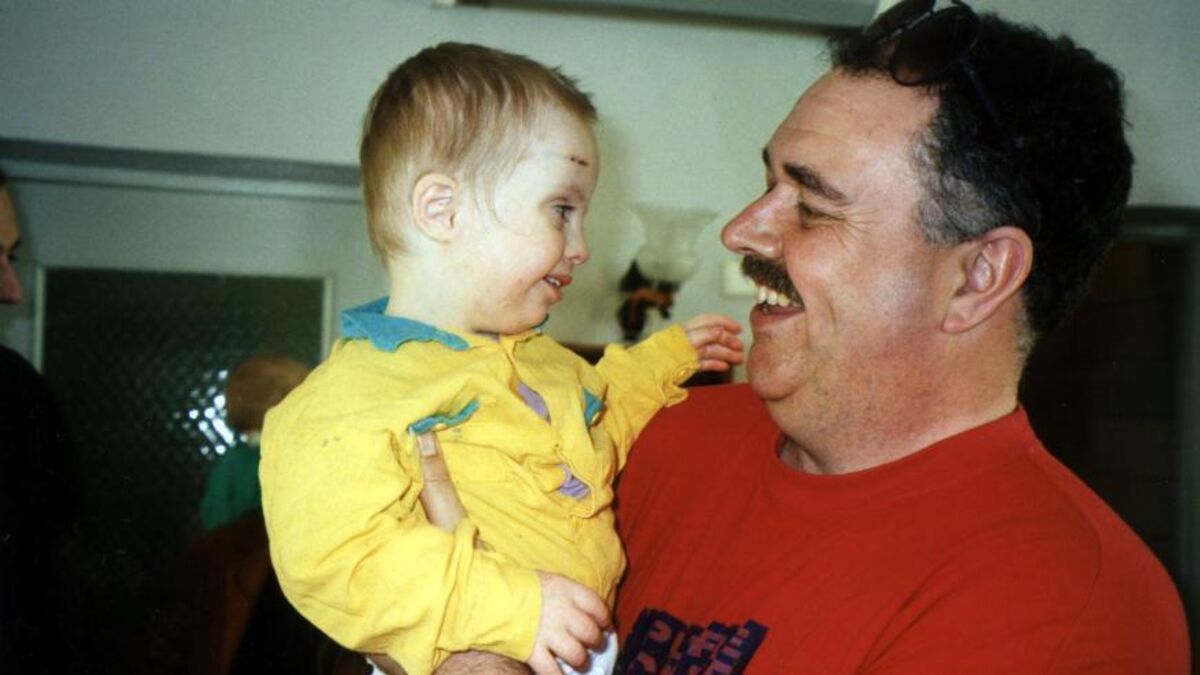
Trevor Laffan and a child at an orphanage in Belarus, when he visited the country as part of the Chernobyl Children’s Project
It’s a historical fiction novel set in London during the final years of World War II, as seen through the eyes of two teenagers and a retired bookshop owner. They do what they must in order to stay alive.
Charlie Matters is a 13-year-old orphan boy, Molly Wakefield is a 15-year-old girl, and Ignatius Oliver is a widowed owner of a bookstore, and the novel explores how these three strangers come together and help each other to survive.
It describes in detail the nightly air raids by the Germans, the dread of the sirens, and the scramble to get to the underground shelters. The terror of the bombings, the whistling noise the bombs made as they fell from the sky, the explosions, and the fear of not knowing if you would survive the night.
It’s only a work of fiction but it gels with stories told by my late mother-in-law who lived through those same dark days when she lived in England.
Her personal account of those times made those stories all the more real. The accounts of others too have been well documented in books and movies over the years, so we all have some idea of what war was like.
All the more reason, you would think, that it should be in everyone’s interests to ensure we never experience the likes of it again.
Unfortunately for mankind, it seems the gods of war like Trump, Putin, and Benjamin Netanyahu haven’t learned that lesson.
For me, the war in Ukraine hit closer to home recently when I read an article in UK about the conflict there, and how another Chernobyl disaster is only one Russian missile strike away.
The concrete-covered bowels of that plant contain material that is currently lying dormant in a cement coffin, but if it should ever escape, we would be in serious trouble again. The consequences of that possibility are too horrific to even contemplate, especially as the effects of the first incident are still being felt around the world.
The original disaster occurred after a flawed reactor design, combined with a series of human errors during a safety test, caused Chernobyl’s Reactor 4 to explode at 1.23am on April 26, 1986.
The explosion released roughly 400 times more radioactive material than the Hiroshima atomic bomb, affecting swathes of Europe.
Many were killed instantly, while it is unknown how many have lost their lives to various forms of cancer since then.
It is also impossible to accurately estimate how many children suffered illness and disability in later years in Belarus, western Russia, and Ukraine, but there were lots.
I can say this with absolute certainty because I saw it for myself. I, and many others, spent many years travelling to these places with various charitable organisations and we witnessed the devastation caused as a result of that disaster.
We dealt with many villages, hospitals, and orphanages over those years, and did what we could to help them with humanitarian aid provided through the generosity of Irish people who fundraised tirelessly after seeing horrific images of sick children.
There was no shortage of institutions in Belarus housing children the State claimed to be caring for. In reality, these institutions were mostly located in remote wooded areas. They housed children, with illnesses and deformities of all types, abandoned and completely lacking in care. Sanitation was very often non-existent, and hygiene never entered the equation.
A team of dedicated Irish volunteers subsequently went into that place and transformed it. They built proper toilet, kitchen, and shower facilities and implemented professional care plans for the children.
That was just one institution, there were many more just like it.
Charities from around the world did what they could, but the scale of the problem was of such magnitude that we could never get on top of it completely.
But there could be more to come. The Times article explained how the threat of another Chernobyl disaster is very real today because the feat of engineering that encased the nuclear reactor 40 years ago, was never meant to protect it against drone attacks.
After a Russian drone strike last year caused extensive damage to the vast steel arch protecting the site, the lead Ukrainian official responsible for decommissioning the power plant warned that any further missile or drone attacks on the site - intentional or accidental - risks resurrecting the threat of a catastrophe that once spread fall-out across Europe.
“If a missile hits the arch and the sarcophagus collapses, it means hundreds of tonnes of fuel-containing masses, melted lava including uranium and plutonium, and transuranic elements, along with molten concrete and steel, would be released,” said Serhii Tarakanov, the director-general of the Chernobyl Nuclear Power Plant.
“It would also release massive quantities of radioactive dust, which is currently sitting calmly inside the sarcophagus,” Tarakanov added. “That dust would rise and form a cloud and could go anywhere.”
The Chernobyl site was designed to last a century - but was never designed to withstand strikes by kamikaze drones and ballistic missiles - yet 92 Russian drones were recorded as flying within three miles of Chernobyl.
The gods of war don’t care. They won’t be affected.







 App?
App?


