Saluting Frank O’Connor, 60 years after his death
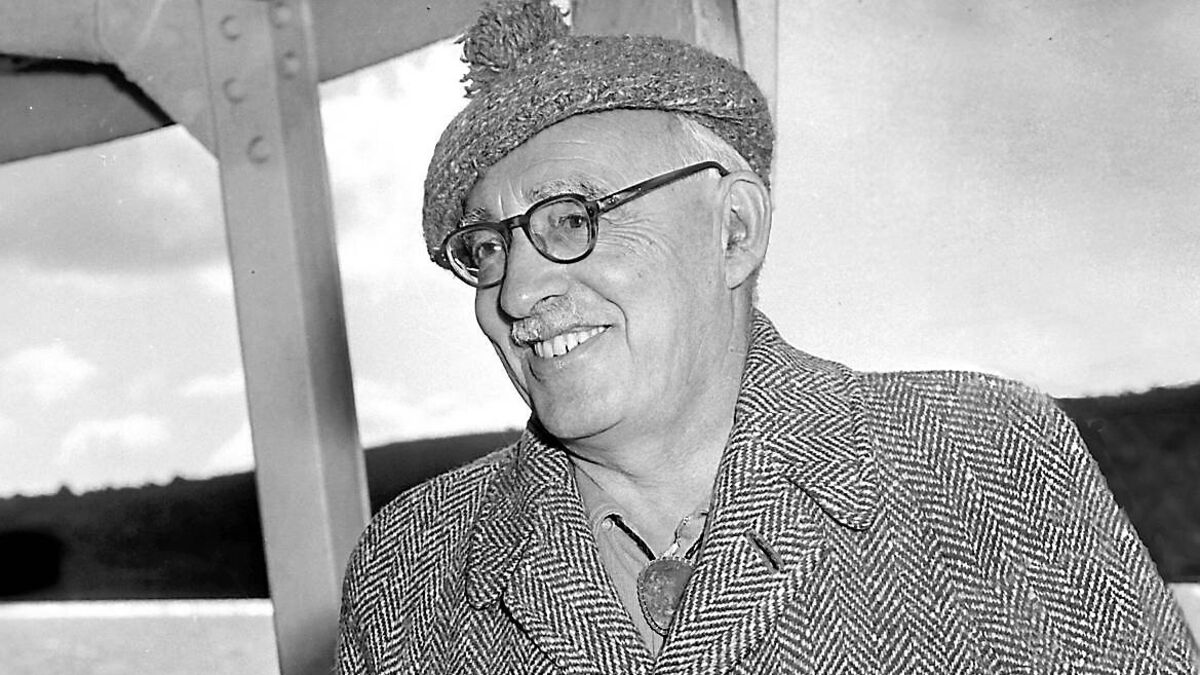
PROUD SON OF CORK: Frank O’Connor at Cobh upon his return from the USA in 1961.
Sixty years ago, on Thursday, March 10, 1966, Michael O’Donovan, better-known by his pen-name as an author, Frank O’Connor, died at the age of 62.
The acclaimed short-story writer spent much of the previous 15 years lecturing in the U.S where he enjoyed a reputation as a master of his craft, supported by frequent articles in the New Yorker.
At home in Ireland, O’Connor’s career was constrained by consistent confrontations with the clergy and the repressive Censorship of Publications Board.
Although well-celebrated by his peers, O’Connor was embroiled in several high-profile literary scandals and five of his books were banned. His work, driven by frustration with the religious and social conservatism of the state, abounds with priests, disillusioned soldiers, and the marginalised impoverished of Cork.
The latter subject was rooted in O’Connor’s childhood. Born in 1903 on Douglas Street above a sweetshop, he soon moved to Blarney Street which, in his words, began “at the foot of Shandon Street, near the river-bank, in sordidness” and ascended the hill “to something like squalor”. Their family cottage “contained nothing but a tiny kitchen and a tiny bedroom with a loft above it”.Cork was a city of only 80,000 people then and Blarney Street was “just on the edge of the open country”. Not far away, down Strawberry Hill, were Cork Gaol and the Good Shepherd Convent and Magdalene Laundry where O’Connor’s mother was raised. At the foot of Convent Avenue then was a home belonging to the prominent Barry family, for whom she served as maid.
O’Connor, an only child, was close to his mother, Minnie, who suffered an unhappy marriage to his alcoholic father, Michael. A former British soldier brought up near the barracks in Harrington Square, he had moved the family there when O’Connor was seven.
The author detested this “uneven unlighted piece of ground [...] that seemed to have been abandoned by God and was certainly abandoned by Cork Corporation”. This resentment towards official neglect would grow as O’Connor aged.
A self-proclaimed idealist, he enlisted in the IRA at 15 and fought in the War of Independence. Ironically, given his later career, he then operated as censor for the anti-Treaty IRA during the Civil War. He was briefly interred in Cork Gaol, beside his mother’s birthplace.
Largely self-educated, O’Connor spent his post-revolutionary years contributing to the culture of the city, helping re-establish a city library above a shop at 25, Patrick Street, and co-founding the Cork Drama League (CDL) “in the hope of providing for Cork a local theatre which will adequately express the best of Southern thought and emotion”.
The young librarian, however, was frustrated by the inefficiency of Cork County Council. Furthermore, Father O’Flynn, founder of the Cork Shakespearean Society at the Loft in Shandon, accused the CDL of staging vulgar, agnostic plays. This led O’Connor to conclude “that Cork standards of literature and my own could not exist for long side by side”.
Disillusioned and hurt, O’Connor left the city for Dublin in December, 1928.
Revisiting Cork in 1961 for BBC’s Monitor, O’Connor claimed to have left it “ten years too old”. He assigned Cork ‘the mental age of “18-and-a-half”, after which age there was no intellectual development to be made. Rather than a condemnation of his home town, however, O’Connor blamed the ‘provincialism’ created by social neglect and religious control.
Cork, however, remained his favourite setting and practically all of his major works take place within a few small streets. Few writers have ever captured the city’s geography better than O’Connor, who admired the “murmuring honeycomb of houses” that “rose to the gentle rounded top on which stood the purple sandstone tower of the cathedral and the limestone spire of Shandon church”.
In his study of the short story, The Lonely Voice, O’Connor claimed they should examine “submerged population groups”. These were most often found “behind all the gracious houses” in “the lanes of little country cabins” of Cork city, “each with its two rooms and the loft overhead”. By giving voice to the residents of these forgotten tenements, he sought the radical expansion of the city’s culture beyond any social or class restrictions.
Cork has grown up considerably since his ‘mental age’ estimation. The slums of O’Connor’s youth were largely wiped out by the 1960s; ‘The Doll’s House’, a tenement on the corner of Bachelor’s Quay and Grattan Street and the setting of his novel The Saint And Mary Kate was destroyed in 1966, while his cottage on Blarney Street was demolished in 1977. The site of his birth, ‘Frank O’Connor House’, has been home to Munster Literature Centre since 2003.
This growth was partially assisted by the author, whose fight against censorship contributed greatly to the country’s cultural development, but much credit is owed to the city’s many creatives, campaigners, and activists who continue to improve the once-neglected areas of O’Connor’s fiction.
Last month’s refurbishment of the Shandon clockface and the promised €7m regeneration of the Butter Market signal an exciting boost for the area.
O’Connor’s relationship with Cork city came from a complex place of deeply-felt frustration and emotional investment. He apparently intended, one day, to return to live in Cork.
The author wrote that “nothing could cure me of the notion that Cork needed me and I needed Cork. Nothing but death can, I fear, ever cure me of it”.
The author was buried in Deans Grange Cemetery on March 12, 1966, in Dublin.



 App?
App?


