75 years ago, Republic is born - April 18 should be a holiday!
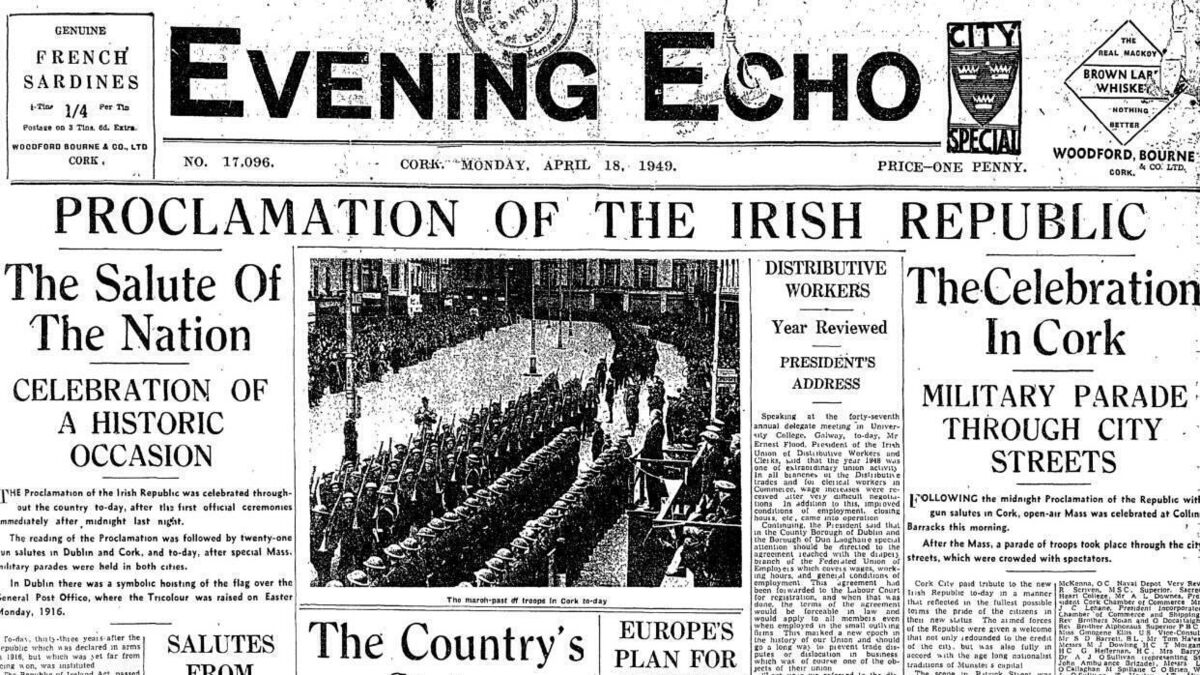
Even so, I find it surprising that the 75th anniversary of the founding of our Republic is due to fall next week with very little in the way of fanfare.
It certainly didn’t pass the people of Cork by at the time.
On Easter Monday, April 18, 1949, an estimated 20,000 citizens lined Patrick Street in what the Echo described as “the most memorable scene ever witnessed by the city’s main thoroughfare”.
There had been 21-gun salutes in Cork and Dublin at midnight to mark the severing of the new Republic from the UK’s “dominions”, and a parade of troops were cheered through Cork city, before an open-air mass at Collins Barracks.
The celebrations “paid tribute to the new Republic in a manner that reflected in the fullest possible terms the pride of the citizens in their new status,” said the Echo. It was “fully in accord with the age-long nationalist traditions of Munster’s capital.”
But, clearly, this was a big deal.
Although the Free State had been founded a couple of decades earlier, and that Easter Monday marked the 33rd anniversary of the Rising, the day the Republic was formed was a hugely significant moment in the psyche of the Irish people.
This country and its people were telling Britain, after centuries of rule and misrule, that “His Majesty, George V” was now “their” Majesty. That we didn’t do monarchs and all those trimmings here. Furthermore, we didn’t want to belong to their “Commonwealth” of nations either, thank-you very much.
It was a pivotal day; a young nation distancing itself from the binding ties of Britain and its empire, and joining the ranks of countries likes the U.S and France, which similarly forged their republics in blood, sweat, and tears. Ireland was now a republic too; viva la republic.
Back in 2018, he suggested the Decade of Centenaries should end on April 18, 2024, with parties in all the cities to mark the 75th anniversary of the Republic of Ireland.
Varadkar felt a newly-formed annual Republic Day would be a fitting end to the Decade of Centenaries, fearing they would otherwise end on a “downbeat note” with the Civil War commemorations.
His call seems to have fallen on deaf ears. What a shame we can’t agree to celebrate a truly historic, bloodless moment in Irish history.
******
It won’t surprise you one jot to hear that, on that day of days in 1949, there was a split. In Ireland, there is always a split. It may not surprise you either to hear Éamon de Valera was behind it. Dev; the great unifier, the great divider.
He had lost power for the first time in 16 years in 1948, and decided his Fianna Fáil party would boycott all celebrations around the declaration of the republic a year later.
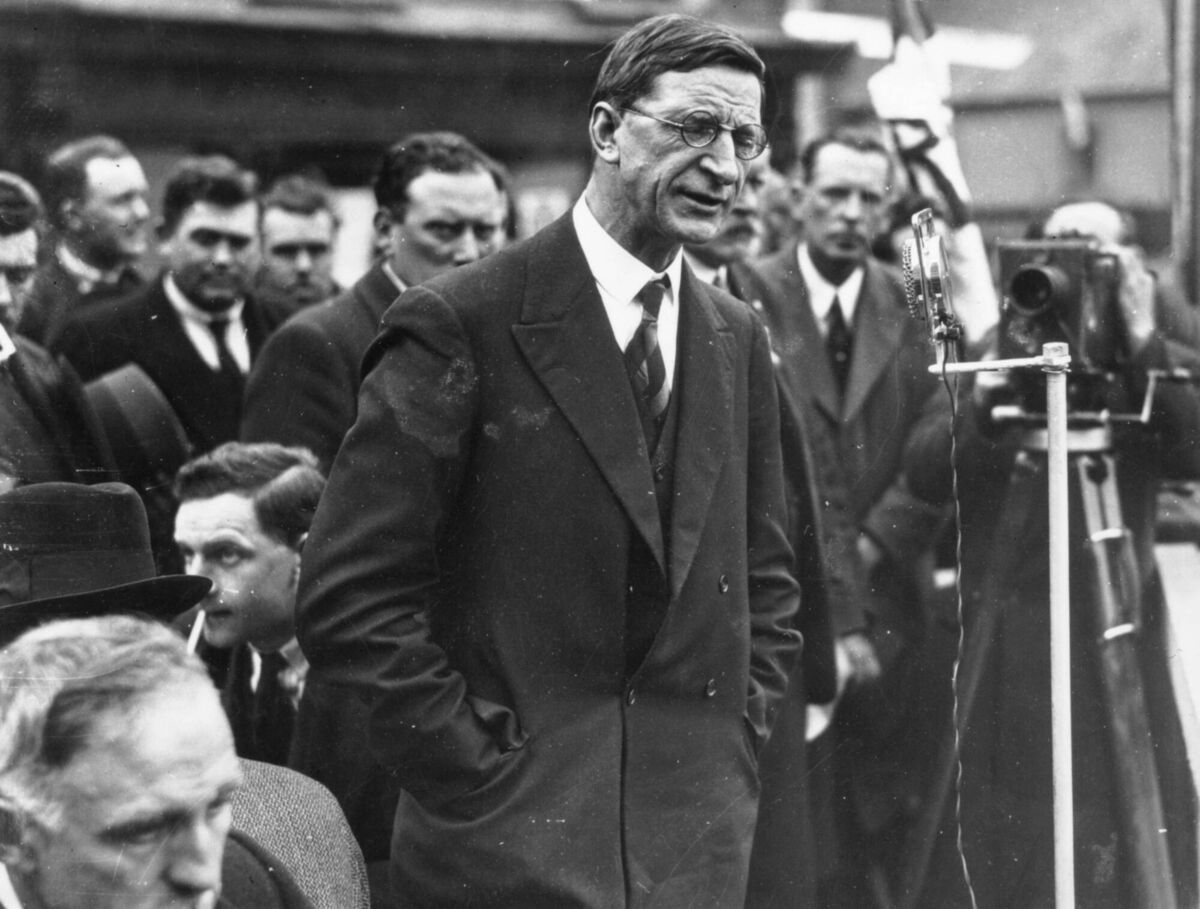
For Dev, there could be no republic until all 32 counties were in on it.
But the events of April 18, 1949, went ahead regardless, and the Echo reported that “rumours that some young extremists might put up a counter-demonstration to mark disapproval of partition” proved groundless; “the only anti-British slogans to be seen are chalked up in Irish on the walls... they call for an end to the use of the English language”.
You may be surprised to hear there was also a rump of people opposed to cutting ties with the Commonwealth. “This feeling is strong but not organised,” stated the Echo.
The Taoiseach of the day was Fine Gael leader John A. Costello, and it is noticeable how keen he was to stress his opposition to Partition and his desire for a united Ireland - in a far more outspoken way than most current political leaders.
He also moved to assuage any fears that Ireland had somehow been cut adrift in those days before the European community of nations had been established
“We have put ourselves apart but not cut ourselves adrift from our former association with the great nations of the Commonwealth,” said Costello. “We have severed the formal links but have not sundered the intangible bonds between us.”
The Taoiseach was asked by one reporter: “Are we to take it that the use of the word Éire will now be incorrect?”
His answer spelt out his belief that Éire could only be used once Ireland was united: “It was always incorrect as used. Éire is the Irish for Ireland just as Deutschland is the German for Germany. Éire was confined in its signification to the 26 counties. That was never correct and it will continue to be incorrect.”
This perhaps explains the negative attitude of Irish people when well-meaning types, particularly from the UK, think they are using Éire as a courtesy, when it should only be used when the island is one nation.
The Echo’s rather curmudgeonly columnist ‘Eden’ tapped into this mood when he wrote of those Bank Holiday celebrations in 1949: “Though we have been living in a republic since midnight, there hasn’t been much change in our affairs. Those who have been free to make holiday have discovered by now that the horses run as slow under a republic as under any other system.”
‘Eden’ referred to a citizen he saw impatiently awaiting a bus in the city rain that morning. “For going on seven and a half centuries,” the man growled, “we have been waiting for this day, and now it’s here the buses are running as late as ever!”
However, ‘Eden’ then got serious.
“Nevertheless, history has been made. To ensure the coming of this day, men have suffered, fought, bled, and died through generations. Some have suffered, fought, bled, and lived to see its dawn. The day at least calls for a lifting of hats in their memories, and a grateful prayer of thanksgiving from those who have inherited what they fought for.”
******
It is interesting to observe how much this country has changed since those words were written three-quarters of a century ago - and, when it comes to public transport, how much has stayed the same!
Would it be fair of me to suggest - especially in light of the recent study about the cost of a united Ireland - that there is less of a yearning now, from most of our politicians and our citizens, for a united Ireland than there was then?
It is certainly becoming more commonplace for commentators to state that they would not vote for a united Ireland if they felt it would negatively affect their livelihoods.
All of this at a time when Sinn Féin stands on the threshold of power, and despite the best efforts of the most repellant British Government in history to make Ireland - north and south - yearn to give it a kicking.
There has been speculation that this island rejoining the British Commonwealth could be part of a compromise offered to Unionists in order to seal a united Ireland. This isn’t an unpalatable as it may sound.
It wouldn’t mean us losing our republican ethos, as the majority of the Commonwealth members, including all those from Africa, are republics or have their own native monarch.






 App?
App?


