We must do more for brain injury sufferers
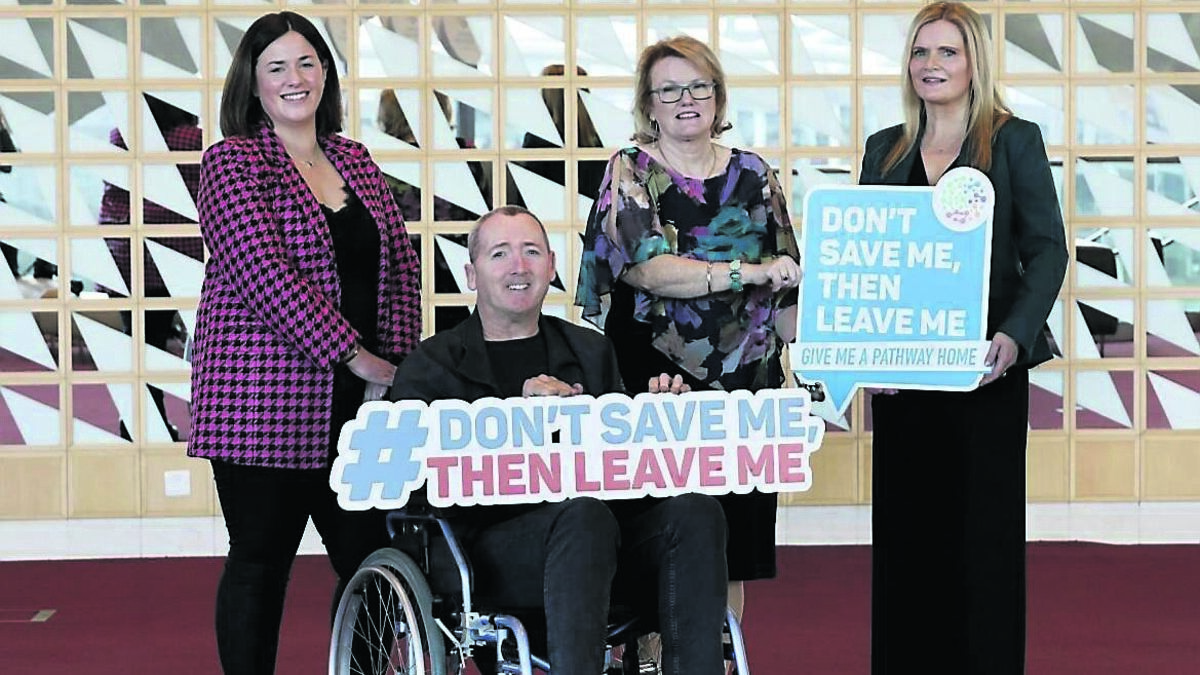
Barbara O’Connell, third from left, at the launch of the Acquired Brain Injury Ireland campaign, called ‘Don’t Save me then Leave me, Give me a Pathway Home’.
MY brother, Peter Bradley, received his first Acquired Brain Injury in 1980. He got meningitis in 1998 and was unable to return home, due to a lack of rehab, and ended up in a nursing home for people with dementia.
We founded the organisation Acquired Brain Injury Ireland (ABII) in 2000 and got him out of the nursing home in 2001.
The absence of support for Peter, and so many others like him, compelled me to set up our organisation - so that those capable of living a full and independent life can do so.
More than two decades on, we are still fighting that fight.
A 2021 report by the Ombudsman called Wasted Lives, raised major concerns about the inappropriate placement of 1,300 younger people with disabilities, including many with acquired brain injury, in nursing homes - as there was no alternative or rehabilitation programme available to them.
Figures obtained under the Freedom of Information Act showed that at the start of 2023, there were still 1,250 people under 65 in nursing homes - with a majority of these with acquired brain injury.
The Ombudsman is planning an update of the Wasted Lives report this autumn, and again recently called on the Government, the Department of Health, and the HSE to address it.
The expertise and ‘know how’ to address this injustice, and waste of human potential already exists - and is the focus of an ABII led campaign called ‘Don’t Save me then Leave me, Give me a Pathway Home’.
In Budget 2024, ABII is seeking funding to rehabilitate approximately 90 young people in inappropriate placement in nursing homes back into the community.
With funding support of €4million next year, we can take the lead, working with the HSE, to support 90 people towards a much improved quality of life. And this could be built on year on year.

To deliver this, we would establish three National Assessment Teams to assess the needs of those under 65 inappropriately in nursing homes; and set out a pathway for them to move back to community living and to also prevent future admissions.
A further €500,000 would also enable a much-needed Case Manager in each of the nine HSE CHO Areas. A Case Manager acts as a single point of contact to coordinate a clear pathway for a person’s transition from acute hospitals, through post-acute and into community rehabilitation.
Case Managers ensure that if an individual is placed in a nursing home - and if they do not need to be there - that they are not forgotten about or ‘out of sight, out of mind’.
For a total of €4.5million, life-changing impact can be delivered to 90 young people, and their families.
Specialist Teams would then be in place to work with survivors, while Case Managers navigate the recovery journey - coordinating a one stop shop system of guidance, support and expertise for both survivors and families.
Our National Neuro Rehabilitation Strategy sets out an ‘Ideal Pathway’ for those impacted by brain injuries and other neurological conditions, moving from acute hospital care, through specialist in-patient rehabilitation and onto services like ours within the community.
If you have a brain injury in Ireland tomorrow, you will be rushed to hospital to save your life. However, after that the journey is a lottery and dependent on where you live.
The approach we are seeking funding for would not only support the HSE to address the Ombudsman’s concerns, it would also provide a wider value-for-money through fewer prolonged stays in acute hospitals, free up essential beds, reduce the burden of care on families, and significantly reduce costs to the State.
Every year in Ireland, an estimated 19,000 people acquire a brain injury resulting in life-altering, dramatic change, that’s 52 people per day.
These injuries happen suddenly and are caused by road traffic accidents, stroke, assaults, concussion and viral infections like meningitis.
People inappropriately in nursing homes are being denied their human right to rehabilitation and the opportunity to rebuild the life they fought for.
The Government needs to act now, to implement the Ombudsman’s recommendations and allocate budgets to reduce the number of young people inappropriately in nursing homes.
Brain injury survivors can make progress on their recovery journey throughout life, but the first three years are critically important for functional neuroplasticity (as the brain learns to move functions from a damaged area to an undamaged area).
This is why it’s so important that they have access to the right support and services at the right time.
For every brain injury survivor, one more day left stuck inappropriately in a nursing home, waiting for rehabilitation, is another day wasted.
For members of the public needing information or support, see www.abiireland.ie

App?