We can see the future now in Pakistan... we have to react
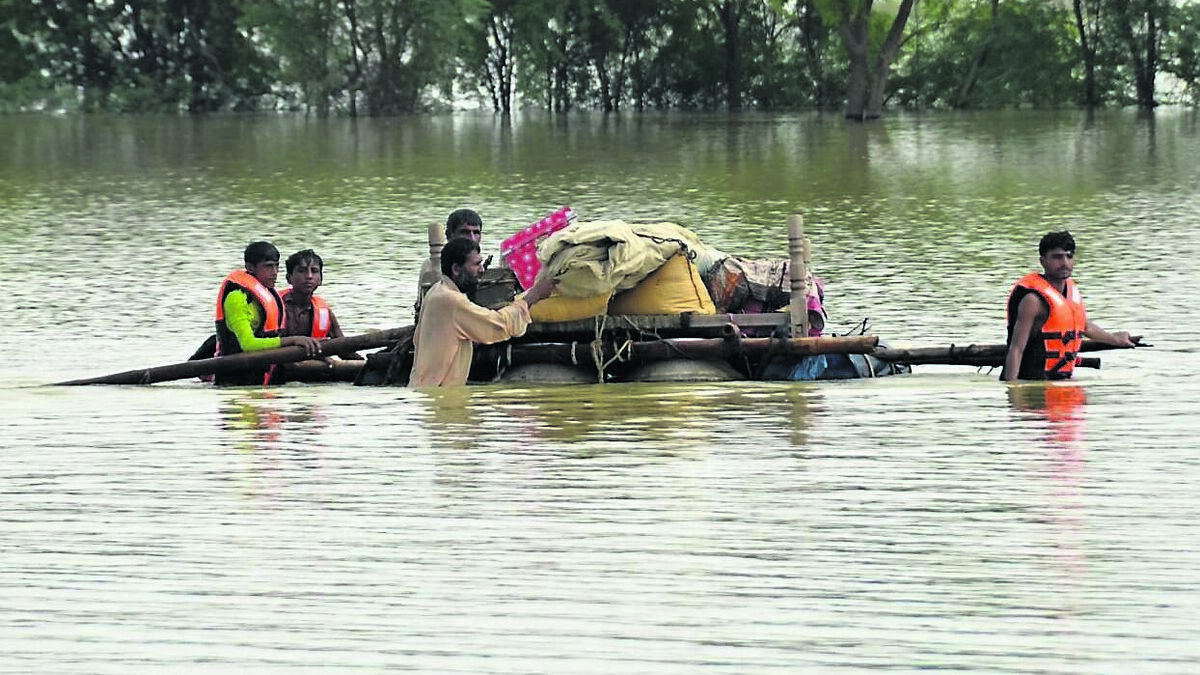
It’s hard to wrap our heads around the level of destruction and disruption the inundated country is experiencing.
The Pakistani Prime Minister Shehbaz Sharif said: “The magnitude of the calamity is bigger than estimated”, after visiting flooded regions, and called for international assistance to tackle his country’s national emergency.
The amount of crops destroyed, livestock killed, homes and buildings washed away, bridges and dams damaged is unfathomable. The death toll is likely to rise as disease spreads. The impoverished country faces an enormous task to save and rebuild lives and communities.
Climate scientists concluded that the probability of an event such as the extreme heatwaves endured by Pakistan and India in early spring has increased by a factor of about 30 because of climate change.
The weather attribution scientists will most likely release similar findings in a few weeks’ time when they have analysed the data of these monsoon rains.
In a way, it seems mad that there is still the need for scientists to say ‘Yes, climate change made that horrendous freak weather event more likely’, when the world weather system is so clearly out of kilter. You don’t really need a supercomputer to crunch the numbers to appreciate that one ;unprecedented; weather event after another around the world is an indication that climate change is not a future possibility but a present reality.
A future of extreme weather events, floods, heatwaves and droughts was just incomprehensible.
Now those ‘future’ consequences are facing us square in the face, and we are still struggling to comprehend them because the scale of devastation is so inconceivable.
However, Summer 2022 has been a constant news feed of those heatwaves, wildfires, drought, and floods that were warned about, and the rising death tolls from human-induced climate change is impossible to ignore.
“We’re at ground zero of a climate dystopia,” said Sherry Rehman, the Pakistan Minister of Climate Change, on Channel 4 news. “This is the new normal we will have to adapt ourselves.”
Per capita, a Pakistani person emits less than a tonne of carbon per year, in Ireland we emit 12 tonnes per capita.
So, the people least guilty of emissions and least equipped to deal with the devastation wrought are the very people on the frontline of climate catastrophes like the Pakistani heatwave and floods or the drought at the Horn of Africa facing its fifth failed rainy season.
Sending thoughts and prayers and pledges of international aid are fine, but what happens next year or the year after, as these extreme weather events become the norm?
Real global climate leadership is so desperately needed, but countries around the world are worried about other, more domestic, issues - inflation, energy crisis, and in Ireland, the intractable housing crisis. Those are all real and important issues, but so is climate action.
Where are all the climate leaders? We need a hero.
And that’s part of the problem, wishing that a Bruce Willis-esque character will arrive to save the day as per the usual disaster movie narrative is not helpful. If only the solution to the climate crisis was as easy as blowing up a fast-approaching comet.
Unfortunately, there is no one silver bullet for reducing greenhouse gas emissions, and the current political, economic and social systems seem incapable of taking the urgent action needed to halt warming and avert more climate catastrophes.
Breaking up with fossil fuels is the job of the decade, of the century, and recent stories that budgets for active travel measures have gone unspent is deeply depressing.
We can’t even get it together to build the infrastructure needed with the money that has been allocated.
Maybe it’s time for a Minister of Climate Action to drive the change needed and push local authorities and other government departments and agencies to drive (pardon the pun) the large-scale transition required.
I know we have Eamon Ryan as the Minister for Environment, Climate and Communications and Transport, but that is a broad brief and perhaps a role dedicated and responsible for climate action alone would help focus minds on the task of our lifetimes.






 App?
App?


