Monkstown's golfing history is a very proud one
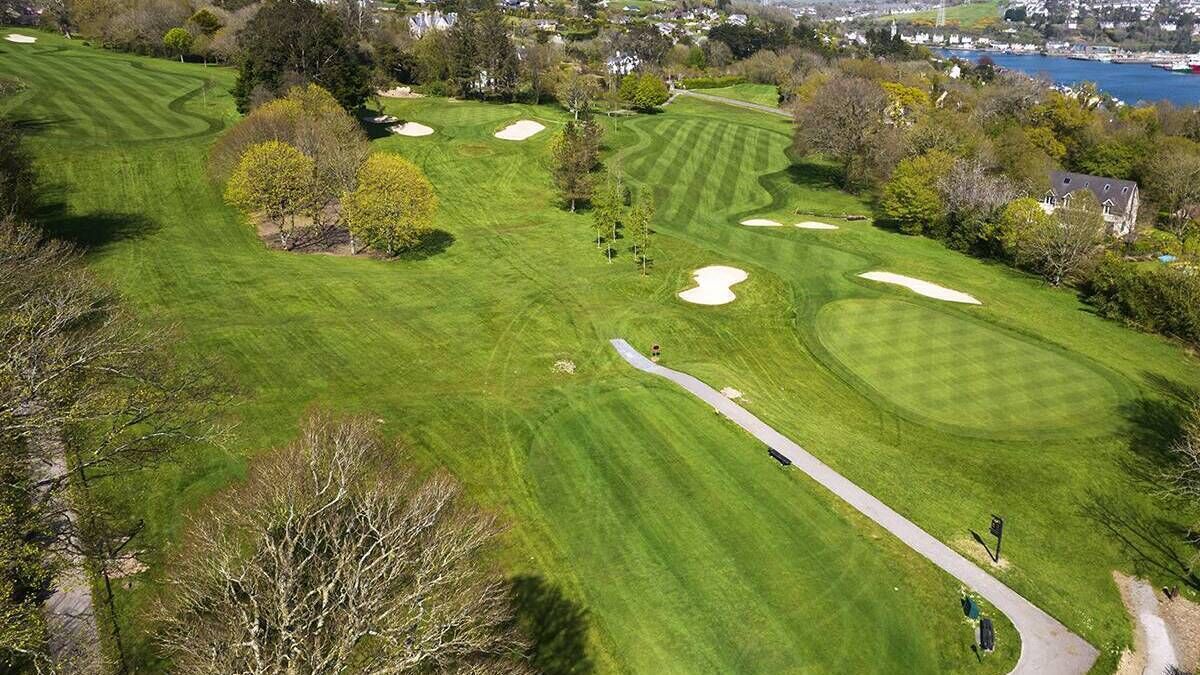
Monkstown Golf club's 6th, 7th & 8th holes. Picture: Niall O'Shea
Monkstown is a golf club that can trace its history back almost 120 years, and remains one of the most popular golfing destinations in the county. Following his success in laying out the first nine-hole course in Little Island, Cork GC Professional David Brown was involved in the original layout of the course in Monkstown, and that opened for play in April 1908.
Famed course architect Alister MacKenzie also had a hand in the development of Monkstown, and 100 years ago his plans for the course were approved.
MacKenzie removed much of the rough on the course and retained the challenge by designing a “well bunkered course”.
MacKenzie was instrumental in the development of golf in Cork, he was involved with design changes in Muskerry and Douglas while also designing much of the current layout in Cork Golf Club.
Like many other clubs in the early days of golf in Ireland, the course’s proximity to the Monkstown train station was a key factor in the early popularity of the club.
In 1958, the club completed the purchase of the castle and the course, this development was facilitated by growing demand for membership.
From then the club continued to grow, boasting a large membership.
A further investment by members in 1966 saw the club purchase of the 62 acre Parkgariff farm and that in turn allowed the course to be extended to a full 18 holes.
That land also allowed the club to develop a new purpose-built clubhouse that would serve the club for close to 40 years.
Heading towards the centenary in 2008, the club embarked on an ambitious programme that would see a major new clubhouse development.
An impressive two storey clubhouse, incorporating much improved facilities was opened in time for the 100th anniversary and later in 2008 the club also hosted the GUI Cups and Shields all Ireland finals.
2008 also saw the most recent changes to the course which reshaped the closing hole and added a new water feature which is also a very pleasing backdrop to the clubhouse.
While the course routing has remained essentially the same for the last two decades, the work in Monkstown is never ending.
Six years ago the clin set about removing several non-native trees and replaced these with indigenous hardwood trees.
Thanks to the number and variety of trees on the course, it’s now home to a large number of native red squirrels.
Over the past two years golf course architect Ken Kearney has been involved a complete redevelopment of the bunkers.
Taking the front and back nine in two separate projects, many bunkers were moved to provide a challenge in line with current ball distances.
More bunkers were closed while new bunkers were introduced to enhance the challenge of the course.
All of the new bunkers have been built to the highest modern standard increasing their playability and reducing maintenance costs.
Work has also been completed in a number of teeboxes, and a newly constructed tee on the signature fifth hole adds to the distance and the challenge.
The club has also recently developed a short game area and a covered range with teaching and fitting bays, Monkstown Castle, which forms the club crest is closely associated with the club.
Originally built in 1636, the castle and the demesne went through several different owners with the De Vesci family holding it for much of that time.
There were many different occupants including a period where it was used as a barracks and housed 450 soldiers in the early 1800’s.
Playright George Bernard Shaw is said to have spent time there and his family are credited with the extensive woodlands around the demesne which were planted when they were in residence in the late 1800’s.
The castle served as a base for Monkstown Badminton Club for a few years in the early 1900’s before the golf club was established in 1908.
The golf club purchased the castle and surrounding demesne in 1959 and set about many necessary repairs to the 300 year old building, including extensive works to access routes.
Following the purchase of additional land in 1966, the club built a new clubhouse in 1971, removing the need to retain the castle as a base.
New owners commenced intensive restoration works which were completed in 2010.
While the restoration work fully restored the exterior and roof of the castle, the interior remained empty.
The castle retains its place in the club as its clearly seen when walking to and from the seventh tee.
As it has for well over century, the castle keeps a watchful eye the course.






 App?
App?


