Christy O'Connor: Cork hurlers have suffered the most as empire struggled to strike back
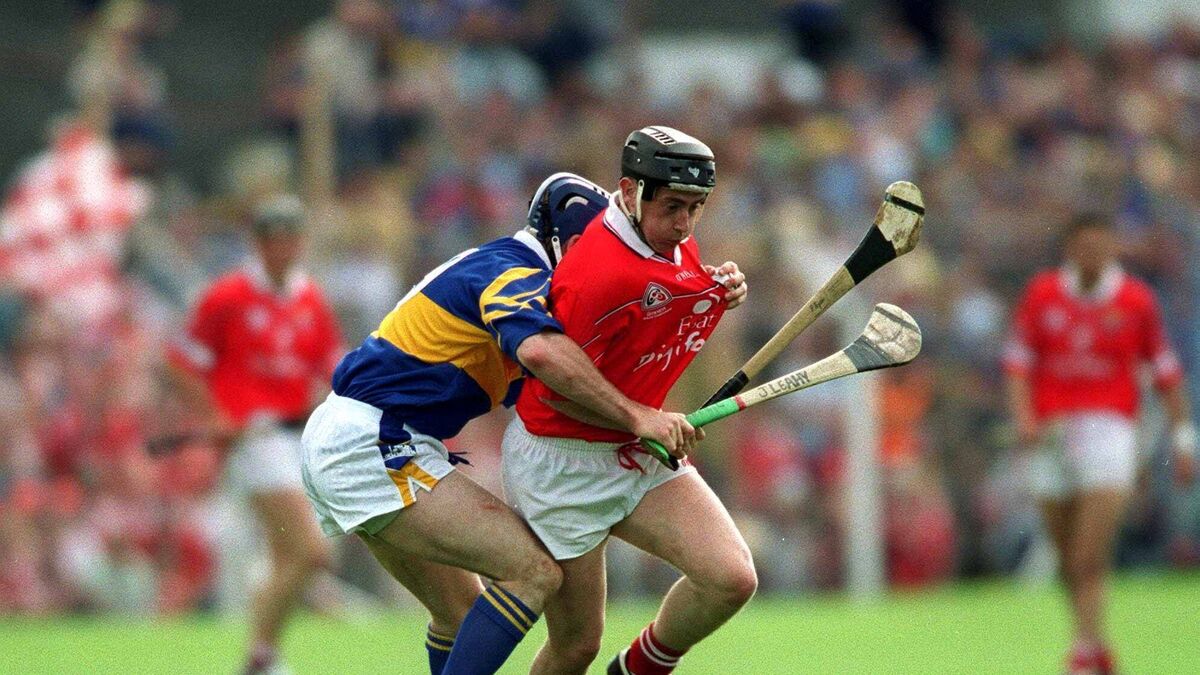
Current Cork manager Pat Ryan in action against John Leahy, Tipperary, in the 2000 Munster final at Semple Stadium. Picture: Ray McManus/SPORTSFILE
Towards the end of the 1990s and the most revolutionary period in hurling’s history, Ger Loughnane, who led Clare to the 1995 and 1997 All-Irelands, made a prediction that it was only a matter of time before the empire struck back.
Kilkenny had been All-Ireland champions in 1992 and 1993 but the other empires of Cork and Tipperary had been in the dark for most of the decade, shut out by new forces which had emerged into a glorious new light. The hurling world had been turned upside down during the game’s revolution years.
Prior to 1994, there had never been a period of more than two years when one of Cork, Kilkenny or Tipp didn’t win an All-Ireland. Those two-year hiatuses had only happened on seven occasions across a period of 106 years.
And then three different counties – Clare, Offaly and Wexford - put a five-year winning sequence together between 1994-’98. A whole New World Order had taken hold but Loughnane was right.
After Clare came with a young and exciting team in 2013, a new breakthrough era looked on the cards again but Kilkenny and Tipperary ruthlessly quashed those notions when winning the next three All-Irelands.
After Galway and Limerick won the 2017 and 2018 All-Irelands, Kilkenny and Tipp looked set to muscle in again on the upstarts after contesting the 2019 All-Ireland final. Except it definitely wasn’t happening this time around.
The upstarts weren’t going anywhere. They were here to stay.
There was no holding back a Limerick machine that continually rolled over Cork, Kilkenny and Tipp en route to an incredible four-in-a-row between 2020-’23.
There has never been a period like this in hurling where seven of the last eight All-Irelands have been won by counties outside the Big Three.
It's been a dark period for the empire but none of the big powers have felt that pain as acutely as Cork, who have gone the longest time of the Big Three without an All-Ireland.
It's been even more excruciating again considering how close Cork have come to ending that famine on a couple of occasions during the last two decades, losing the 2013 final to Clare after a replay, and last year’s decider to Clare after extra-time.
When Tipp went 18 years without an All-Ireland between 1971-’89, it was a knockout championship back then, but Tipp were nowhere near the level they wanted, or needed, to be for over a decade of that famine; between 1972-’82, Tipp played 17 championship games and won just two.
It almost seems ironic now that as Cork look set to finally end the famine that Tipp are lined up in the other corner trying to stop them. Especially when this fixture has been so steeped in folklore and mythology.
This is the tenth All-Ireland final meeting between two teams from the same (competing) province. However, Sunday’s match-up is certainly the most traditional provincial All-Ireland final ever played, the one with the greatest volume of history and lore attached to it.
And yet, Cork and Tipp have had to fight hard to get their relationship back to its old box-office status.
Its dismantling first began in that decade when one era ended and another began.
After meeting nine times between 1984 and 1992, six of which were deemed classics, the 1990s ended as the most dormant period in the history of their relationship. Because Cork and Tipperary spent most of the 1990s in the shadows of other Munster counties.
Three years was the longest period that the counties had ever gone without meeting in the championship but Cork and Tipp went eight years without clashing in the 1990s, which threatened to alter the historic trend of the relationship.
Cork-Tipperary matches did not carry the same significance of old because they were no longer the dominant forces in the province. They didn’t raise the blood in each other either like the sight of a Clare or Limerick jersey would have during that time.
That was the first time in Cork and Tipperary’s history that each county did not see the other as the true standard in the province.
The arrival of new teams and the explosion in hurling’s profile also forced a revision of the mythology of the Cork-Tipperary relationship. The arrival of the qualifier system also removed some of the rivalry’s old sheen.
Cork-Tipp was always an institution but when the counties met in 2007, the attendance was only 12,106. In the first season of the Munster round robin in 2018 the crowd was just over 22,000.
The matches were always events but Cork-Tipp still didn’t pop with the old fizz.
This decade, the relationship has turned again with Cork having won three and drawn one of their last four meetings, with Cork having easily won those three matches.
Even though Cork and Tipp were meeting as often as ever, it was no longer the biggest show, or the largest attraction, in the province. That billing belonged to Cork-Limerick, Clare-Limerick and Cork-Clare.
On Sunday though, Cork-Tipp is finally prime-time again. Absolute box-office once more.










 App?
App?


