Finding the value in examining GAA match data
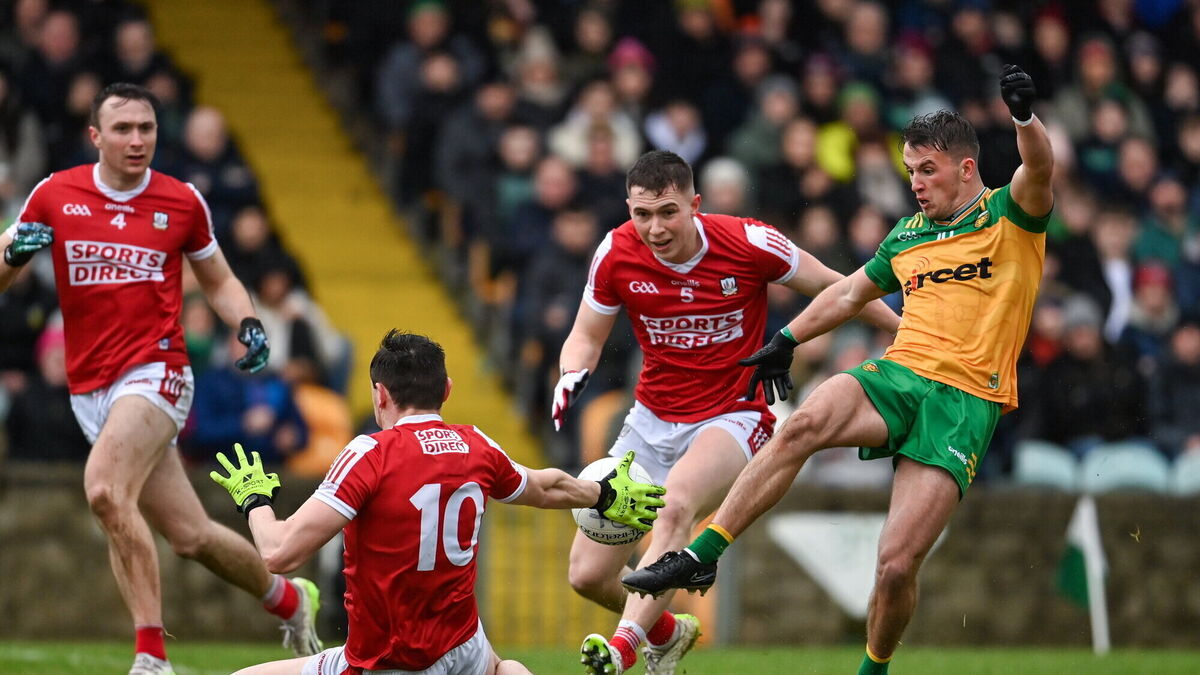
Eoghan McSweeney of Cork blocks a shot at goal by Donegal's Peadar Mogan during the Allianz FL Division 2 matc in Ballybofey. Picture: Ramsey Cardy/Sportsfile
We’ve all bemoaned it at some stage in the – probably recent – past.
A short pass across defence or an attacker getting the ball but turning backwards and giving a safe lay-off. Why don’t they let it in long, or take on the man or go for a score?
These frustrated views are to an extent coloured by the fact that we remember the wonderful high catch or the lovely dummy to beat a marker or the wonder-point or goal. However, those events are more memorable because of their rarity and are often joined by less successful attempts that end up being counter-productive to the chances of winning.
Winning while playing beautifully is of course the ideal but, if it’s a 50-50 choice, it’s going to be a landslide in one direction. A good coach will want his or her team doing the things that best increase the chances of victory and that might not always chime with what thrills the watching audience.
Essentially, it boils down to value. Not in monetary terms but players’ actions which, over time, are shown to be effective in increasing the team’s score or reducing the opposition’s.
Any junior club team worth their salt has a stats man or woman as part of the backroom team now; a top inter-county side is likely to have four or five compiling the figures. But of course the numbers on their own, in a context vacuum are not worth much.
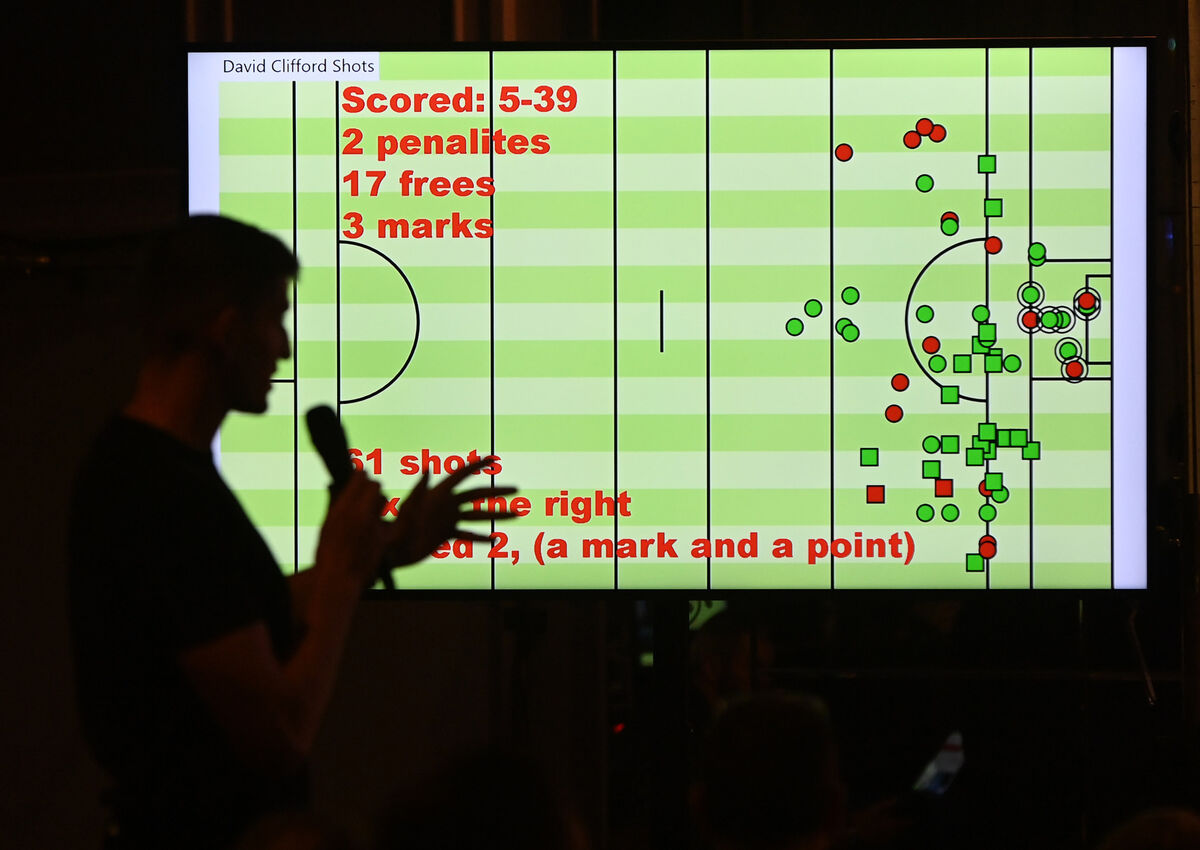
Stephen O’Meara is one of the top practitioners in parsing the data into something useful. As well as coaching teams – currently he works with Tinryland of Carlow, whom he has taken to the last two county SFC finals – he has been in the Galway and Donegal football set-ups as an analyst. He runs GAA Pro Stats and has developed software that is in high demand from clubs and counties while he is involved in The Square D podcast and has written a book called Understanding Gaelic Football.
All of which is a lead-up to saying that Cork’s 11-point defeat to Donegal in their Allianz Football League Division 2 opener may not have been the absolute disaster it was portrayed as.
That’s not to say it was good – a 1-20 to 2-6 loss can not be painted as a positive – but O’Meara’s analytics showed an expected score of 19.2 points for Donegal and 16.4 for Cork.
Essentially, Donegal had a far better-than-average shooting display – the shot-conversion rate was 78 percent in their favour and 47 for Cork.
“The expected score at half-time was 8.4 for Donegal and 8.1 for Cork,” O’Meara says.
“Cork shot really badly and Donegal had an outrageous day of shooting. It’s very rare that the shots from 45 yards, outside of the boot and under pressure, will all go over. It’s easy to forget that that’s not the map.
“They had 15 shots in the first half and only one of them was from inside 35 yards. That’s extremely unusual, especially as they were under pressure.”
The good shooting, on top of an excellent pressing effort, paved the way for victory for Jim McGuinness’s die. They were helped by Cork running into trouble, but the two goals for the visitors showed the risk involved in a such a strategy from the hosts.
“Donegal came with a high press and it was highly effective,” O’Meara says.
“I thought that Cork were thoroughly naïve, to be honest. The funny thing was that the Cork goal had come from a failed high turnover and so it had a big bearing on the expected score.
“The flipside is that Donegal were causing so much trouble because of the high press. It’s a fine line, risk/reward, and the concern for them is that were cut open twice by Cork for goals – that’s what happens when the press doesn’t work.”
The use of stats might be seen as making things too scientific and reducing the ability of players to express themselves but a coach can only work within the environment as it exists and not how we might want it to exist.
The bottom line is that, if a team scores more when a ball goes through a certain player than when it doesn’t, his value increases. O’Meara puts forward an interesting example.
“If you put a junior A club footballer in at corner-forward,” he says, “and all he does is when he gets the ball is hand it straight back where it came, nice and safe, risk-free, on average that team should still be breaking a blanket defence 40 percent of the time.
“In order to have value, it’s all relative to that four out of ten figure. With an inside forward, that figure is three out of five or six out of ten. You have a skilful forward who kicks five outlandish points, people will remember those high-end plays, but if he also kicks five wides, his value actually becomes negative.
“I’d love to fix the rules of Gaelic football to make those player higher-value but, as things stand, they are not.”
O’Meara’s software reveals many truths, such as that of a player who is a valuable cog in an inter-county machine trying too hard to make an influence at club level and actually being of negative value. Or a hurling team continually going long from puckouts even though they were only winning three of ten – they were still getting joy from the turnovers that resulted, whereas turnovers given up from short puckouts were punishing them.
The data takes away the biases, not least zoning in on a negative that’s more memorable simply because of its rariy.
“I read a good article about Jürgen Kloop’s defensive philosophy,” O’Meara says.
“They let in two shots from outside the area against Inter Milan and they were being lambasted but basically it’s that Liverpool let teams shoot from 22 yards and never shoot themselves from that far out.
“They know it’s bad value to do that – if it’s bad value for them, it’s bad value for the opposition to shoot from there and therefore good value for Liverpool.
“Over the course of two or three seasons, you will leave in a few from that far out – those are the percentages – but by and large it’s a strategy that works.”









 App?
App?


