What do Cork’s Marina Park and Bilbao’s Guggenheim waterfront have in common?
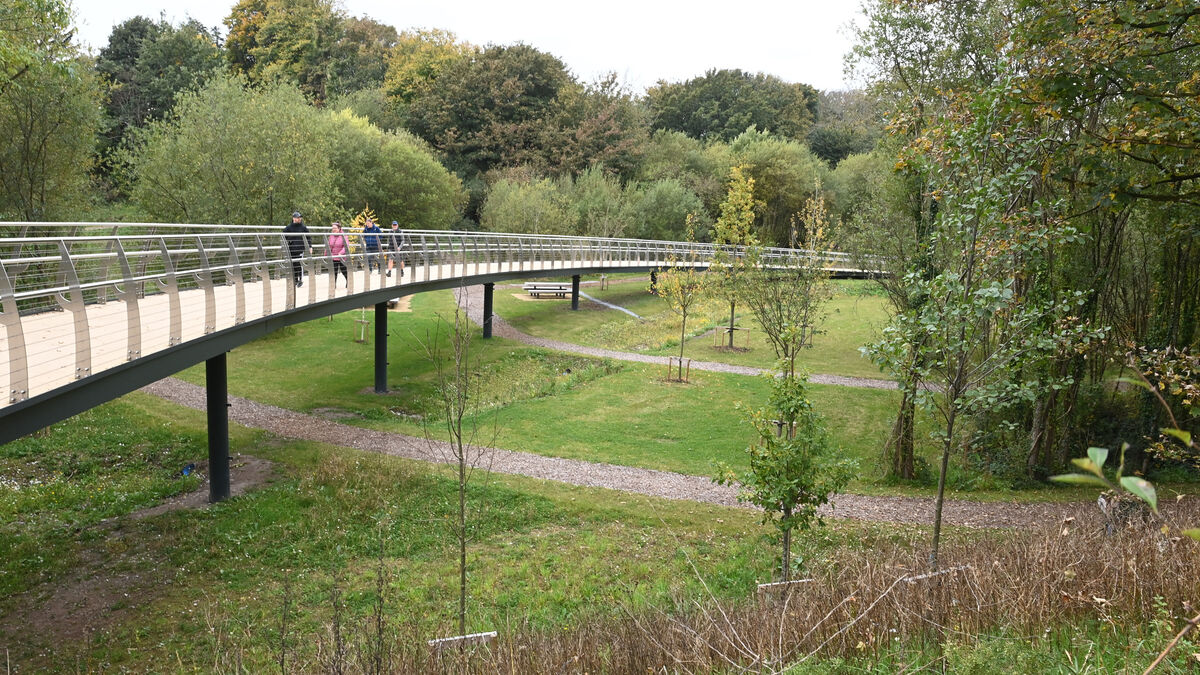
Marina Park was redeveloped with support from European Union cohesion funds. Picture: Larry Cummins.
What do Cork’s Marina Park and Bilbao’s iconic Guggenheim waterfront have in common?
Both were redeveloped with support from European Union cohesion funds – the EU’s main investment programme for regional development.
Through cohesion policy, the EU aims to ensure that every part of the Union benefits from economic growth.
Between 2021 and 2027, Ireland will have received €1.4bn in EU cohesion funding, spread across hundreds of projects nationwide. These include improving energy efficiency in housing, revitalising town centres, tackling poverty, and helping Ireland’s fishing and farming sectors become more sustainable.
Across the EU, cohesion funds account for roughly a third of the bloc’s long-term budget.
Negotiations are currently underway on the EU’s next long-term budget, for the period from 2028 to 2034. As part of this, the European Commission wants to reform the way cohesion funding is organised – which could influence the way funding is distributed to Irish regions.
Major restructuring proposed In July 2025, the European Commission unveiled plans to simplify the EU budget by merging more than 50 separate programmes into 16 larger funding instruments.
One of the largest of these would be an €865bn “multi-fund” combining support for economic, social and territorial cohesion with agriculture, rural development, fisheries, maritime policy and security programmes.
Around half of this funding would still be dedicated to cohesion, rural development and fishing communities. However, once inflation is taken into account, the amount available for these areas could be about 15% lower than under the current budget.
Another key change relates to how the money would be distributed. Under the proposed structure, each EU country would negotiate a National and Regional Partnership Plan (NRPP) with the European Commission. These plans would set out national investment priorities and targets.
Certain shares of this funding would have to be earmarked for specific purposes, including direct income support for farmers, social objectives, and climate and environmental goals. Rural areas would be guaranteed at least 10% of total funding.
Payments would also be linked more closely to performance: the EU would release funds once countries reach the agreed investment milestones. However, the European Parliament has raised concerns that the reforms could lead to a “renationalisation” of cohesion policy.
For decades, EU cohesion policy has operated under the “partnership principle”, which involves local and regional authorities in the design and delivery of projects.
Regional governments and associations, both in Ireland and across Europe, now worry that the proposed changes could shift much of the decision-making power to national governments, potentially reducing the role of local and regional authorities.
In Ireland, for example, cohesion policy can help to address the consequences of Brexit, which differs across regions. A centralised ‘one size fits all’ approach would not help with this.
Responding to these concerns last November, the European Commission proposed to strengthen the partnership principle and introduce “regional checks” to ensure the involvement of local and regional in all phases of the national plans.
Another concern relates to how funding will be distributed across different types of regions. Under the Commission’s proposals, €217bn would be reserved for less developed regions – those with a GDP per capita below 75% of the EU average. Specific allocations for more developed regions that nonetheless face challenges, such as transitioning to greener economies, are not currently foreseen.
However, safeguards will ensure that such regions receive funding equivalent to at least 75% of their allocation under the current EU budget.
This could be relevant for Ireland, as all regions – the southern, eastern and midlands, and northern and western regions – are well above the GDP threshold of 75% and are classified as “more developed” in the next budget period.
The Irish Government has already begun preparing for negotiations on the next EU budget. A national consultation on the future of EU cohesion policy launched in January 2024 gathered input from more than 90 stakeholders, including regional bodies and project beneficiaries.
On this basis, the Irish Government has called for cohesion funding after 2027 to continue focusing strongly on reducing regional disparities and supporting disadvantaged communities. It also proposes greater emphasis to be placed on regional development strategies.
Ireland will have an opportunity to shape budget discussions in line with these priorities during its upcoming presidency of the Council of the EU later this year.
With negotiations on the EU’s next budget set to continue over the coming year, the final shape of the reforms is still far from settled – but the outcome will determine how regions in Ireland and across the EU receive funding in the years to come.
- David Geary is chief executive officer of European Movement Ireland.







 App?
App?


